Newsletter DocShipper- July 2026 - Edition 01
Newsletter

The Logistics Bridge: / China–Europe
Trade News

- July 2026 - Edition 1

Welcome to The Logistics Bridge — your twice-monthly read on the transport and logistics news that actually moves the needle for importers, e-commerce sellers and entrepreneurs sourcing from China for the European market.

In every edition we cut through the noise across ocean, air and rail freight, decode the latest customs and regulatory shifts, and surface the developments that can reshape your import-export operations — before they hit your bottom line.

Our goal is simple: turn a volatile, complex trade landscape into clear, actionable insight, so you can protect your margins, plan with confidence and keep your supply chain one step ahead.

Figures of the Fortnight

Did You Know?

+61% year-on-year — ocean rates plateau at a high altitude

The Drewry World Container Index sat at $4,547 per 40ft container on 16 July, down 2% week-on-week but still up roughly 61% year-on-year.

On Asia–Europe, Shanghai–Rotterdam held at $4,873 and Shanghai–Genoa at $6,300, while CMA CGM pushed new FAK rates of $7,000/40ft on Asia–Europe from 15 July.

The peak may have crested — but “off the peak” still means historically expensive.

−19% in 48 hours — the €3 duty emptied the China–EU air skies

Within two days of the de minimis exemption ending on 1 July, direct freighter capacity from China and Hong Kong to the EU fell 19% week-on-week, and Hong Kong–Europe tonnage dropped 12% — back to March levels.

The new €3 duty per tariff code hit the Temu/Shein parcel model hard and instantly rerouted e-commerce flows.

Logistics News

Logistics News of the Fortnight

SEA

Ocean Freight News

After racing up through June, the Drewry WCI eased 2% to $4,547/40ft on 16 July — the first sign the peak-season rally is running out of road. On Asia–Europe, Shanghai–Genoa slipped 3% to $6,300 and Shanghai–Rotterdam 1% to $4,873, both down from early-July highs. Carriers expect demand to soften from late July into August. (Drewry, 16 Jul)

WHAT THE DOCSHIPPER EXPERTS SAY?

A dip after a vertical climb is not a return to cheap freight — the index is still up ~61% year-on-year. Treat the plateau as a planning opportunity to lock rates, not a signal to wait for a collapse that carriers are actively working to prevent.

THE ESSENTIAL DOCSHIPPER ADVICE

  1. Lock contract rates now while the market pauses.
  2. Don’t wait for a “crash” — surcharges will defend the floor.
  3. Track the Drewry WCI and SCFI weekly.
  4. Confirm quotes at booking, not before.

CMA CGM announced new FAK rates of $7,000 per 40ft on Asia–Europe and $7,900–$8,500 on Asia–Med, effective 15 July, as carriers “test the market” with fresh hikes even as spot rates soften. Peak Season Surcharges remain in force across services. (The Loadstar)

WHAT THE DOCSHIPPER EXPERTS SAY?

The gap between published FAK levels ($7,000) and the softening spot index ($4,547 composite) shows carriers trying to reset the ceiling higher before demand fades. Whether these stick depends entirely on August volumes — but they signal carrier intent to hold pricing power.

THE ESSENTIAL DOCSHIPPER ADVICE

  1. Benchmark carrier FAK quotes against the spot index.
  2. Push back on FAK hikes that outrun the market.
  3. Diversify carriers to keep leverage.
  4. Split volume between spot and contract.

Even as momentum stalls, the Drewry WCI is up around 61% year-on-year, a reminder that 2026’s baseline is far above 2025. The Cape-of-Good-Hope diversions born of the Middle East crisis continue to absorb effective capacity, keeping a firm floor under rates. (IndexBox)

WHAT THE DOCSHIPPER EXPERTS SAY?

Year-on-year is the number that matters for budgeting. If your H2 forecast still assumes 2025 rate levels, it is already wrong. Rebuild the model from the current plateau and stress-test for a possible late-year rebound.

THE ESSENTIAL DOCSHIPPER ADVICE

  1. Rebuild H2 budgets from current rate levels.
  2. Stress-test for a Q4 rebound scenario.
  3. Add bunker and Cape-detour costs into landed cost.
  4. Keep rail in the mix as a cost hedge.

The seasonal demand peak is expected to soften from late July into early August, yet carriers are leaning on surcharges to sustain revenue as spot rates cool. Northern European equipment repositioning and hub congestion continue to limit how fast rates can fall. (Freightos)

WHAT THE DOCSHIPPER EXPERTS SAY?

Softening demand plus disciplined capacity management is the classic recipe for a “sticky” plateau — rates ease slowly, not sharply. Importers who booked at the June peak should re-quote now; those on contracts should hold and watch August 

THE ESSENTIAL DOCSHIPPER ADVICE

  1. Re-quote if you booked at the June peak.
  2. Watch August volumes before committing Q4.
  3. Check Northern Europe equipment availability.
  4. Keep booking windows short while volatile.
Air

Air Freight News

The end of de minimis on 1 July hit air cargo instantly. Within 48 hours, direct freighter capacity from China and Hong Kong to the EU fell 19% week-on-week, and Hong Kong–Europe tonnage dropped 12%, back to late-March levels, as the e-commerce parcel model that filled those flights lost its duty advantage. (Air Cargo News)(IndexBox)

WHAT THE DOCSHIPPER EXPERTS SAY?

This is a structural rerouting, not a blip. As Shein and Temu shift to bulk B2B freight and EU local stocking, the direct-parcel air model shrinks — pulling capacity off China–EU lanes and reshaping who gets space. Traditional importers may actually benefit from freed-up belly capacity

THE ESSENTIAL DOCSHIPPER ADVICE

  1. Re-plan e-commerce flows around consolidated B2B freight.
  2. Watch for freed belly capacity on China–EU lanes.
  3. Re-quote air now as the market resets.
  4. Confirm HS classification for the new €3 duty

Global air spot rates fell about 2% to $3.62/kg in early July, with China–Europe down 7% to $4.21/kg as the de minimis suspension dented demand. Worldwide capacity has recovered to roughly 2% above pre-conflict levels, easing the squeeze seen in June. (STAT Times)(Global Trade Magazine)

WHAT THE DOCSHIPPER EXPERTS SAY?

The rate relief is real but fragile — it’s demand-led (the parcel drop), not a lasting capacity glut. Any renewed Middle East disruption would reverse it quickly. Use the window, but don’t budget on it lasting through the H2 peak.

THE ESSENTIAL DOCSHIPPER ADVICE

  1. Use the current dip to move time-sensitive cargo.
  2. Keep a fuel/war-risk buffer for H2.
  3. Lock allocations before the peak rebuilds.
  4. Blend air with rail for cost control.

While parcel flows fell, Taiwan–Europe air volumes jumped around 20% over three weeks, driven by demand for AI-related computer equipment. China–Europe tonnage held broadly stable after an earlier dip — evidence that premium tech shipments are now a structural pillar of air cargo. (STAT Times)

WHAT THE DOCSHIPPER EXPERTS SAY?

Air cargo is rebalancing from low-value parcels toward high-value tech. For importers of electronics and AI hardware, that means competing for space with deep-pocketed shippers — book early and expect firm rates on those lanes even as the broader market softens.

THE ESSENTIAL DOCSHIPPER ADVICE

  1. Book tech/electronics space early on Asia–Europe.
  2. Expect firm rates on premium lanes despite the dip.
  3. Consolidate smaller shipments to secure capacity.
  4. Track Taiwan and China origins as lead indicators.

Despite expectations of a pre-deadline rush, there were few clear signs of frontloading before 1 July — instead the change produced a sharp drop the moment it took effect. The abruptness caught some shippers without a plan for the new duty and documentation load. (Air Cargo News)

WHAT THE DOCSHIPPER EXPERTS SAY?

The lesson for the next regulatory deadline (the €2 handling fee in November) is to plan the transition, not just the front-load. Shippers who prepared classification and consolidation ahead of 1 July are absorbing the change; those who didn’t are scrambling.

THE ESSENTIAL DOCSHIPPER ADVICE

  1. Prepare now for the November €2 handling fee.
  2. Fix HS classification and documentation early.
  3. Model duty impact per SKU before deadlines.
  4. Shift to consolidated freight where it saves duty.

Subscribe to the Newsletter

Receive, twice a month by email, a selection of major news that may impact your operations between China and France.

Rail

Rail Freight News

The Middle Corridor of the China–Europe freight network has now surpassed 25,000 cumulative trips since its 2013 launch, a milestone reached in mid-2026. Running via Kazakhstan, the Caspian Sea and the South Caucasus — bypassing Russia — it has become the compliance-friendly backbone of Eurasian rail. (CGTN)

WHAT THE DOCSHIPPER EXPERTS SAY?

For EU importers, “Russia-free” is not a slogan — it removes sanctions and reputational risk from your supply chain. As the Middle Corridor matures with more terminals and schedules, it shifts from a workaround to a primary planning-grade lane.

THE ESSENTIAL DOCSHIPPER ADVICE

  1. Favour the Middle Corridor to avoid Russia-transit risk.
  2. Pre-qualify terminals and customs flows.
  3. Match rail origin to your supplier region.
  4. Lock recurring slots as demand grows.

Volumes through Azerbaijan on the Middle Corridor have grown nearly 90% since 2022. In 2025, national operator ADY handled 380+ block trains from China (+35% YoY) and about 137,000 TEU (+20%) — infrastructure investment turning the trans-Caspian route into a reliable China–Europe artery. (Travel And Tour World)

WHAT THE DOCSHIPPER EXPERTS SAY?

Capacity is being built, not just used — which is what makes the corridor bankable for planning. The bottleneck historically was the Caspian crossing; sustained investment there is steadily removing it.

THE ESSENTIAL DOCSHIPPER ADVICE

  1. Build the trans-Caspian route into your network now.
  2. Plan around the Caspian crossing schedule.
  3. Use rail for mid-value, moderately urgent goods.
  4. Compare rail vs. ocean on total cost, not per kilo.

A new China–Europe freight service from Wuhan to Baku via the Middle Corridor has launched, combining rail with a Caspian Sea crossing and reinforcing multimodal options between inland China and Europe. It adds resilience as ocean lanes stay long and expensive. (Railway PRO)

WHAT THE DOCSHIPPER EXPERTS SAY?

New origin–destination pairs matter because they shorten inland pre-haul for specific supplier regions. A Wuhan departure can beat a coastal-port-plus-ocean routing on both time and predictability for central-China sourcing.

THE ESSENTIAL DOCSHIPPER ADVICE

  1. Match your rail origin to your supplier’s region.
  2. Factor inland pre-haul into transit comparisons.
  3. Confirm final-mile from the destination terminal.
  4. Book fixed-schedule services for reliability.

2026 is the year rail stopped being a backup and became a core lane. The importers gaining an edge are those who onboarded rail before the disruption — not those scrambling for slots mid-crisis.

WHAT THE DOCSHIPPER EXPERTS SAY?

2026 is the year rail stops being your ‘Plan B’ and becomes your main lane. Lock in your rail strategy now — because the winners will be the ones who planned ahead, not the ones panicking for space when the chaos hits.

THE ESSENTIAL DOCSHIPPER ADVICE

  1. Treat rail as a core lane in annual planning.
  2. Secure slots early as demand accelerates.
  3. Balance cost and transit across all three modes.
  4. Ask DocShipper to model the best lane per SKU.
Customs

Customs and regulations updates

Since 1 July 2026, every low-value parcel entering the EU faces a new €3 customs duty per tariff code, replacing the €150 duty-free threshold. Chinese platforms like Temu and Shein control roughly 90% of this trade. A separate €2 handling fee is expected in November 2026, stacking on top. (Washington Times)

WHAT THE DOCSHIPPER EXPERTS SAY?

Because the charge is per tariff code, not per parcel, consolidation and classification now directly drive landed cost. The winners are importers who bundle into single headings where legitimate and move from parcel flows to consolidated B2B freight — and who are already preparing for the November fee.

THE ESSENTIAL DOCSHIPPER ADVICE

  1. Model the €3-per-code impact on your top SKUs.
  2. Shift from individual parcels to consolidated freight.
  3. Review packaging to minimise distinct tariff codes.
  4. Prepare now for the November €2 handling fee.

Also from 1 July, the EU’s new steel safeguard regime entered force: tariff-free quotas cut to 18.3 million tonnes, and an out-of-quota duty of 50% (double the previous rate) on 26 types of steel imports, with “melt and pour” origin rules to block transshipment via third countries. (Brussels Signal)

WHAT THE DOCSHIPPER EXPERTS SAY?

his reaches far beyond steel traders — anyone importing steel-intensive finished goods from China faces higher input costs and tighter origin scrutiny. “Melt and pour” means proving where the steel was actually made, not just where the product was assembled.

THE ESSENTIAL DOCSHIPPER ADVICE

  1. Re-cost steel and steel-intensive imports.
  2. Obtain melt-and-pour origin documentation.
  3. Check quota status before committing orders.
  4. Explore alternative sourcing where duties bite.

A simplification (Regulation (EU) 2025/2083) introduced a 50-tonne annual de minimis threshold for CBAM: importers below it are fully exempt from CBAM obligations — except for hydrogen and electricity. CBAM covers iron and steel, aluminium, cement, fertilisers, hydrogen and electricity. (PwC)

WHAT THE DOCSHIPPER EXPERTS SAY?

This is rare good news — many mid-sized importers now fall outside CBAM entirely. But the 50-tonne line is per covered-goods category, so check your annual volumes carefully; crossing it triggers the full declarant and certificate obligations.

THE ESSENTIAL DOCSHIPPER ADVICE

  1. Confirm whether your annual volumes stay under 50t.
  2. Track cumulative imports across the year.
  3. Secure declarant status if you exceed the threshold.
  4. Collect embedded-emissions data from suppliers.

July’s changes don’t act alone — they layer onto ICS2 (full advance-data filing now mandatory) and feed a broader EU push to rebalance trade with China. Next on the calendar: the €2 parcel handling fee in November, and continued antidumping activity across product categories. (Carvo)

WHAT THE DOCSHIPPER EXPERTS SAY?

A single China–Europe shipment can now touch the €3 duty, ICS2 data rules, steel safeguards and CBAM at once. Mapping all of them against your product mix — before the goods move — is the difference between smooth clearance and costly holds.

THE ESSENTIAL DOCSHIPPER ADVICE

  1. Map every 2026 rule against your product mix.
  2. Verify ICS2 advance-data completeness.
  3. Diarise the November €2 fee now.
  4. Ask DocShipper for a compliance gap-check.
FIGURES OF THE FORTNIGHT

The China–Europe Freight Market in Numbers

Drewry container index july 2026

Interpretation:

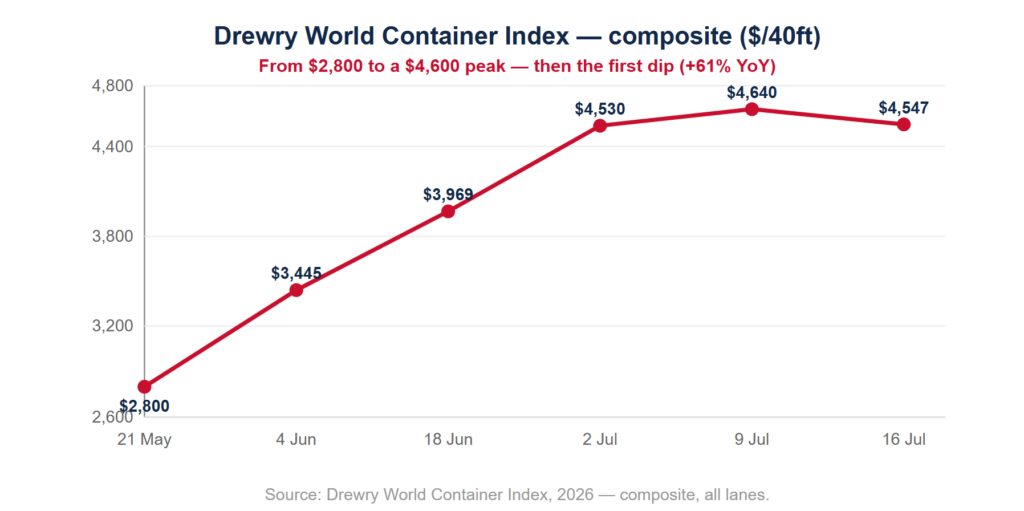
The Drewry index climbed almost without pause from $2,800 (21 May) to a peak near $4,640 on 9 July, before easing to $4,547 on 16 July — the first weekly decline of the cycle.

At its top, the composite was up roughly 62% from the spring low and about 61% year-on-year. The climb was powered by an early peak season, Cape-of-Good-Hope diversions that quietly removed capacity, hub congestion, and front-loading ahead of July’s tariff changes.

On China–Europe specifically, Shanghai–Rotterdam reached $4,873 and Shanghai–Genoa $6,300, while CMA CGM published FAK rates of $7,000/40ft. The mid-July dip suggests the peak has crested, but with carriers defending rates through surcharges and demand only expected to ease from August, importers should budget from this elevated plateau — not from spring lows.

WHAT TO REMEMBER

  • The index peaked near $4,640 (9 July) then dipped to $4,547 (16 July) — up ~61% year-on-year. The peak has likely crested, but rates stay historically high. Drewry, 16 Jul 2026
  • Asia–Europe leads: Shanghai–Rotterdam $4,873 and Shanghai–Genoa $6,300 per 40ft, while CMA CGM published FAK rates of $7,000/40ft. Drewry / The Loadstar
  • The €3 duty reshaped air overnight: China–EU freighter capacity fell 19% in 48 hours and China–Europe air rates dropped 7% to $4.21/kg. Air Cargo News
  • Rail keeps winning: the Middle Corridor topped 25,000 trips and Q1 volumes rose +29% as displaced ocean and air demand shifts to rail. CGTN / RailMarket

THE ESSENTIAL DOCSHIPPER ADVICE

  1. Budget from the current plateau, not spring lows — H2 ocean costs remain ~61% above last year.
  2. Lock ocean contract space now while the market pauses; don’t wait for a collapse carriers are actively defending against.
  3. Reclassify and consolidate to absorb the €3-per-tariff-code duty — and diarise the November €2 handling fee.
  4. Onboard the China–Europe Middle Corridor rail option as a genuine cost-and-compliance hedge.
The Must-Attend Events

Logistics dates and events not to miss in 2026

logistic event june- july 08-09

Cold Chain Connection Toronto 2026

📅 Date : 08 – 09 July 2026

📍 Toronto, Canada

GCCA event on temperature-controlled logistics, cold-storage capacity and pharma/food supply chains.

Central Asia Transport, Logistics & Investment Forum (CATLIF) 2026

📅 Date : 9–10 July 2026

📍Astana, Kazakhstan

Strategic forum on the trans-Caspian / Middle Corridor — infrastructure, investment and cross-border transit. Directly relevant to the China–Europe rail routes gaining ground as a Hormuz hedge.
logistic event june- july 09 - 10
EVENTS OF THE MONTH

June Supply Chain Calendar

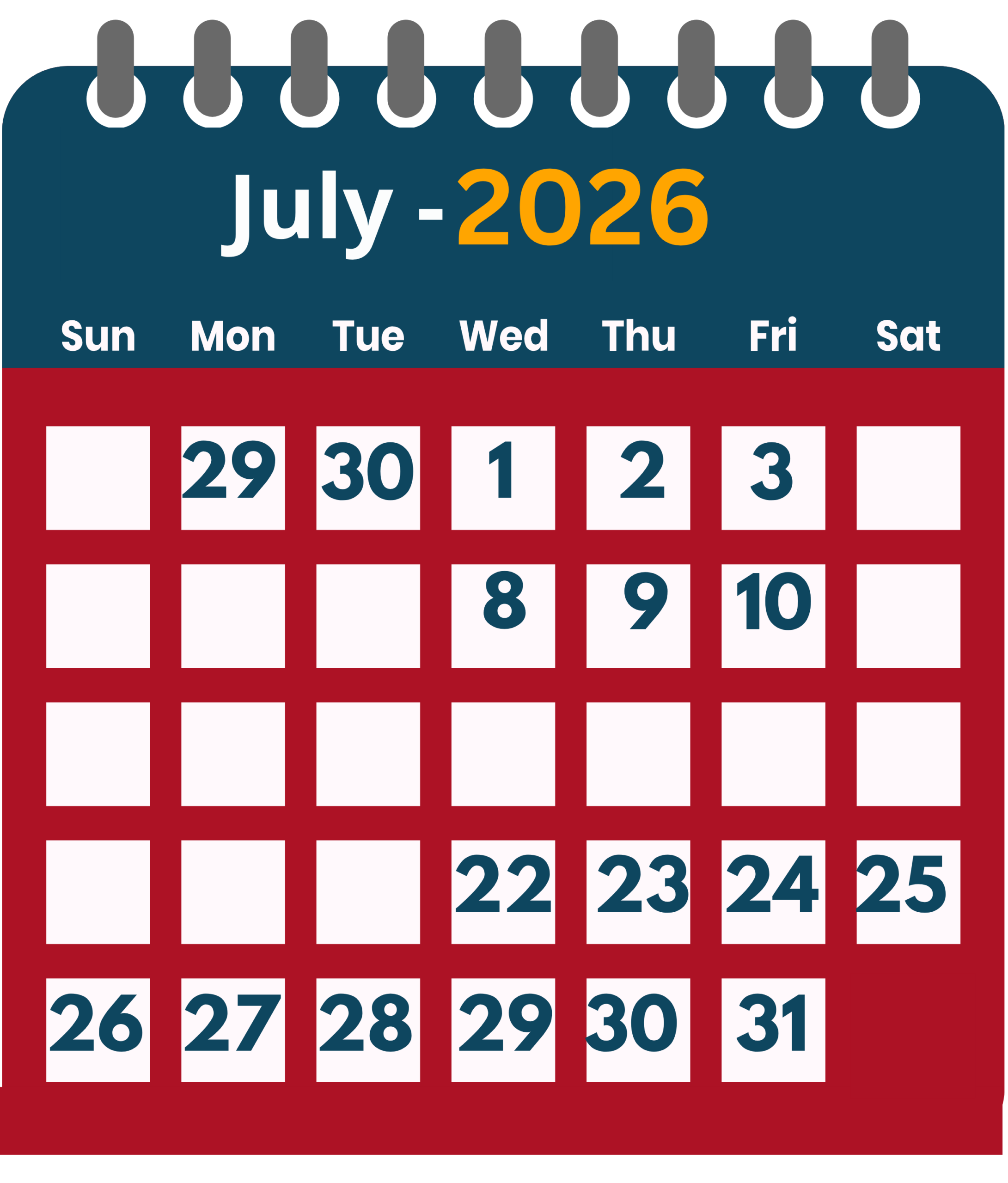
The major logistics events to watch this july 2026.

July 2026 - logistics calendar

📅  29 June – 1 July – SMC³ Connections 2026

📍 Palm Beach, Florida, USA — The Breakers

The summer gathering of the freight transportation ecosystem — carriers, shippers and logistics service providers — for strategy, data and LTL/network insights.


📅  30 June – 2 July – Multimodal 2026

📍Birmingham, UK — NEC (National Exhibition Centre)

The UK and Ireland’s flagship freight, logistics and supply chain event, and the centrepiece of UK Logistics Week. Hundreds of exhibitors, five conference theatres and 80+ sessions across road, rail, sea and air — with co-located Warehouse & Yard, eDX and Road Transport Expo. Focus: AI, net zero, customs compliance and supply chain resilience. Free to attend.

📅  1–3 July – Thailand Warehousing, Logistics Automation & Supply Chain Expo 2026

📍 Bangkok, Thailand — BITEC

Southeast Asia’s reference exhibition for warehousing, logistics automation and supply chain technology — robotics, WMS/TMS and intralogistics for the fast-growing ASEAN corridor relevant to China+1 sourcing.


📅 8–9 July – Cold Chain Connection Toronto 2026

📍 Toronto, Canada

GCCA event on temperature-controlled logistics, cold-storage capacity and pharma/food supply chains.

📅  9–10 July – Central Asia Transport, Logistics & Investment Forum (CATLIF) 2026

📍Astana, Kazakhstan

Strategic forum on the trans-Caspian / Middle Corridor — infrastructure, investment and cross-border transit. Directly relevant to the China–Europe rail routes gaining ground as a Hormuz hedge.


📅 22 July – Cold Chain Connection Mexico City / Cold Chain Institute Latin America 2026
📍 Mexico City, Mexico

GCCA regional event on cold-chain operations and nearshoring-driven supply chain growth.


📅 Mid-July – Midwest Association of Rail Shippers (MARS) Summer Meeting 2026

📍USA (Midwest)

Twice-yearly gathering of rail shippers, carriers and providers — rail capacity, intermodal and freight policy. (Exact date to confirm.)


Downloadable Resources

Some logistics infographics that might interest you!

DOWNLOADABLE RESOURCES

Discover the latest logistics articles & updates