In short ⚡
Sea Freight Transit Times from China: Complete Table by Destination range from roughly 20 to 45 days port-to-port, but realistic door-to-door delivery takes longer because of handling, customs, inland transport, consolidation and schedule disruptions. Current benchmarks include approximately 37.6 days to the US West Coast, 57.6 days to North Europe and 66.1 days to the US East Coast. The key destination estimates are:| Destination | Port-to-port reference | Realistic door-to-door reference |
|---|---|---|
| US West Coast | Service dependent | Approximately 37.6 days |
| US East Coast | Approximately 30 to 40 days, routing dependent | Approximately 66.1 days |
| North Europe | Approximately 30 to 45 days | Approximately 57.6 days |
| UK | Approximately 35 to 45 days | Confirm the delivery address and service |
| Australia | Approximately 25 to 35 days | Confirm the final delivery location |
| Canada | Confirm the port pair and service | Confirm the inland destination |
| Mediterranean | Confirm the current service | Confirm the delivery address and routing |
Find guidance on port-to-door planning, destination-specific estimates, FCL versus LCL timing, routing and seasonal delays, schedule reliability, and the five-step method for calculating a realistic delivery date.
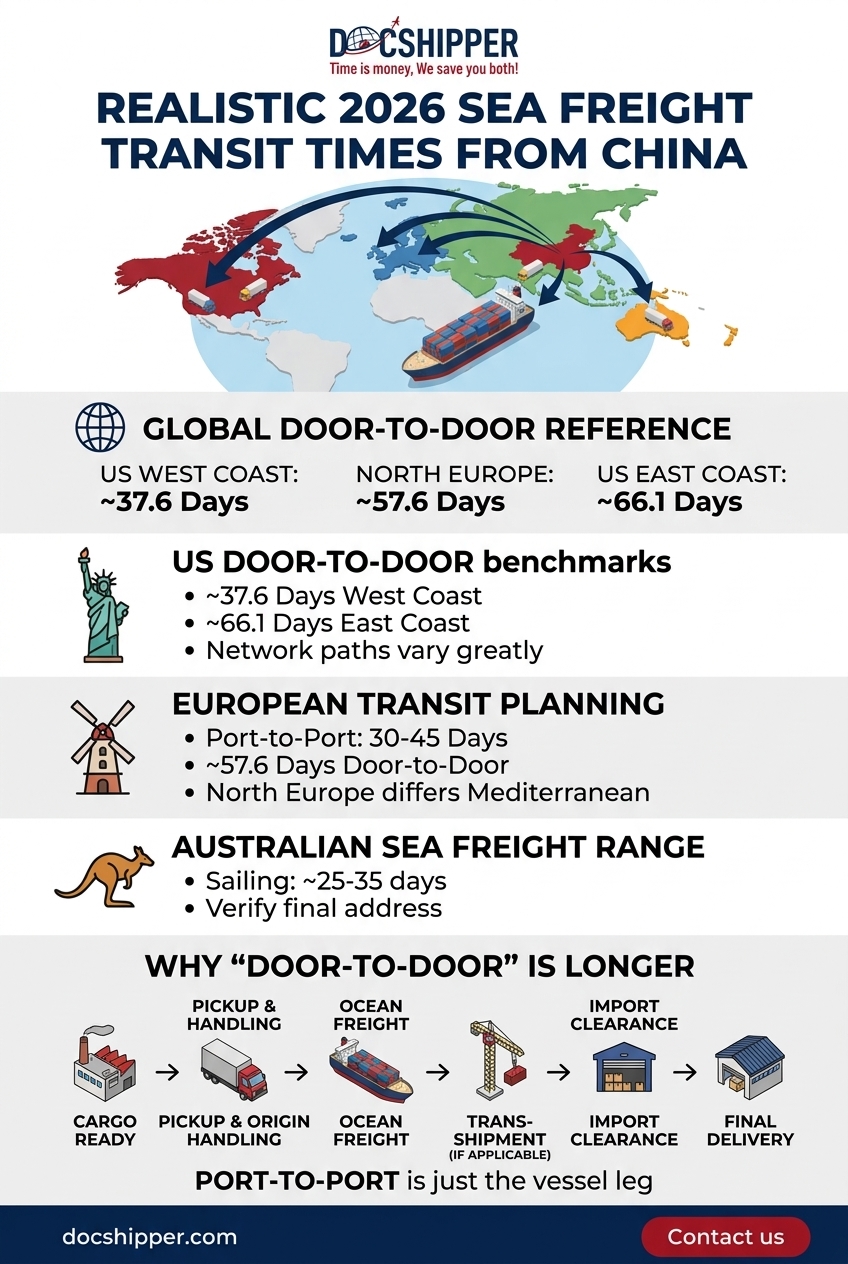
How long does sea freight from China actually take in 2026?
Sea freight from China takes roughly 20 to 45 days port-to-port, but a realistic door-to-door delivery time is longer. Recent measurements show approximately 37.6 days to the US West Coast, 57.6 days to North Europe and 66.1 days to the US East Coast, including the wider delivery process rather than only the vessel journey.
The honest short answer
The number a carrier first quotes is usually a sailing-time range between two ports. Your customer, however, is waiting for delivery at a warehouse, shop or fulfilment centre. That date also depends on export handling, consolidation, customs, inland transport, transshipment and possible schedule disruption.
For example, Maersk’s carrier guidance gives approximately 30 to 45 days port-to-port from China to Europe. The Flexport Ocean Timeliness Indicator measured approximately 57.6 days door-to-door from China to North Europe for the week ending 10 August 2026. The difference is the planning gap that importers often miss.
| Lane | Port-to-port reference | Measured door-to-door reference |
| China to US West Coast | Destination and service dependent | Approximately 37.6 days |
| China to US East Coast | Destination and routing dependent | Approximately 66.1 days |
| China to North Europe | Approximately 30 to 45 days | Approximately 57.6 days |
| China to Australia | Approximately 25 to 35 days | Confirm the door-to-door lane estimate |
The door-to-door figures above come from the Flexport Ocean Timeliness Indicator, published on 13 August 2026. They are useful benchmarks, not a guaranteed delivery date for every port pair, cargo type or shipping line.
Why “it depends” is the real answer
Destination is the first variable. A shipment to Los Angeles follows a different network from one to New York, while a shipment to North Europe may be affected by a different routing decision from one to the Mediterranean or the Middle East.
Service structure matters too. A direct service removes an intermediate port, while a transshipment service requires the container to be discharged, handled and loaded again. FCL cargo normally follows the container sailing schedule, whereas LCL cargo must wait for consolidation before departure and deconsolidation after arrival.
Season can move the effective date even when the published sailing time stays unchanged. Chinese New Year, peak-season demand and terminal congestion can make the time between booking and actual departure materially longer.
Use the destination table below as the starting point. Then convert the port-to-port figure into a door-to-door estimate by adding the operational stages and a buffer for schedule reliability.
Sea freight transit times from China by destination: the complete table
This master table separates the advertised sailing range from the delivery time you should use for planning. Where a current public benchmark is available, it is shown below; where the exact figure depends on the live lane, service and delivery address, confirm it through the linked DocShipper destination page rather than relying on a generic number.
North America: US West Coast, US East Coast and Canada
The US West Coast is generally the shorter major US ocean route from China, while the US East Coast requires a longer ocean and inland network. The measured door-to-door benchmarks are approximately 37.6 days for the US West Coast and 66.1 days for the US East Coast, based on the Flexport indicator for the week ending 10 August 2026.
For the US East Coast, the example route may involve a longer service pattern and different routing choices. The quoted transit time must therefore identify the destination port, whether the service is direct or uses transshipment, and whether the estimate ends at the port or at your final address.
For Canada, the final delivery location is equally important. Vancouver, Montreal and inland destinations do not have the same port-to-door profile, so a port-to-port number should not be presented to customers as the complete delivery commitment.
Europe, the Mediterranean and the UK
Maersk gives a carrier reference range of approximately 30 to 45 days port-to-port from China to Europe and approximately 35 to 45 days from China to the UK. The North Europe door-to-door benchmark of approximately 57.6 days shows why the carrier range should not be used alone when you are planning stock availability.
North Europe and the Mediterranean should be treated as separate planning groups. Port choice, transshipment, inland delivery and the routing selected by the carrier can all change the time between the vessel arrival and your actual receipt.
| Destination | Example port pair or region | Port-to-port range | Realistic door-to-door reference | Lane details |
| US West Coast | China to US West Coast | Service dependent | Approximately 37.6 days | DocShipper US lane |
| US East Coast | Shanghai to New York, as an example | Approximately 30 to 40 days, routing dependent | Approximately 66.1 days | DocShipper US lane |
| North Europe | China to Rotterdam, as an example | Approximately 30 to 45 days | Approximately 57.6 days | DocShipper Europe lane |
| UK | China to a UK port | Approximately 35 to 45 days | Confirm the delivery address and service | DocShipper Europe lane |
| Mediterranean | China to a Mediterranean port | Confirm current service | Confirm the delivery address and routing | DocShipper Europe lane |
| Canada | China to a Canadian port | Confirm port pair and service | Confirm inland destination | Lane-specific confirmation required |
Intra-Asia, the Middle East, Africa and Oceania
Shorter geographic distance does not automatically mean a predictable delivery date. Intra-Asia services may be frequent, but transshipment, port cut-offs and the final inland leg still determine when the cargo is available.
Maersk lists approximately 25 to 35 days port-to-port from China to Australia. For other destinations, including Vietnam, Thailand, Japan, South Africa, Turkey, Saudi Arabia and Hong Kong, use the dedicated DocShipper lane pages for the current origin, destination, service and shipment scope.
| Destination | Port-to-port range | Door-to-door estimate | DocShipper lane page |
| Vietnam | Confirm current lane range | Confirm origin, destination and delivery scope | China to Vietnam |
| Thailand | Confirm current lane range | Confirm origin, destination and delivery scope | China to Thailand |
| Japan | Confirm current lane range | Confirm origin, destination and delivery scope | China to Japan |
| South Africa | Confirm current lane range | Confirm origin, destination and delivery scope | China to South Africa |
| Turkey | Confirm current lane range | Confirm origin, destination and delivery scope | China to Turkey |
| Saudi Arabia | Confirm current lane range | Confirm origin, destination and delivery scope | China to Saudi Arabia |
| Hong Kong | Confirm current lane range | Confirm origin, destination and delivery scope | China to Hong Kong |
| Australia | Approximately 25 to 35 days | Confirm the final delivery location | Lane-specific confirmation required |
Port-to-port vs door-to-door: why the number you are quoted is not your delivery date
Port-to-port is the transport time between the origin and destination ports. Door-to-door includes the pickup, export process, ocean movement, import clearance, inland transport and final delivery, which is why a 30-day sailing can become a 50-day delivery.
What each term actually covers
Port-to-port normally describes the ocean leg from the departure port to the arrival port. It may exclude factory pickup, export customs, terminal handling, transshipment waiting time, import customs and transport from the destination port to your warehouse.
Door-to-door covers the agreed movement from the supplier’s or pickup address to the final delivery address. The precise scope depends on the quotation and the Incoterm, so check whether customs clearance, duties, taxes, unloading and last-mile delivery are included.
| Port-to-port | Door-to-door |
| Ocean movement between two named ports | Pickup from the supplier or agreed origin address |
| May exclude origin handling and export customs | Origin handling, export documentation and export customs |
| May exclude transshipment dwell | Ocean transport, transshipment and arrival handling |
| Ends before inland delivery | Import customs, inland haulage and final delivery |
The steps hidden inside “door-to-door”
Start with cargo readiness. A container cannot depart simply because the booking exists: the goods must be packed, the documents must be ready and the cargo must meet the terminal cut-off.
Then add origin handling. This can include pickup, loading, export customs, documentation and delivery to the origin terminal. With LCL, the cargo may first move to a consolidation warehouse or Container Freight Station, commonly called a CFS.
After the sailing and any transshipment, the shipment still needs import clearance and inland delivery. A worked planning example is 32 days sailing from Shanghai to Rotterdam, plus approximately 3 days for origin handling and approximately 5 days for import customs and inland transport. That produces approximately 40 or more days door-to-door before any delay buffer.
FCL vs LCL: how consolidation changes your transit time
FCL means your goods use a full container, while LCL means your cargo shares container space with other shipments. LCL adds consolidation before departure and deconsolidation after arrival, so the vessel’s sailing time is not the complete transit time.
Why LCL is slower than the sailing time suggests
With FCL, the container is normally packed for your shipment and moves according to the booked sailing schedule. You still need to meet the cut-off and complete the required documentation, but there is no need to wait for other shippers’ cargo to fill the shared container.
With LCL, the forwarder collects separate shipments at a CFS, checks the cargo, consolidates it into a container and sends it to the port. At destination, the container is opened and the cargo is separated before delivery. These warehouse cycles can add several days at both ends.
The LCL cut-off can therefore become the effective departure date. Missing one consolidation cycle may make the cargo wait for the next available sailing even if space exists on the vessel you originally considered.
When the extra days are worth it
LCL can be appropriate when the shipment does not justify a full container or when preserving cash flow matters more than achieving the shortest possible transit. FCL is usually more attractive when the shipment volume is sufficient to use a container efficiently, when the cargo is time-sensitive or when handling risk must be reduced.
Do not compare only the ocean rate. Compare the complete timeline, including pickup, CFS handling, consolidation, destination deconsolidation, customs and inland transport.
| Factor | FCL | LCL |
| Container use | Dedicated container for one shipment | Shared container with other shipments |
| Pre-departure process | Pack and deliver before the vessel cut-off | Deliver to a CFS and wait for consolidation |
| Arrival process | Container release and delivery | Deconsolidation before individual delivery |
| Transit planning | Closer to the vessel schedule | Requires additional consolidation planning |
| Best fit | Higher volume or time-sensitive cargo | Smaller shipments that do not require a full container |
What drives the variation: routing, season and schedule reliability
Three forces move your delivery date most often: routing, seasonal congestion and schedule reliability. Direct versus transshipment services, Red Sea diversions around the Cape of Good Hope, Chinese New Year and late vessel arrivals all need to be considered before you commit a date.
Transshipment and the Red Sea and Cape of Good Hope detour
A transshipment service introduces another operational handover. The container may wait for a connecting vessel, and a missed connection can add more time than the published sailing range suggests.
Red Sea disruption has also changed the planning assumptions for some Asia-Europe and Asia-US East Coast services. When ships avoid the Suez Canal and sail around the Cape of Good Hope, the route is longer and consumes more vessel time. The impact varies by carrier, destination and current service pattern.
Lars Jensen, CEO and Partner at Vespucci Maritime and an independent container-shipping analyst, warned in December 2024: “When the Suez Canal reopens, we should expect serious bottlenecks.” His comment, published by APM Terminals, illustrates why a route change can continue affecting schedules even after the immediate disruption changes.
Chinese New Year and peak season
Chinese New Year creates two planning pressures. Factories may close or operate with reduced capacity, while shippers often bring orders forward before the holiday, increasing demand for bookings, equipment and terminal capacity.
Peak season can create a similar effect without a formal shutdown. When space tightens, your cargo may be rolled to a later sailing, and the period between cargo readiness and actual departure becomes longer.
Schedule reliability: the buffer nobody quotes
Global container schedule reliability was 64.1% in November 2025, according to Sea-Intelligence. The result improved by 9.5 percentage points year-on-year, but roughly one vessel in three still arrived late.
At 64.1% reliability, plan for uncertainty rather than treating the fastest quoted transit as the expected outcome. On a six-shipment quarter, a simple planning interpretation is that approximately two shipments may slip, although the actual result will vary.
Carriers are trying to improve predictability. The Gemini Cooperation between Maersk and Hapag-Lloyd targets more than 90% schedule reliability through a hub-and-spoke network. A target, however, is not the same as a guaranteed result for your specific lane.
| Driver | How it affects your date | Planning action |
| Direct or transshipment service | Connections and additional port handling can extend the transit | Ask whether the quote is direct and identify every transshipment port |
| Red Sea and Cape routing | Some Asia-Europe and US East Coast services require longer routing | Confirm the current vessel route before promising a delivery date |
| Chinese New Year | Factory closures and pre-holiday demand can delay departure | Book earlier and confirm cargo readiness before the holiday period |
| Peak season | Limited space, equipment pressure and rollovers can extend the wait | Use a realistic buffer and monitor the booking after confirmation |
| Schedule reliability | Late arrivals remain common even when the service is booked | Add a delivery buffer rather than using the best-case sailing time |
How to estimate your own realistic transit time from China
Estimate a realistic delivery date in five steps: identify the port-to-port range, add origin handling, add LCL consolidation if applicable, add import customs and inland transport, then add a reliability buffer. The result is a planning date that is more defensible than a carrier’s sailing-time headline.
The 5-step estimate
- Find the port-to-port range for your lane. Identify the Chinese origin port, destination port, service type and whether the route is direct or includes transshipment. Use the destination table as a benchmark, then confirm the current lane-specific schedule.
- Add origin handling. Include supplier readiness, pickup, packing, export documents, export customs, terminal delivery and the carrier cut-off. Do not start counting from the date you request a quotation unless the cargo is already ready to ship.
- Add LCL consolidation when applicable. If your shipment is shared-container cargo, include the CFS process before departure. For FCL, confirm the container loading and terminal cut-off instead.
- Add import customs and inland transport. Include document review, customs clearance, port release, trucking or rail and final delivery. The destination address matters as much as the destination country.
- Add a reliability buffer. Use the current service performance, season and routing risk to decide how much time to hold. The 64.1% global reliability figure is a reason to include a buffer, not a universal number of days for every lane.
A simple buffer rule
Separate the operational estimate from the customer commitment. First calculate the expected door-to-door movement. Then add a buffer that reflects the route, season, shipment type and the consequence of being late.
| Step | Example planning input | Running total |
| Port-to-port movement | 20 days | 20 days |
| Origin handling | 3 days | 23 days |
| LCL consolidation | 5 days | 28 days |
| Customs and inland delivery | 5 days | 33 days |
| Reliability buffer | 5 days | Approximately 38 planned days |
In this supplied example, the planning result is approximately 38 days for a China to US West Coast LCL shipment. The figures are a reusable calculation template, not a guarantee for a particular booking. Confirm the exact days against the current DocShipper lane schedule.
For a precise estimate, provide the Chinese pickup location, destination address, cargo volume, shipment readiness date and whether you need FCL or LCL. DocShipper can then build the date from the actual lane, consolidation plan and delivery scope rather than quoting an isolated sailing time.
Key takeaways and how to get an exact transit time
Sea freight planning becomes more reliable when you replace a generic 20 to 45-day statement with a destination-specific door-to-door date and a clearly stated buffer.
- Port-to-port sailing time is only one part of the shipment. Plan around the door-to-door delivery date.
- Current door-to-door benchmarks are approximately 37.6 days to the US West Coast, 57.6 days to North Europe and 66.1 days to the US East Coast, according to the Flexport Ocean Timeliness Indicator.
- FCL follows the container sailing schedule more closely, while LCL adds consolidation before departure and deconsolidation after arrival.
- Direct services, transshipment, Red Sea and Cape of Good Hope routing, Chinese New Year and peak season can all move the date.
- Global schedule reliability was 64.1% in November 2025, meaning roughly one vessel in three arrived late.
- Use the relevant DocShipper lane page for current destination-specific transit information instead of relying on a generic ocean freight range.
Need the exact transit time for your specific lane and cargo? Tell DocShipper your origin, destination and volume, and our team will confirm a realistic door-to-door schedule and quote for your FCL or LCL shipment from China.
FAQ | Sea Freight Transit Times from China: Realistic 2026 Delivery Estimates
Treat the required date as a delivery deadline, not a vessel departure date. Build in time for supplier readiness, booking confirmation, customs, inland delivery and possible disruption. If the deadline is critical, ask your forwarder to compare sea freight with an expedited option or a split shipment rather than relying on the fastest quoted sailing time.
The container may not be loaded onto the planned vessel, even if the booking has already been confirmed. It may then be rolled to the next sailing, adding several days or more depending on the route. To reduce this risk, confirm the factory’s cargo-ready date, container loading date, documentation status and terminal cut-off in writing before booking.
Delays commonly occur when the commercial invoice, packing list, bill of lading instructions or customs data contain inconsistent descriptions, quantities, weights or values. Check that the importer details, product classification and consignee information match across all documents. Correcting an error after sailing can delay customs release and create additional storage or handling costs.
Yes. Dangerous goods, batteries, temperature-sensitive products, oversized cargo and regulated goods may require additional approval, specialised equipment or extra inspections. These shipments can face earlier booking deadlines and fewer sailing options. Confirm the cargo classification and required documents before requesting a transit estimate.
The cargo may be placed in a terminal or warehouse while customs clearance and delivery arrangements are completed. Depending on the destination and shipping terms, storage, demurrage or detention charges may begin after a limited free period. Prepare the import documents and customs instructions before arrival, and confirm who is responsible for each charge under the agreed Incoterm.
Sometimes, but it depends on the carrier, cargo status, destination customs rules and whether the new address requires a different inland route. A change requested after arrival can involve amendment fees, re-routing, additional customs work or storage. Provide the final delivery address before booking whenever possible, especially for inland destinations.
Ask for updates at three points: when the booking is confirmed, when the container gates in at the origin terminal and when the vessel departs. Then monitor the actual vessel movement, transshipment connection and estimated arrival. If the vessel is rolled, diverted or misses a connection, request a revised door-to-door date immediately rather than continuing to use the original quotation.
Need Help with
Logistics or Sourcing ?
First, we secure the right products from the right suppliers at the right price by managing the sourcing process from start to finish. Then, we simplify your shipping experience - from pickup to final delivery - ensuring any product, anywhere, is delivered at highly competitive prices.


Fill the Form
Prefer email? Send us your inquiry, and we’ll get back to you as soon as possible.
Contact us