How to choose the right logistics partner to protect your supply chain and margins

  • DocShipper Team 8 Min
  • Published on March 3, 2022 Updated on January 6, 2026
img

In short ⚡

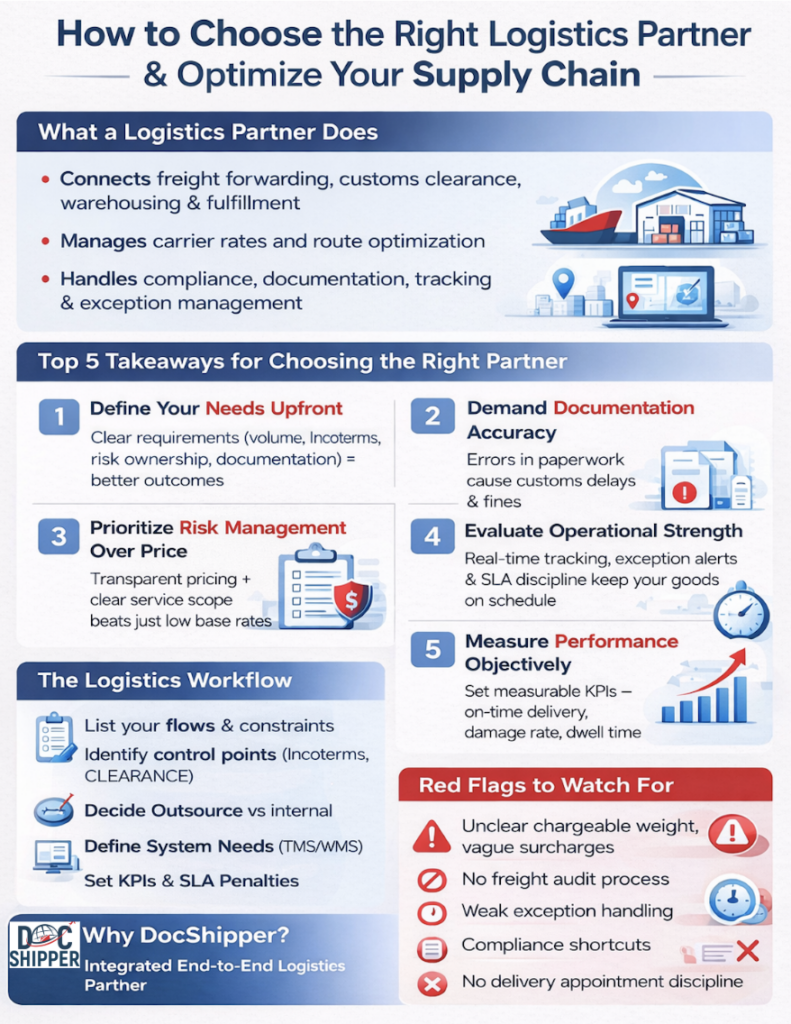
A logistics partner is a specialist company that manages end-to-end supply chain operations beyond just booking transport, integrating freight forwarding, customs clearance, warehousing, and order fulfillment to protect service levels and margins. The right logistics partner also handles carrier management, documentation, risk control, shipment tracking, and freight audit to reduce delays, hidden costs, and compliance issues.

We hope you’ll find this article genuinely useful, but remember, if you ever feel lost at any step, whether it’s finding a supplier, validating quality, managing international shipping or customs,  DocShipper can handle it all for you!

Free shipping quote 24h      I want to talk to a sourcing expert

What a logistics partner actually does for your business

A logistics partner isn’t just “someone who books a truck.”

Done right, they become the operator behind your supply chain management, connecting freight forwarding, customs clearance, warehousing, and order fulfillment so you protect both service levels and margins.

Here’s the thing, most headaches you call “transport issues” actually come from missing links between paperwork, packaging, and execution.

That’s where a good 3PL provider or 4PL provider changes your day-to-day, because they run the system, not just a single shipment.

DocShipper Info

Turn your logistics provider into a real operations partner, not just a carrier booker.
DocShipper connects freight, customs, warehousing and fulfillment so your supply chain runs as one integrated system.
Secure your margins before problems appear.

Core roles in transport, warehousing and fulfillment

Last quarter, we saw a fast-growing brand rush a promo launch, the stock landed on time, but it sat idle because the distribution center had no slotting plan and the inbound labels didn’t match the WMS.

They had “shipping covered,” but not inventory management and order fulfillment, that’s the classic gap a true logistics partner closes.

A strong partner typically covers these core blocks, depending on whether you’re using logistics outsourcing, contract logistics, or a hybrid model.

  • Freight forwarding and execution, booking carriers, multimodal transport, freight consolidation, and managing freight rates
  • Carrier management and route optimization, including load planning and tendering
  • Customs brokerage and transport compliance, including export declarations and Incoterms alignment
  • Warehousing operations, put-away, cycle counts, and bonded warehouse options when relevant
  • Order fulfillment and last-mile delivery, including returns and reverse logistics
  • Value-added services, labeling, kitting, palletization, and light assembly
  • Shipment tracking and exception handling through a TMS and/or warehouse management system

If you want a practical mental model, think “move, store, pick, deliver, fix exceptions,” all under clear service level agreement rules.

And yes, good partners also run a freight audit, because billing errors quietly kill margins.

Where a logistics partner fits in your wider supply chain strategy

Tip: choose your logistics partner based on the decision you want to outsource, not just the lanes you ship.

If you only need execution, a solid 3PL provider and freight brokerage strength may be enough.

If you want orchestration across vendors, carriers, and warehouses, you’re closer to a 4PL provider approach with procurement, key account management, and performance governance included.

We’ve seen importers try to DIY coordination across three forwarders, two warehouses, and five carriers, the first disruption turns it into a blame game.

The World Bank regularly highlights how logistics reliability impacts trade performance, and you feel that at ground level when one missed handoff delays the whole chain.

This is the workflow we recommend you map before you sign anything, because it forces clarity on roles and handoffs.

Step-by-step workflow (partner-fit mapping):

  • Step 1: List your flows, inbound, outbound, returns, and any just-in-time delivery constraints
  • Step 2: Identify control points, Incoterms, booking, bill of lading issuance, clearance, delivery appointment
  • Step 3: Decide what you keep vs outsource, commercial negotiation, tendering, claims, customer delivery promises
  • Step 4: Define systems needs, TMS/WMS integrations, shipment tracking, exception alerts
  • Step 5: Set measurable outputs, on-time, damage rate, dwell time, cost-to-serve, and SLA penalties/credits

When you do this, the partner’s role becomes obvious, execution arm, control tower, or both.

Key risks when you choose the wrong logistics partner

Choosing the wrong logistics partner rarely blows up on day one.

It shows up later as “mystery” surcharges, recurring delays, and borderline compliance decisions that put your shipments, and your reputation, at risk.

We’ve stepped into accounts where the product was great and demand was real, yet cash got trapped in transit because the supply chain wasn’t managed with discipline.

That’s why you should treat selection like a real sourcing project, with an RFP, clear evaluation criteria, and a binding service level agreement.

DocShipper Alert

Hidden costs often come from weak governance and vague contracts.
DocShipper structures RFPs, SLAs and freight audits so you avoid surprise surcharges and compliance grey zones.
Protect your cash flow before it gets trapped in transit.

Hidden costs, delays and compliance failures to watch for

Is your quote “all-in,” or is it a teaser that evaporates after pickup?

A weak logistics partner often wins on a low base rate, then makes margin on accessorials and poor planning.

We once audited a lane where the shipper kept paying “unexpected” storage and demurrage, the root cause was no delivery appointments and zero carrier management discipline.

Use this red-flag checklist before you accept any proposal.

  • Unclear rate basis, no defined chargeable weight rules, fuel formula, or validity window for freight rates
  • No freight audit process, invoices arrive late, with vague references and no documentation
  • Weak exception handling, no proactive shipment tracking alerts, only reactive emails
  • Compliance shortcuts, “we can declare it differently,” or pushing inconsistent HS classification without support
  • Document ambiguity, no clarity on who issues the bill of lading and who controls originals
  • Capacity risk, no backup carriers, no tendering plan, no peak season playbook

If you’re shipping internationally, add a hard requirement for documented customs clearance processes and escalation paths.

The WCO sets globally recognized customs standards, and serious operators align their brokerage practices with that reality, not with improvisation.


Looking for a Reliable Shipping & Sourcing Partner?

We handle the entire sourcing process, supplier research, negotiation, production, and inspections, so you can focus on what matters most: growing your business.

Common packaging, documentation and insurance mistakes

Hard truth: most export losses don’t come from “bad luck,” they come from preventable basics that your logistics partner should catch.

We’ve seen a pallet collapse mid-transit because the carton strength matched domestic courier standards, not ocean stacking pressure, then the claim failed because the paperwork didn’t match the cargo.

This is exactly where logistics optimization becomes very practical, packaging specs, document accuracy, and insurance terms must align.

Here’s a compact table you can use to spot the usual failure points fast.

Area Common mistake Real-world consequence What to require from your logistics partner
Packaging Weak carton, no edge protection, poor palletization, no stretch wrap standard Damage, rework, refused delivery at DC, extra handling fees Packaging guidelines by mode, load planning support, photos at origin, handling marks
Documentation Mismatched invoice, packing list, and bill of lading, wrong shipper/consignee, missing licenses Customs clearance delays, inspections, fines, cargo holds Document pre-check, customs brokerage validation, clear Incoterms responsibility matrix
Insurance Assuming carrier liability equals cargo insurance, wrong insured value, exclusions ignored Claim rejection, partial compensation, margin wiped out Clear cargo insurance offer, claim process, evidence list, SLA for claim handling
Handoffs No sealed-handling procedure, weak chain of custody across modes Disputes, delays, missing cartons, accountability gaps Shipment tracking, milestone scans, partner SOPs, escalation contacts

When you fix these three basics, you’ll notice fast how many “carrier problems” disappear on their own.

And if you want a second pair of eyes, we at DocShipper routinely run pre-shipment checks across packaging, docs, and coverage before cargo moves, because prevention is cheaper than claims.

Criteria to define your needs before you contact a logistics partner

Last year, we worked with an importer who rushed into selecting a logistics partner after a peak-season panic, and two weeks later their cargo was stuck because no one had clarified who handled export documents. From experience, this is where most shippers get burned, not by bad intent, but by unclear needs and assumptions you could have avoided.

You’ll save money and stress if you frame your requirements upfront, because a serious logistics partner will only perform well if you’re clear on volumes, Incoterms, risk tolerance, and service scope. Institutions like the ICC Incoterms Committee remind us that role clarity is the backbone of any international movement, and you feel that truth fast in real operations.

Before any call or quote request, here’s a simple checklist we always walk through with clients.

  • Origin and destination complexity, factories, consolidation points, final delivery constraints.
  • Transport mode mix, ocean, air, rail, or multimodal based on urgency and margins.
  • Risk ownership, packaging, insurance coverage level, and damage responsibility.
  • Documentation scope, commercial invoices, COO, HS accuracy, licenses if applicable.
  • Service depth, pure transport or end-to-end support including customs and warehousing.

DocShipper Advice

Before contacting any provider, get crystal clear on your flows and responsibilities.
DocShipper helps you define Incoterms, risk ownership and documentation scope so every shipment runs predictably.
Turn chaotic peak seasons into repeatable processes.

Essential factors to evaluate when you compare logistics partners

Here’s a direct tip we repeat daily, don’t compare quotes first, compare risk control, especially when assessing a logistics partner for exports. We’ve seen tempting low-cost offers turn into painful losses after one compliance issue flagged by customs.

You’ll notice fast that the strongest partners speak confidently about insurance limits, SLA metrics, and claims handling, not just transit times. The World Customs Organization regularly highlights how documentation accuracy and data quality separate reliable operators from risky ones.

To make comparison practical, use a simple table like this during your decision phase.

Evaluation factor Weak logistics partner Reliable logistics partner
Pricing structure Low base rate, many unclear surcharges Transparent pricing with defined accessorials
Documentation support Reactive, after problems appear Proactive checks before cargo departure
Insurance coverage Minimal or optional without guidance Clear cargo insurance advice and limits
Operational communication Slow updates, generic replies Named contact and structured reporting

DocShipper Info

Comparing partners only on price exposes you to compliance and delay risks.
DocShipper combines transparent pricing with strong documentation, insurance and SLA discipline.
Use us as your control tower to stabilize performance.

Conclusion

The right logistics partner protects your margins before the shipment even leaves the factory. You’ve probably felt how one weak link can erase months of negotiation effort, which is exactly why selection discipline matters.

At DocShipper, we’ve built our approach around these realities, learned on the ground with exporters facing real customs, packaging, and insurance challenges. The main takeaways to keep front of mind are below.

  • Define your needs first, volumes, Incoterms, risk ownership, and service scope.
  • Prioritize risk management over attractive base pricing.
  • Demand clarity on documentation, insurance, and accountability.
  • Choose transparency, not promises, when selecting your logistics partner.

FAQ | How to choose the right logistics partner to protect your supply chain and margins

Pay attention to small pattern changes; they usually precede major failures:

  • Operational red flags:
  • More “system issues” or excuses for missed cut‑offs.
  • Repeated rollovers, no clear root-cause analysis.
  • Frequent last‑minute changes in routing without explanation.
  • Financial red flags:
  • Sudden, recurring “extra charges” with vague descriptions.
  • Invoices arriving much later than the shipments.
  • Reluctance to commit to rate validity periods.
  • Compliance red flags:
  • Suggesting “flexible” declarations or HS codes without written justification.
  • Poor record-keeping of customs documents.
  • Management red flags:
  • High staff turnover on your account.
  • Your key contact is often “not available” when problems arise.

If you see 3+ of these over a 2–3 month span, start a structured review and quietly benchmark alternatives.

Ask us anything!

Need Help with
Logistics or Sourcing ?

First, we secure the right products from the right suppliers at the right price by managing the sourcing process from start to finish. Then, we simplify your shipping experience - from pickup to final delivery - ensuring any product, anywhere, is delivered at highly competitive prices.

Component-15.png

Live Chat

Get instant assistance from our team—just click and start chatting!

Live Chat Now
image

Fill the Form

Prefer email? Send us your inquiry, and we’ll get back to you as soon as possible.

Contact us
image
Component-15.png

Call us

Reach out to us on WhatsApp for quick, convenient, and personal support.

Call us
image
Component-15.png