In short ⚡
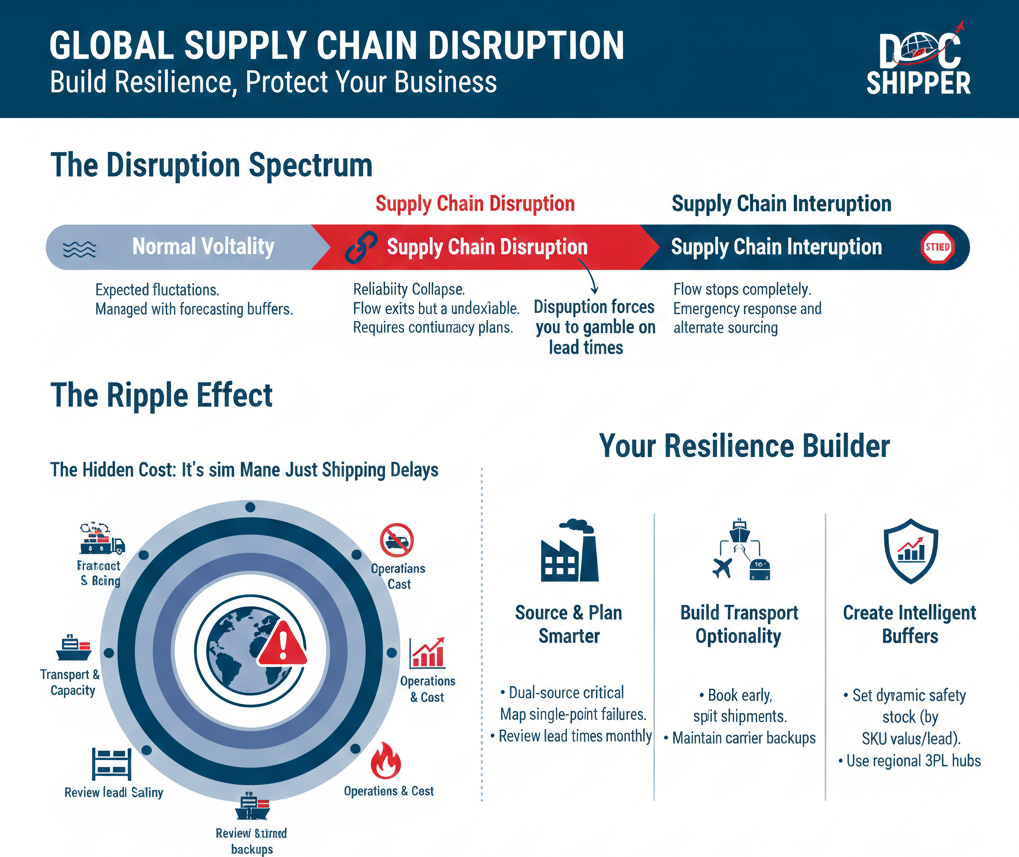
Supply chain disruption is a collapse in reliability of your planned logistics flow, where transport, capacity, or policy shocks make lead times unpredictable even though the flow still exists. Unlike normal volatility or a full interruption, it triggers contingency moves such as rerouting, split bookings, multimodal transport, and emergency airfreight to protect cost, service levels, and competitiveness.
We hope you’ll find this article genuinely useful, but remember, if you ever feel lost at any step, whether it’s finding a supplier, validating quality, managing international shipping or customs, DocShipper can handle it all for you!
What supply chain disruption is and why it hits your business so hard
Supply chain disruption isn’t a buzzword you throw into a slide deck, it’s the moment your lead time stops being a number and starts being a gamble.
You’ve probably felt it since COVID, especially during China’s 2022 lockdowns, when ocean freight schedules broke, air cargo got rationed, and trucking capacity vanished at the worst time.
From experience at DocShipper, you’ll notice fast that the pain rarely comes from one delay.
It comes from the chain reaction across procurement, inventory management, order fulfillment, and even last-mile delivery.
Clear definition: disruption, interruption, and how they differ from normal volatility
Back in 2022, we watched a simple purchase order out of Shenzhen turn into a three-part chess game.
Port congestion pushed the ETD, trucking slots disappeared overnight, and the buyer asked, “Is this a delay or a shutdown?” That’s the difference you need to name clearly when you do risk mitigation.
Supply chain disruption means your planned flow still exists, but it becomes unreliable because of capacity constraints, transportation bottlenecks, or policy shocks.
Supply chain interruption is harsher, the flow stops or breaks, like a factory halt, a border closure, or a customs clearance freeze.
Normal volatility is what you already price in with demand forecasting and supplier lead time buffers.
Disruption is what forces contingency planning, rerouting, alternative Incoterms, or emergency airfreight.
To keep the terms actionable, here’s a quick comparison you can use in your supply chain risk assessment.
| Situation | What it is | What you’ll see operationally | Typical response |
| Normal volatility | Expected fluctuation | Small schedule shifts, minor rate changes | Adjust safety stock, refine demand forecasting |
| Supply chain disruption | Reliability collapse | Blank sailings, missed trucking appointments, warehouse overflow | Split bookings, multimodal transport, tighten shipment tracking |
| Supply chain interruption | Flow stops | Production downtime, cargo stuck pre-export, customs holds | Activate business continuity planning, switch sourcing, emergency airfreight |
The real impact on cost, service levels, and long‑term competitiveness

Here’s the tip, don’t measure the impact of supply chain disruption only by the freight invoice.
You also pay on the P&L through stockouts, backorders, expedited shipments, and lost shelf space.
During the China 2022 lockdown wave, we saw importers “save” money by waiting for ocean rates to cool down.
Then they lost three weeks of sales because their just-in-time plan had zero margin, and their distributors didn’t wait.
The impact of supply chain disruption on business usually shows up in five places, and you can spot them early if you track them weekly.
Use this short checklist to audit your exposure before the next peak season hits.
- Lead time variance is widening, even when transit time stays stable.
- Order fulfillment drops below target, or OTIF starts sliding.
- Warehousing costs surge due to early arrivals or forced storage.
- Trade compliance issues spike, wrong HS codes, missing documents, Incoterms confusion.
- Capacity constraints show up in allocations, rolled cargo, or denied bookings.
If you’re wondering why this feels so brutal, it’s because a global supply chain disruption doesn’t just slow transport.
It breaks synchronization between sourcing, vendor management, and the physical flow across ocean, air, and trucking.
And once your competitors build resilience with supplier diversification and flexible contract logistics, they recover faster than you do.
UNCTAD has repeatedly highlighted how shocks compound through maritime chokepoints and liner capacity shifts, which is exactly what you feel at booking time.

DocShipper Alert
DocShipper audits your flows end to end, from sourcing to last mile,
to stabilize costs and protect service levels before the next shock.
Main causes of supply chain disruption you must plan for now
The causes of supply chain disruption aren’t mysterious anymore, but they still catch you off guard when you treat them as “rare events.”
A single COVID-era lockdown decision in China could ripple into port congestion, missed feeder connections, and a cash-crunch from inventory stuck in transit.
The goal isn’t to predict every crisis.
It’s to design supply chain resilience so you can keep service levels while others scramble.
Looking for a Reliable Shipping & Sourcing Partner?
External shock drivers: geopolitics, pandemics, extreme weather, and cyber risk

What actually triggers a supply chain disruption when everything looked “fine” last week?
External shocks hit your lanes and partners first, and your internal planning second.
We still remember a case where a shipper booked ocean freight early, then a regional COVID restriction killed export trucking to the port.
The cargo sat at origin, and the only way to protect launch dates was partial emergency air freight for top SKUs and ocean for the rest.
The impact of supply chain disruption spikes when shocks pile up across modes.
Think multimodal transport dependencies, export customs brokerage capacity, and airline belly space shrinking at the same time.
To make this practical, here are the external drivers you should map to each trade lane you use.
- Geopolitics, sanctions, tariff barriers, sudden import/export regulations changes.
- Pandemics and public health measures affecting factories, ports, and domestic trucking.
- Extreme weather disrupting ports, rail ramps, and last-mile delivery networks.
- Cyber risk hitting terminal operating systems, carriers, or your own shipment tracking platform.
- Regulatory enforcement surges causing customs clearance slowdowns and document scrutiny.
If you move cargo internationally, you also need to respect the difference between “delay” and “non-compliance.”
A disrupted lane plus weak trade compliance turns into inspections, holds, and penalties.
The WTO constantly tracks how policy changes affect trade flows, and those shifts can hit you faster than freight rates do.
DocShipper Alert
DocShipper maps geopolitical, sanitary and customs risks on your trade routes,
and builds concrete backup plans so your cargo keeps moving.
Internal vulnerabilities: single‑sourcing, data gaps, and over‑lean inventories
Brutal truth, most supply chain disruption pain gets amplified by choices you made when things were calm.
If you run just-in-time with one factory, thin safety stock, and fuzzy ETA visibility, even a small delay becomes a supply chain interruption for your customers.
In 2022 we saw buyers with “cheap” sourcing setups lose weeks because their supplier didn’t share realistic production status.
They only discovered the slip when the booking window had closed, and by then ocean capacity constraints forced a rollover.
You can reduce the impact of supply chain disruption on business by tightening three internal levers: sourcing design, data, and buffers.
Use this simple workflow to pressure-test your setup before the next peak or policy shock.
Resilience workflow you can run in 45 minutes:
- List critical SKUs, rank by margin and stockout cost.
- Map each SKU to suppliers, highlight single-sourcing and long tooling constraints.
- Validate lead time end-to-end, production, trucking, port dwell, ocean or air, customs clearance, last-mile.
- Check visibility, do you get milestone updates, document readiness, and exception alerts?
- Set buffers, safety stock rules and reorder points that reflect variance, not averages.
- Define contingencies, rerouting options, LCL vs FCL triggers, 3PL warehousing overflow plan.
When you do this properly, you’ll spot the silent killers: weak vendor management, unclear Incoterms responsibilities, and missing trade documents that delay customs.
If you need a second set of eyes, we can help you structure freight forwarding and 3PL options around your service level targets without overpaying for speed.
DocShipper Advice
DocShipper reviews your sourcing, Incoterms and logistics setup,
then designs pragmatic buffers and routing options tailored to your SKUs.
How to assess your exposure to global supply chain disruption
Back in late 2022, during China’s lockdowns, we worked with a retailer whose containers sat outside Shanghai for weeks, a textbook supply chain disruption that nobody had mapped properly. Here’s the thing, you’ll notice fast that risk only feels abstract until your goods stop moving.
You can’t fix what you haven’t measured, and exposure always hides in the details that look boring on spreadsheets. From experience, the World Economic Forum keeps reminding the industry that visibility, dependency, and reaction time define how hard disruptions hit you.
Before jumping into tools, start with a simple, honest checklist you can review with your team this week.
- Origin concentration, are over 50 percent of your SKUs coming from one country or one region.
- Transport dependency, do you rely on a single port, airline, or trucking corridor.
- Supplier resilience, can your factory actually operate during lockdowns, power cuts, or labor shortages.
- Data latency, do you get shipment status in days rather than hours.
- Buffer reality, does your safety stock exist on paper or physically in a warehouse you control.
DocShipper Info
DocShipper analyzes origin concentration, carriers and buffer reality,
then recommends concrete actions to secure your supply chain before peak season.
Practical tactics to reduce disruption and build a resilient supply chain
Here’s a direct tip you can apply immediately, treat uncertainty as a planning input, not an exception, especially when supply chain disruption is becoming structural rather than episodic. During COVID, we saw importers survive simply because they booked early and stayed flexible when others froze.
One client split a single FCL booking into two LCL shipments and one air backup during a capacity crunch, not cheap, but service levels stayed intact. That’s where guidance from bodies like FIATA aligns with what we do daily on the ground, optionality beats perfection.
To make this concrete, here is a practical workflow we use with our customers to reduce exposure.
Step-by-step resilience workflow:
Step 1: Book ocean freight earlier than usual and lock space, even if volumes are estimates.
Step 2: Split bookings by mode or carrier so one delay doesn’t stop everything.
Step 3: Keep Incoterms flexible so you can switch between FOB and EXW when capacity tightens.
Step 4: Activate LCL or trusted 3PL partners for partial shipments during peaks.
Step 5: Review supplier lead times monthly, not quarterly, and renegotiate when signals change.
DocShipper Advice
DocShipper plans mixed modes, early space reservations and 3PL options with you,
so disruption becomes a controlled cost instead of a crisis.
Conclusion
So let us ask you a simple question, after everything COVID exposed, are you still treating supply chain disruption as bad luck rather than a managed risk. We’ve seen again and again that the companies who adapted fastest came out stronger.
To close the loop, here are the key takeaways you should keep in mind as you move forward.
- Map your exposure before disruption forces you to react under pressure.
- Build flexibility through early booking, split shipments, and modal alternatives.
- Work closely with partners who can adapt fast across ocean, air, and trucking.
- Accept controlled redundancy, a bit of extra cost often protects service and revenue.
FAQ | Supply chain disruption: how to protect your business and turn risk into advantage
You can’t avoid every shock, but you can drastically reduce how often they paralyze you:
- On sourcing:
- Dual‑source or multi‑source critical SKUs (at least 2 suppliers/regions for A‑items).
- Avoid having more than 50% of your volume dependent on one country or single port.
- On transport:
- Pre‑book key lanes for peak periods and negotiate allocation with carriers/forwarders.
- Use at least 2 carriers or service types (e.g., 1 main ocean line + 1 NVOCC + backup air).
- On inventory:
- Set differentiated safety stock: higher for high‑margin or long‑lead‑time SKUs.
- Keep some inventory closer to your main markets in a regional 3PL warehouse.
- On process & data:
- Review lead times monthly; don’t rely on outdated “standard” transit times.
- Implement shipment tracking with milestone alerts (gate‑in, loaded, departed, arrived, cleared).
- On governance:
- Run quarterly “what if” drills: simulate a port closure, rate spike, or supplier shutdown and decide who does what.
The visible cost is the invoice; the hidden cost is in your P&L and balance sheet:
- Direct costs:
- Emergency airfreight or premium services.
- Demurrage, detention, storage, and re‑handling charges.
- Overtime in warehouses and customer service.
- Revenue impact:
- Stockouts leading to lost sales and canceled orders.
- Fines or penalties from retailers/marketplaces for late OTIF performance.
- Lost promotions or shelf space you paid to secure.
- Working capital:
- Excess inventory in the wrong place (in transit, at origin, or in overflow storage).
- Longer cash conversion cycle because goods are delayed or stuck at customs.
- Brand & relationship:
- Erosion of service reliability KPIs with key accounts.
- Higher churn and more aggressive price negotiations from distributors.
To quantify it, track per disruption:
- Extra logistics costs.
- Lost sales (units x margin).
- Extra days of inventory and cash tied up.
Then use this to justify investment in resilience (buffers, 3PL, dual sourcing).
Even without a pandemic, disruptions often come from a combination of small, predictable weaknesses:
- Operational causes:
- Overbooked vessels or blank sailings on busy trade lanes.
- Local trucking strikes, driver shortages, or road bans.
- Port equipment failures, terminal congestion, or labor disputes.
- Planning causes:
- Over‑optimistic production lead times from suppliers.
- Last‑minute PO changes (quantities, SKUs, labels) that break planning.
- Underestimating peak seasons (back‑to‑school, Singles’ Day, Black Friday).
- Compliance/administrative causes:
- Wrong HS codes, missing certificates, or late shipping documents.
- Misaligned Incoterms where nobody clearly owns export/import steps.
- Tech & data causes:
- EDI/API failures between systems (carrier, 3PL, retailer).
- Poor visibility leading to late reaction to small delays.
Most of these can be mitigated with better planning, documentation control, and clear ownership of each leg.
The strongest players treat disruption as a constant and redesign their setup around flexibility:
- Network design:
- Regionalize production and warehousing (e.g., part in Asia, part nearshore).
- Use “multi‑node” inventory: main DC + satellite hubs closer to final markets.
- Sourcing:
- Build strategic partnerships with key suppliers (shared forecasts, capacity commitments).
- Qualify backup suppliers in different regions before they’re needed.
- Transport:
- Mix FCL, LCL, air, rail, and cross‑border trucking depending on SKU value and urgency.
- Negotiate flexible contracts allowing mode switches and space guarantees.
- Digital & data:
- Implement real‑time visibility platforms with predictive ETAs.
- Use analytics to adjust safety stock dynamically based on variance, not averages.
- Governance:
- Create a cross‑functional “control tower” team to monitor risks and act quickly.
- Define clear escalation rules: when to upgrade to air, when to reroute, when to delay launches.
They don’t chase perfection; they aim for controlled redundancy and fast reaction.
Many responses to disruption make things worse. Typical errors include:
- Strategic mistakes:
- Treating each disruption as a one‑off “accident” instead of a pattern to plan for.
- Keeping single‑sourced high‑risk SKUs because they were slightly cheaper.
- Operational mistakes:
- Waiting too long to rebook or reroute, then losing all alternative options.
- Upgrading everything to airfreight instead of prioritizing SKUs by margin and urgency.
- Shipping full containers of low‑value items while high‑margin items are out of stock.
- Communication mistakes:
- Not informing key customers early, so they lose trust when delays become visible.
- Vague internal ownership: nobody clearly responsible for decisions in a crisis.
- Data & compliance mistakes:
- Working with outdated lead times and capacity assumptions.
- Ignoring documentation quality until customs blocks a high‑value shipment.
Avoid these by:
- Setting clear decision rules (e.g., when lead time variance > X days, trigger Plan B).
- Ranking SKUs and customers by strategic importance.
- Keeping your forwarder/3PL in the loop early, not after the crisis is already visible.
Read more
Looking for more? Check out these articles.
Need Help with
Logistics or Sourcing ?
First, we secure the right products from the right suppliers at the right price by managing the sourcing process from start to finish. Then, we simplify your shipping experience - from pickup to final delivery - ensuring any product, anywhere, is delivered at highly competitive prices.
Fill the Form
Prefer email? Send us your inquiry, and we’ll get back to you as soon as possible.
Contact us