Alibaba Sourcing Guide in 2026: Safe, Efficient

  • DocShipper Team 18 Min
  • Published on May 23, 2023 Updated on January 13, 2026
img

In short ⚡

Alibaba sourcing is the process of finding wholesale suppliers on Alibaba, requesting price quotes, validating supplier verification, and placing purchase orders for bulk purchasing or custom production. It involves managing MOQ, lead time, quality control, and Incoterms (such as FOB, CIF, or EXW), plus logistics steps like freight forwarding, customs clearance, and documentation.

We hope you’ll find this article genuinely useful, but remember, if you ever feel lost at any step, whether it’s finding a supplier, validating quality, managing international shipping or customs,  DocShipper can handle it all for you!

Free shipping quote 24h      I want to talk to a sourcing expert

What is Alibaba sourcing and is it right for your business?

Alibaba sourcing is the process of finding wholesale suppliers (often Chinese factories or trading companies), requesting price quotes, validating supplier verification, then placing a purchase order for bulk purchasing or custom production.

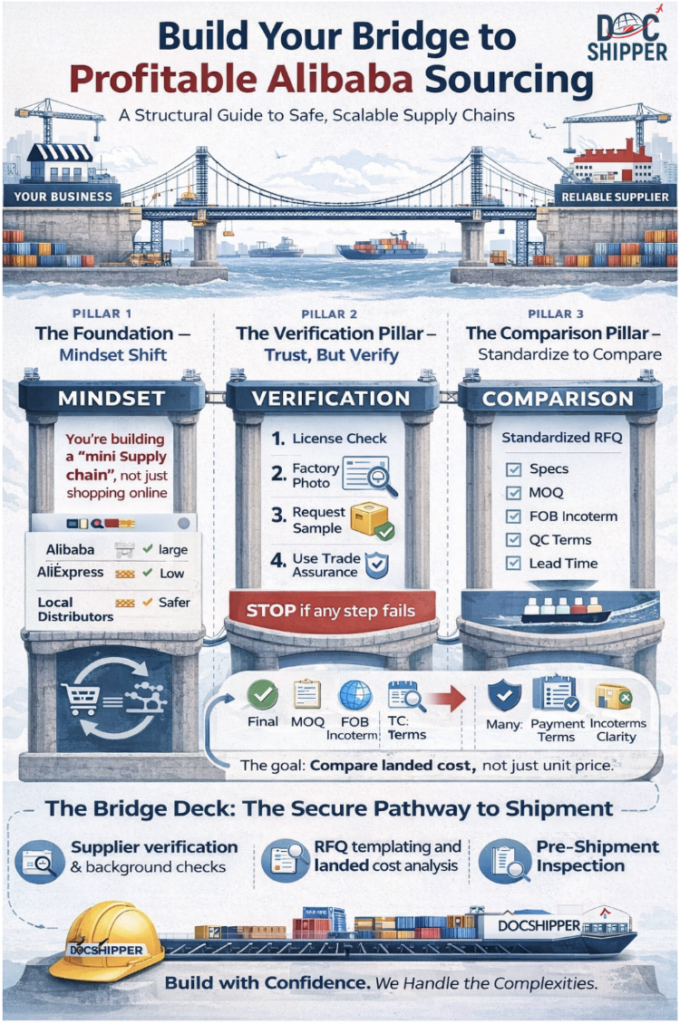
You’re not just “buying online”, you’re building a mini supply chain management system, with MOQ (minimum order quantity), lead time, quality control, and incoterms (like FOB (free on board), CIF (cost insurance freight), or EXW (ex works)) baked into every decision.

Here’s the thing, if your margins feel squeezed and you’ve outgrown local distributors, alibaba wholesale is often where you regain control, pricing, and customization.

But if you hate ambiguity, slow replies, and logistics details like customs clearance, HS code, and bill of lading, you’ll want a tighter process from day one.

From experience at DocShipper, the most common “first-time importer” story is simple, you order what looks like the same product, and you receive a different grade of material because the spec sheet was never locked in a proforma invoice.

This is also why even small buyers end up using Trade Assurance, a sample order, and sometimes an inspection service before scaling.

To decide if Alibaba sourcing matches your model, use this quick checklist.

  • You need better unit cost through bulk purchasing and negotiated MOQs.
  • You want private label packaging, inserts, or brand marks, not generic stock.
  • You can plan ahead for lead time plus international shipping.
  • You accept process, including supplier screening, documents, and trade compliance.
  • You’re ready to test with samples, then scale with a repeatable PO workflow.

One last note, even if you’re doing dropshipping or cross-border e-commerce, Alibaba can still help, but you’ll need to think about fulfillment center options, warehousing, and the realities of B2B lead times.

For trade context, it helps to remember the WTO’s view of global value chains, what you buy is rarely “a product”, it’s a chain of inputs, specs, and responsibilities.

DocShipper Info

Not sure if Alibaba fits your model today?
DocShipper audits your product, margins and timing, then designs a sourcing and logistics setup that fits your cash flow and risk profile, from MOQ to customs paperwork.

How Alibaba wholesale works vs AliExpress and local distributors
Alibaba-vs-AliExpress

Last quarter, we saw a buyer switch from AliExpress to alibaba sourcing for the same accessory, and the first surprise was the paperwork, not the price.

On Alibaba, you typically negotiate everything, MOQ, unit cost, carton specs, labeling, incoterms, and even how you’ll handle inspection service and claims.

To make the differences obvious, here’s a practical comparison you can use before you choose a channel.

ChannelBest forTypical MOQCustomizationRisk profileLogistics reality
Alibaba wholesaleScaling, better margins, repeat supplyMedium to high (MOQ applies)Private label, packaging, spec changes, OEM manufacturing/ODM manufacturingManageable with Trade Assurance, verification, auditsYou manage freight forwarding, customs clearance, docs like bill of lading
AliExpressQuick tests, very small ordersLowLimitedLower process, higher unit costOften DDP-like simplicity, less control
Local distributorsFast replenishment, local complianceLow to mediumRareLowest operational risk, higher priceMinimal import/export work for you

You’ll notice fast that Alibaba pushes you into import export thinking, because the supplier quote often excludes shipping, duties, and port charges unless the incoterm is crystal clear.

If you want speed and zero admin, a distributor wins, but if you want control and profitable scaling, Alibaba is usually where the math starts working again.

DocShipper Info

Confused by Incoterms and hidden logistics costs?
DocShipper manages freight forwarding, customs and documents for your Alibaba orders so you keep supplier control without drowning in import export complexity.

When Alibaba manufacturing and sourcing makes sense for your margins and model

Tip: if your product is simple and your brand needs differentiation, push beyond trading companies and explore ali baba manufacturing options with OEM manufacturing or ODM manufacturing.

That’s where you can change materials, tolerances, packaging, and compliance labeling, and stop competing on the same “me-too” listing your competitors already sell.

We’ve seen importers get stuck right here, they had demand, but they kept reordering a generic SKU and couldn’t defend their price, once they moved to private label and tighter specs, their conversion rate jumped, even with a higher MSRP.

To decide if sourcing direct is worth it, run your numbers using this simple workflow.

Margin-fit workflow for Alibaba sourcing:

  • Step 1: Estimate your target landed cost, include duty, freight forwarding, insurance, and fees.
  • Step 2: Request a supplier price quote with an incoterm, start with FOB for transparency.
  • Step 3: Validate the MOQ versus your cash flow and expected sell-through.
  • Step 4: Add quality costs, sample order, quality control, possible rework, and returns.
  • Step 5: Compare against your channel, retail, marketplace fees, and ad spend.

In practice, Alibaba manufacturing makes the most sense when customization protects your margin, or when volume offsets the overhead of verification, documentation, and logistics.

If you’re unsure about compliance, remember ISO-style thinking applies, define your spec, define your acceptance criteria, then inspect against it.

DocShipper Advice

Want to move from “me too” products to a real brand?
DocShipper helps you brief factories, lock specs and packaging, and manage OEM/ODM workflows so your margins grow with every reorder.

How to search Alibaba the smart way and shortlist the best suppliers

Alibaba sourcing becomes easy when you stop scrolling and start filtering like a buyer, not a tourist.

You’re trying to build a shortlist of reliable factories with the right production capacity, clean communication, and terms you can actually execute, not just the lowest number on a listing.

We’ve watched buyers waste two weeks messaging 30 suppliers, then realize they never asked for the same spec, the quotes were impossible to compare.

This is the moment most alibaba importers get frustrated, and it’s also where a structured approach saves you.

For a useful benchmark mindset, the ITC often emphasizes transparency and comparability in cross-border sourcing, your shortlist should make “apples to apples” pricing possible.

Product vs supplier search, filters, and using AI sourcing agents

AI-in-Procurement

What most buyers miss is that alibaba sourcing works better when you search suppliers first, not products, once you’re past the idea stage.

Product search helps you map the market, but supplier search helps you validate who can repeatedly deliver, under the right incoterms, with consistent QC.

To keep it operational, here’s a search workflow you can follow in 20 minutes.

  • Step 1: Use product search to learn naming variations, specs, and common materials.
  • Step 2: Switch to supplier search, filter by verified profiles and relevant capabilities.
  • Step 3: Shortlist 8 to 12 suppliers, then send one standardized RFQ (request for quotation).
  • Step 4: Compare quotes on the same incoterm, same packaging, same QC scope, same lead time.
  • Step 5: Reduce to 3, then request samples and video factory proof before money moves.

When volume grows or the category is scam-prone, you’ll also hear about AI sourcing agents, and yes, they can help you draft RFQs and triage replies, but they can’t replace supplier verification or a factory audit.

If you want human help, an alibaba sourcing agent can be useful for language, time zones, and ground checks, as long as incentives are clear and they don’t quietly “steer” you to their preferred factories.


Looking for a Reliable Shipping & Sourcing Partner?

We handle the entire sourcing process, supplier research, negotiation, production, and inspections, so you can focus on what matters most: growing your business.

Key checks to spot the best suppliers on Alibaba (MOQs, reviews, certifications)

Bold truth: the best suppliers on Alibaba usually don’t look like the cheapest listing, they look like the most consistent operator.

You’re buying a process, not a photo, so your checklist should focus on repeatability, documentation, and how they handle problems.

We once saw a buyer ignore a weird MOQ jump, they ordered anyway, and the supplier “solved” it by swapping components to hit the target cost, the product passed a quick glance, then failed in customer hands two weeks later.

Use this shortlist checklist before you fall in love with a price.

  • MOQ logic: Does the MOQ match the production method, or does it feel arbitrary?
  • Review patterns: Look for repeat buyers and consistent delivery notes, not one-off hype.
  • Certifications: Ask which ISO-style systems they run and what product tests they can support.
  • Trade Assurance readiness: Do they accept Trade Assurance and issue a proper proforma invoice?
  • OEM/ODM clarity: Can they show previous OEM manufacturing or ODM manufacturing work without dodging?
  • Production capacity: Can they explain throughput and peak season constraints without vague promises?
  • QC approach: Do they accept third-party inspection service and define acceptance criteria?
  • Logistics competence: Can they quote FOB cleanly and provide export documents like a commercial invoice and packing list?

If your shortlist passes these checks, your next step is to prepare a tight RFQ and start comparing the full landed cost, not just unit price.

DocShipper Advice

Struggling to compare quotes and filter reliable suppliers?
DocShipper builds a structured Alibaba sourcing funnel for you, from RFQ templates to shortlist criteria, so every offer is comparable and actionable.

Use this shortlist checklist before you fall in love with a price.

  • MOQ logic: Does the MOQ match the production method, or does it feel arbitrary?
  • Review patterns: Look for repeat buyers and consistent delivery notes, not one-off hype.
  • Certifications: Ask which ISO-style systems they run and what product tests they can support.
  • Trade Assurance readiness: Do they accept Trade Assurance and issue a proper proforma invoice?
  • OEM/ODM clarity: Can they show previous OEM manufacturing or ODM manufacturing work without dodging?
  • Production capacity: Can they explain throughput and peak season constraints without vague promises?
  • QC approach: Do they accept third-party inspection service and define acceptance criteria?
  • Logistics competence: Can they quote FOB cleanly and provide export documents like a commercial invoice and packing list?

If your shortlist passes these checks, your next step is to prepare a tight RFQ and start comparing the full landed cost, not just unit price.

How you vet suppliers and avoid scams when sourcing on Alibaba

You’ve probably had that moment, a supplier looks perfect on paper, fast replies, shiny catalog, and yet something feels off. In Alibaba sourcing, we’ve seen this exact scenario turn ugly when one client skipped verification and wired a deposit, only to discover a cloned factory profile two weeks later. That’s why vetting suppliers is the real gatekeeper of profit, not just price or MOQ.

From experience, the safest starting point is accepting that badges alone do not protect you. Even Alibaba’s Trade Assurance helps, but you still need to validate licenses, ownership, and production capacity, a practice fully aligned with WTO transparency principles when trading across borders. If a supplier avoids proof, you walk away.

This quick checklist is what we recommend before you move to samples or payments.

  • Company license check, verify the Chinese business license matches the Alibaba account name.
  • Factory vs trading company clarity, ask for factory photos with today’s date.
  • Communication consistency, same contact, same answers, no story changes.
  • Sample willingness, refusal to sample is a strong red flag.
  • Payment behavior, pressure for full T T upfront signals risk.

DocShipper Alert

Worried about cloned factories or disappearing suppliers?
DocShipper runs licenses checks, factory verifications and background controls so you avoid scams before sending a single cent.

How to negotiate, pay safely, and manage shipping with Alibaba importers

Here’s a direct tip you’ll use immediately, in Alibaba sourcing, everything is negotiable except physics. We once watched a buyer push price down so hard that the supplier quietly downgraded materials to survive, a classic sourcing trap. Negotiation only works when quality, lead time, and logistics stay aligned.

Once terms are clear, payment and shipping must follow internationally recognized frameworks, especially Incoterms defined by the ICC Incoterms Committee. You protect yourself by choosing methods that leave paper trails and control risk exposure, because cheap FOB turns expensive when responsibility is blurry.

This comparison helps you choose the right payment and shipping setup.

OptionBest use caseMain risk
Trade Assurance + T TStandard orders with new suppliersLimited coverage scope
30 70 T TTrusted long term suppliersPre shipment exposure
EXW shippingFull logistics controlHidden local costs
FOB with inspectionBalanced risk and costPort delay penalties

Conclusion

So, what actually makes Alibaba sourcing safe and profitable over time? From what we see every day in China operations and global freight coordination, success comes from discipline, not shortcuts, especially when international transport rules from bodies like the IMO shape your shipping obligations.

Here are the key takeaways you should keep in mind as you move forward.

  • Verify before you trust, supplier checks matter more than badges.
  • Negotiate beyond price, quality, payment, and Incoterms move together.
  • Control risk with structure, inspections and clear contracts reduce losses.
  • Plan logistics early, shipping errors erase sourcing gains.
  • Get support when stuck, we at DocShipper step in when sourcing meets logistics reality.

FAQ | Alibaba sourcing for beginners and pros: how to find safe, profitable suppliers

Most people can buy from Alibaba, but there are a few conditions:

  • Account and company:
  • You can open an Alibaba account as an individual; a company is not strictly required.
  • A company becomes useful for:
  • Accessing business-only payment options with your bank.
  • Importing under a business tax ID and recovering VAT (in many countries).
  • Import rules:
  • Many countries allow individuals to import small quantities, but:
  • For commercial quantities, customs may require a business ID/EORI or similar.
  • Some products (food, cosmetics, medical devices, electronics with radio, etc.) may need special licenses or registrations.
  • Practical rule of thumb:
  • For a small test order by air (courier): usually fine as an individual, declared as “samples” or “personal import” (check your local thresholds).
  • For full cartons/pallets by sea or air freight:
  • Plan to import as a company.
  • Register for any required importer number with customs.
  • Before ordering:
  • Ask a freight forwarder or customs broker:
  • “Can I import [product] in [country] as an individual?”
  • “From what value/quantity does customs treat this as commercial import?”
  • Check if your product is “restricted” or “prohibited” in your market.

Ask us anything!

Need Help with
Logistics or Sourcing ?

First, we secure the right products from the right suppliers at the right price by managing the sourcing process from start to finish. Then, we simplify your shipping experience - from pickup to final delivery - ensuring any product, anywhere, is delivered at highly competitive prices.

Component-15.png

Live Chat

Get instant assistance from our team—just click and start chatting!

Live Chat Now
image

Fill the Form

Prefer email? Send us your inquiry, and we’ll get back to you as soon as possible.

Contact us
image
Component-15.png

Call us

Reach out to us on WhatsApp for quick, convenient, and personal support.

Call us
image
Component-15.png