In short ⚡
Manager orders in China means treating your supplier like a partner but your purchase orders like a structured project, covering specs, MoQ, timelines, production scheduling, quality control, logistics, and customs. It aligns clear documentation, milestones, change control, and inspections so factories deliver consistent quality, predictable lead times, and compliant shipments instead of last‑minute delays and costly surprises.
We hope you’ll find this article genuinely useful, but remember, if you ever feel lost at any step, whether it’s finding a supplier, validating quality, managing international shipping or customs, DocShipper can handle it all for you!
What “manager orders in China” really means for your business
If you’re trying to manager orders in China, you’re not “just buying products”. You’re running a mini supply chain management project across time zones, languages, and shifting factory priorities.
Here’s the thing, most problems don’t start at shipping. They start earlier, with fuzzy specs, weak purchase order management, and unclear ownership of production scheduling and quality inspection.
When you do it right, you get predictable lead time optimization, fewer surprises at customs clearance, and cleaner order fulfillment. When you do it wrong, you’ll be “tracking” a shipment that should’ve never left the factory.
To make it practical, use this quick comparison to see what “managing” really covers.
| Task | What you actually control | Documents and references |
| Spec and PO setup | Specs, tolerances, packaging, labeling, MOQ (minimum order quantity), timelines | Commercial invoice draft, packing list plan, product spec sheet |
| Supplier coordination | Milestones, capacity, material readiness, change control | PO, production plan, change log |
| Trade terms | Incoterms selection, risk split, cost split, landed cost calculation | FOB China, CIF terms, payment contract |
| Logistics execution | Booking shipment, freight forwarding, shipment consolidation, warehousing | Bill of lading, export documentation, carrier booking |
| Compliance and customs | HS code classification, import regulations, trade compliance, taxes | Customs entry, import duty, value-added tax, broker filings |
We’ve seen this up close, the importers who win treat the factory like a partner, but manage it like a project. That’s the real meaning of manager orders in China.
DocShipper Info
DocShipper connects specs, suppliers and shipping into one controlled workflow so you keep lead times, costs and compliance under control from day one.
From purchase orders to production control: the role of an order manager in China
A few months ago, a buyer told us their “simple reorder” turned into a mess, the factory swapped a resin without telling them, and the first time they noticed was after their customer complained.
Manager orders in China means you’re the one building the guardrails, so specs don’t drift and timelines don’t magically extend.
You’re coordinating vendor management, production scheduling, and supplier coordination with clear checkpoints, not vague “any update?” messages.
And you’re connecting production to international logistics, because a late carton approval can break your port of loading cut-off and push the whole sailing.
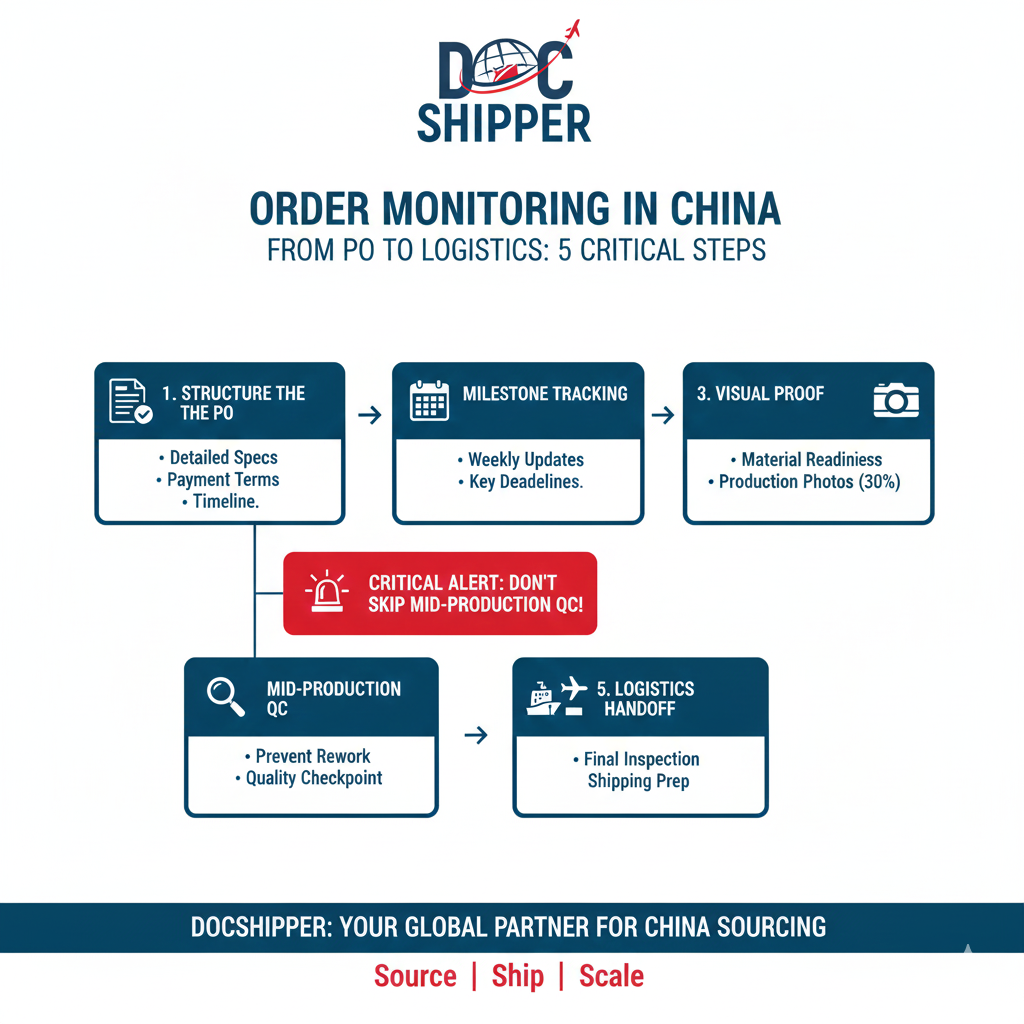
Use this simple workflow to structure your order management from day one.
- Confirm scope: final spec sheet, approved sample, packaging artwork, carton markings
- Lock documents: PO, contract, incoterms, payment terms, penalties for late delivery
- Set milestones: material readiness, first article, 30% in-process, pre-shipment inspection date
- Run change control: any modification requires written approval and re-confirmed lead time
- Pre-shipment readiness: packing list, commercial invoice, export documentation draft
- Logistics handoff: book with a logistics provider, confirm cargo insurance, align cut-offs
- Customs plan: HS code, customs broker instructions, taxes, labeling compliance
When we support clients at DocShipper, we treat this as one chain, not separate “factory” and “shipping” worlds. That mindset alone removes a lot of stress.
Key risks when you place orders from China without proper management
Want to know why so many orders from China derail even with “good suppliers”? Because the risks are operational, not emotional.
Without real purchase order management, your timeline becomes a guess, your quality becomes “factory standard”, and your costs creep up through rework, air freight, or surprise import duty and value-added tax.
The World Bank keeps pointing out how documentation quality and border processes impact delays, and you’ll feel that fast when your paperwork doesn’t match the cargo.
Here are the most common failure points we see when people try to manager orders in China with light follow-up.
- Spec drift: materials, colors, components, or tolerances changed “for availability”
- Hidden subcontracting: production moved to a different workshop without a factory audit
- Packaging mistakes: wrong carton strength, missing barcodes, non-compliant labeling
- Timeline illusion: supplier says “on time” until the final week, then asks for 10 more days
- Document mismatch: commercial invoice values, product description, or quantities don’t align with the packing list
- Incoterms confusion: you think it’s FOB China, they act like it’s Ex Works, so nobody books pickup
- HS code errors: bad HS code classification triggers delays or re-assessment
And yes, it often ends with you trying to track my product while the real issue was a production slip two weeks earlier.

How to set up your orders in China so factories can deliver what you expect
To manager orders in China without daily panic, you set the order up so the factory can’t misunderstand you, even if your main contact goes on holiday.
This is the moment most importers get stuck, they negotiate price hard, then leave the “boring” parts vague. Those boring parts are what protect your margin and your launch date.
Get the basics right, and your order products from china process becomes repeatable. Skip them, and you’ll spend your time chasing updates and fixing surprises in international logistics and customs clearance.
DocShipper Alert
DocShipper reviews your specs, MoQ and timelines before payment so factories deliver what you actually sold to your market.
Defining specs, MoQ, and timelines in your purchase order and contract
Tip: write your PO like you’re handing it to a stranger on their first day, because in many factories, that’s exactly what happens internally.
If you want to manager orders in China, your purchase order management must include measurable requirements, not “good quality” and “standard export packing”.
We’ve seen a buyer lose three weeks because “black” wasn’t defined, matte black vs. glossy black triggered a repaint cycle and the factory charged extra for rework. It sounded small until the port of loading cut-off passed.
Use this checklist to pressure-test your PO and contract before you send money.
- Product specs: dimensions, weight, materials, performance targets, tolerances, safety standards if any
- Quality criteria: AQL target, defect definitions, rework rules, inspection timing
- MOQ: per SKU, per color, and total, plus over/under shipment tolerance (for example ±2%)
- Production lead time: start date, milestone dates, final ready date, penalties or remedies
- Packaging: carton size/strength, inner packs, silica gel, labeling, carton marks
- Trade terms: incoterms (FOB China or CIF terms), cargo insurance, risk transfer point
- Payment terms: deposit, balance after pass inspection, letter of credit if relevant, or platform trade assurance
- Export documentation: required format for commercial invoice, packing list, and certificates if needed
Lock this down, and your supplier coordination becomes easier because you’re discussing facts, not opinions.
Looking for a Reliable Shipping & Sourcing Partner?
Communication rules, contact frequency, and what to check with new vs. regular suppliers
How often should you check in when you manager orders in China, daily, weekly, only at milestones?
The honest answer depends on whether you’re dealing with a new factory, a complex product, or a “routine” reorder that hides small risks.
We’ve watched buyers relax with a long-term supplier, then miss a raw material shortage that pushed production back ten days. One short mid-week check would’ve saved the week.
To make it easy, here’s a simple cadence you can copy, and adapt based on risk.
| Supplier type | Recommended check-in frequency | What you ask for each time |
| New supplier, new product | 2 to 3 times per week | Material arrival proof, production line photos, first article results, updated schedule |
| New supplier, simple product | Weekly plus milestone calls | Output quantity vs plan, packaging readiness, risk list, inspection booking status |
| Regular supplier, stable product | Weekly during production, then 2 days before ex-factory | Completion % by SKU, carton quantity, document draft check, pickup readiness |
| Peak season, any supplier | Every 2 to 3 days | Capacity conflicts, overtime plan, confirmed ex-factory date, logistics cut-offs |
Keep your messages structured, and don’t be shy about asking for proof. This is vendor management, not “being difficult”.
Also, align early on who handles what in logistics, your freight forwarding, their local trucking, who pays, and who controls the booking. Those small gaps are where disputes hide.
DocShipper Advice
DocShipper sets tailored check in cadences, templates and proof requests so your Chinese suppliers report real progress instead of vague “almost finished” messages.
How to track orders from China and get reliable production updates

Last month, we had a client trying to manager orders in China for custom packaging, and the factory kept saying “on track” every week until, suddenly, nothing was ready. You’ve probably lived this too, and from experience, the problem is rarely the delay itself, it’s the lack of real production visibility.
When you manage orders in China properly, you don’t wait for suppliers to volunteer updates, you build a rhythm. We’ve seen this approach recommended by supply chain analysts quoted in OECD manufacturing studies, because structured follow‑up changes supplier behavior fast.
Before you start chasing messages, here’s the exact follow‑up checklist we use internally to get reliable updates.
- Weekly update request: % completed, not “almost finished”
- Two timestamped photos: production line and finished units
- Raw material status: confirmed in stock or still incoming
- Next milestone date: packing start, not vague estimates
- Red flag note: any deviation, even minor
When suppliers know you will check every single item, the tone changes, and excuses disappear. That’s how you track orders from China without burning bridges or losing your sanity.

DocShipper Info
DocShipper centralizes factory updates, photos and timelines so you always know true status before you commit to bookings or launch dates.
How to manage quality control, photos/videos, and logistics before shipment
Here’s a direct tip we repeat daily when you manager orders in China: do not wait for finished goods to talk about quality. We once saw a buyer proudly receive videos of completed items, only to learn later the inner components failed basic ISO tolerance checks.
Quality control only works when it’s scheduled before logistics decisions, something the International Organization for Standardization consistently emphasizes in manufacturing guidelines. This is also where photos, videos, and shipping timelines must align.
To make this actionable, here’s how we compare control levels before authorizing shipment.
| Control level | What you receive | Risk if skipped |
| Basic | Final product photos only | Hidden defects inside packaging |
| Standard | Photos plus short production videos | Late discovery of assembly issues |
| Full | Inspection report, photos, videos, carton checks | Minimal surprise on arrival |
Once quality is validated, you lock logistics terms and booking, not before. At DocShipper, we step in here only when timelines, Incoterms, and inspection reports are aligned, otherwise shipping just amplifies mistakes.
DocShipper Alert
DocShipper coordinates inspection levels, photo and video checks and booking so only validated goods leave China.
Conclusion
So, how confident are you right now in your ability to manager orders in China without constant stress? If the answer feels shaky, that’s normal, this is where most importers hit a wall.
To close things out, here are the key takeaways you should keep in mind before your next production cycle.
- Tracking beats trust, structured updates prevent surprises
- Questions matter, vague check‑ins create vague results
- Quality starts mid‑production, not after completion
- Logistics comes last, once specs and inspections are locked
- Consistency wins, suppliers adapt to your process over time
When you apply these principles consistently, managing orders in China shifts from constant firefighting to controlled execution. And that’s when sourcing actually becomes scalable.
FAQ | Manager orders in China: how to control production, tracking and suppliers without losing your mind
Before there is a tracking number, you “track” production itself, not just shipping. Ask your supplier for:
- A simple production schedule showing:
- Material arrival date
- Production start date
- Assembly/packing dates
- Planned “ex‑factory” date
- Evidence at each milestone:
- Photos/videos of raw material and components on site
- Short videos of the line running with your product
- Count of finished units vs. total ordered
- Written status updates:
- “Today we finished X pcs out of Y”
- Any issues with machines, labor, or raw material
If the supplier can’t give you this minimum visibility, you should:
- Reduce order size or split into batches
- Consider using a third‑party inspection company to visit the factory and confirm real progress.
Once the goods are shipped, tracking depends on the shipping method:
- Courier (DHL, FedEx, UPS, TNT, etc.):
- Use the tracking number on the carrier’s website or app
- Enable email/SMS alerts for status changes
- Postal services (China Post, ePacket, EMS, etc.):
- Track on the postal website and/or aggregator tools like 17track.net or Parcelsapp
- Expect slower and less detailed updates
- Air/sea freight via a forwarder:
- Ask for: flight number or vessel name + bill of lading/air waybill number
- Track on airline/ship tracking sites (e.g. FlightRadar, MarineTraffic)
- Request from your forwarder a simple status sheet (ETA origin port, ETA destination port, customs status, delivery date)
In all cases, if the tracking doesn’t move for several days:
- Ask the supplier/forwarder for a screenshot from their internal system
- Confirm whether the delay is at customs, carrier hub, or last‑mile delivery.
Start by identifying where the delay occurs, then act in layers:
1) Pinpoint the bottleneck
- Ask: “Is the delay in production, export, shipping, or customs?”
- Request proof: updated photos, booking confirmation, or customs notice
2) Decide how critical the delay is
- Do you have a fixed launch date, promotion, or seasonal window?
- Can part of the order ship earlier?
3) Possible solutions
- Production delay:
- Negotiate overtime or prioritize your order
- Split shipment: small urgent quantity by air, rest by sea
- Shipping delay:
- Change to faster service for next orders (e.g. faster vessel, air freight)
- Ask the forwarder to rebook to an earlier sailing/flight if possible
- Customs delay:
- Provide missing documents immediately (certificates, test reports, invoices)
- Let a local customs broker handle communication
4) For future orders
- Add penalties or compensation clauses for late delivery in your contract
- Build a 1–2 week buffer into your own customer promises.
You reduce risk by making “wrong” almost impossible, both contractually and operationally:
- Before production:
- Approve a physical pre‑production sample and keep photos, measurements, and test results on file
- Send a detailed spec/technical sheet (materials, colors, tolerances, packaging, labeling)
- Confirm in writing: “Mass production must match the approved sample. Any change requires written approval.”
- During production:
- Ask for first‑article photos and videos (first units off the line)
- For higher‑value orders, hire a third‑party inspector for in‑process checks
- Before shipment:
- Conduct a pre‑shipment inspection (AQL) with an independent company
- Make final payment conditional on a “pass” inspection report
- Contractual protection:
- Include rework/replacement terms if goods don’t match specs
- Clarify responsibility and cost if a recall or re‑shipment is needed.
Photos/videos are useful, but they’re not enough on their own. Use them as part of a control stack:
- What photos/videos are genuinely helpful:
- Close‑ups of product details (logos, seams, connectors, finishes)
- Wide shots of the production line with date/time visible
- Cartons and packaging with clear labels and barcodes
- How to make them more reliable:
- Ask the supplier to show the day’s newspaper or a phone screen with date/time in the shot
- Request several angles and short continuous videos, not just polished photos
- Compare with your approved sample and spec sheet
- When you should not rely on them alone:
- High‑value orders, safety‑critical products, or complex electronics
- First orders with a new supplier
In those cases, combine photos/videos with a third‑party inspection before paying the balance.
Treat your suppliers like separate “projects” inside one simple system:
- Use a central tracking file or tool:
- One sheet per PO with: product, qty, price, lead time, milestones, inspection dates, shipping method
- Color codes (green/yellow/red) for status of each order
- Standardize communication:
- Same update template sent weekly: % complete, next milestone, risks, requested support
- Same file naming rules for invoices, packing lists, photos, and reports
- Separate roles and responsibilities:
- Who follows up on production?
- Who books and tracks shipments?
- Who validates documents and pays suppliers?
- Build redundancy:
- At least one backup supplier per critical product category
- Keep performance history (on‑time rate, defect rate, responsiveness) so you know who to prioritize for future orders.
Read more
Looking for more? Check out these articles.
- Top 5 Best Freight Forwarders from China to the USA
- How to start an import-export business from China to the US?
- The Ultimate Guide to Minimum Order Quantity (MOQ)
- The Top 10 Chinese Manufacturers of Car Speakers and Amplifiers
- Top 9 Chinese Websites for Online Shopping
- How to source for suppliers in China : Our full guide
Need Help with
Logistics or Sourcing ?
First, we secure the right products from the right suppliers at the right price by managing the sourcing process from start to finish. Then, we simplify your shipping experience - from pickup to final delivery - ensuring any product, anywhere, is delivered at highly competitive prices.
Fill the Form
Prefer email? Send us your inquiry, and we’ll get back to you as soon as possible.
Contact us