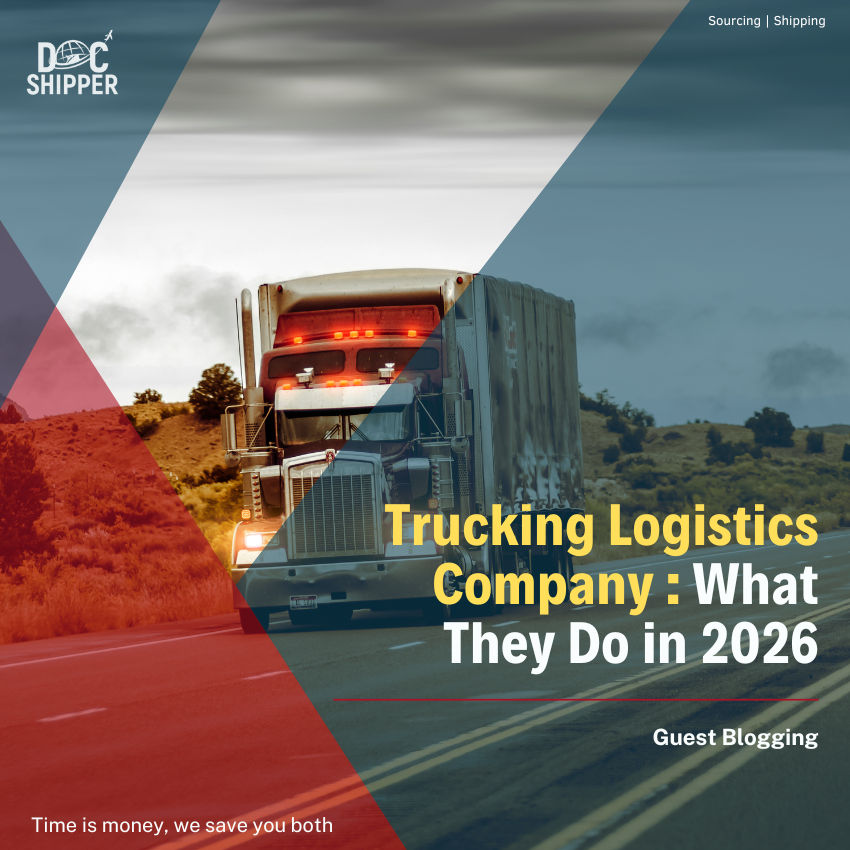
Trucking logistics company guide: how the right partner cuts costs and strengthens your supply chain

  • DocShipper Team 14 Min
  • Published on April 22, 2022 Updated on January 15, 2026
img

In short ⚡

Trucking logistics company services combine road freight execution with end-to-end planning, coordination, and visibility so your shipments move from pickup to proof of delivery without you chasing carriers. A trucking logistics company manages capacity planning, carrier selection, route optimization, documentation, compliance, and shipment tracking, often integrating warehousing, inventory management, cross‑docking, intermodal transport, and specialized equipment into one accountable system.

We hope you’ll find this article genuinely useful, but remember, if you ever feel lost at any step, whether it’s finding a supplier, validating quality, managing international shipping or customs,  DocShipper can handle it all for you!

Free shipping quote 24h      I want to talk to a sourcing expert

What is a trucking logistics company and how does it fit into your supply chain?

A trucking logistics company is the partner you use to plan, book, and control how your freight moves, from pickup to proof of delivery, without you chasing carriers all day.

You’re not only buying a truck, you’re buying supply chain management, capacity planning, dispatching, and visibility through tools like a transportation management system (TMS) and shipment tracking.

Here’s the thing, when your volumes grow, the real pain isn’t “shipping”, it’s the coordination, the carrier compliance, and all the small exceptions that blow up your schedule.

From experience at DocShipper, you’ll notice fast that the best logistics provider behaves like an extension of your operations team, managing freight transportation decisions, freight rates, documentation, and risk, not just moving pallets.

One quick reference point that helps frame the role, the World Bank consistently highlights logistics performance as a driver of national and company-level competitiveness, and you feel that directly when lead times and reliability decide your customer satisfaction.

DocShipper Info

Align your trucking, freight and logistics decisions with a single operations partner instead of chasing carriers.
DocShipper plans, books and controls your road freight so your team focuses on customers, not coordination.

Trucking vs. logistics vs. freight: key differences you must know

Last quarter, we supported a retailer who insisted they “only needed trucking”, until a missed appointment and a rejected delivery triggered storage charges and a second last-mile delivery attempt.

That’s when the difference becomes painfully clear, and why choosing the wrong scope costs you money.

Use this simple breakdown to keep your decisions clean:

TermWhat it really coversTypical tools and deliverablesWhere you feel it in operations
TruckingPhysical move by road, often truckload shipping or less-than-truckload (LTL)Dispatching, route optimization, hours-of-service (HOS) planning, ELD logsPickup windows, transit time, line haul, backhaul
FreightYour cargo plus the commercial move across modes, including intermodal transportTendering loads, carrier selection, freight ratesfreight audit and paymentCost control, claims, exceptions, carrier performance
LogisticsEnd-to-end flow, transport plus warehousing, inventory management, and coordinationDock scheduling, cross-docking, freight consolidation, SOPs and KPIsService level, stock availability, total landed cost

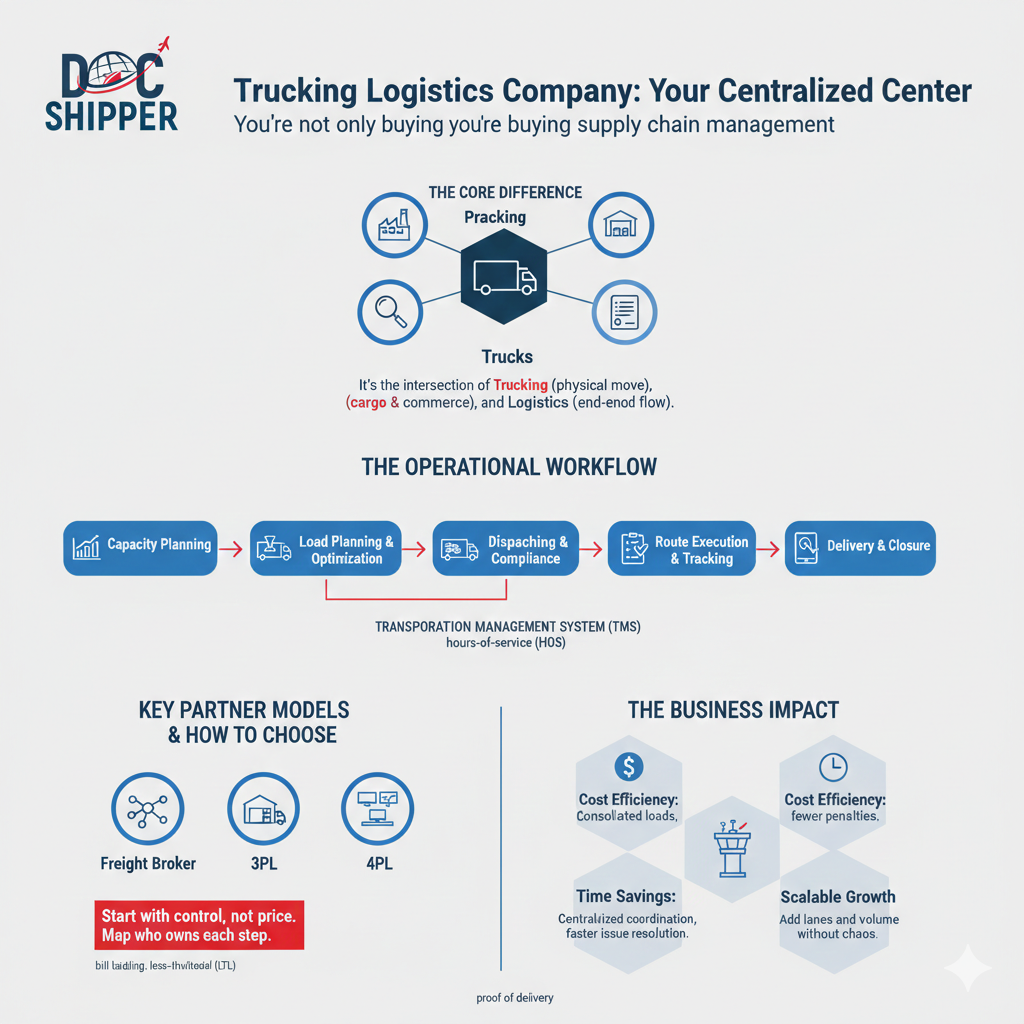
A trucking logistics company sits at the intersection, you get execution on the road plus the orchestration that avoids chaos upstream and downstream.

Types of logistics partners (freight broker, 3PL, 4PL, asset-based, non-asset)

Man and woman using tablet in warehouse

Tip: start by asking one question, do you need capacity, or do you need control over the whole flow?

In a trucking logistics company search, those two needs point you toward very different partner models, and mixing them up is how you end up paying premium rates for basic execution.

Here’s a quick map of the main options, so you can match the model to your reality:

  • Freight brokerage: you access a network of carriers fast, useful when you need coverage and competitive freight rates.
  • Third-party logistics (3PL): you outsource transport plus operations like warehousing, inventory management, and dock scheduling.
  • 4PL: you outsource orchestration, vendor coordination, and KPI governance, often running your TMS and procurement of carriers.
  • Asset-based: the provider owns trucks and sometimes facilities, helpful for dedicated fleet needs and tight service requirements.
  • Non-asset: the provider manages the plan and buys capacity, strong for flexibility, freight consolidation, and scaling into new lanes.

When we help you decide, we usually look at your lane volatility, your delivery penalties, and whether you need specialized moves like drayage from rail ramps or ports.

DocShipper Advice

Unsure which model fits your lanes and volatility, broker, 3PL or 4PL?
DocShipper audits your flows then designs the right mix so you pay for control where it matters, not unused capacity.

Core services you can expect from a modern trucking logistics company

A modern trucking logistics company doesn’t just “find a truck”, you get a repeatable operating system that protects lead time, cost, and compliance.

You’ve probably dealt with the classic mess, a driver shows up late, the warehouse refuses the load, paperwork is missing, and now you’re paying detention plus a reschedule.

We’ve seen that spiral happen when nobody owns the details, like load securing standards, appointment rules, or the right documentation at delivery.

That’s why the best partners combine fleet management, process discipline, and data, so your freight moves predictably across line haul and last-mile delivery.

For a shared frame of reference on what “good” looks like globally, ISO supply chain and quality management standards often influence how mature operators document, measure, and continuously improve logistics processes.

Operational essentials: planning routes, managing loads, paperwork and compliance

Man looking at computer and tablet

What most shippers underestimate is how much value sits in the “boring” layer, load planning, tendering loads, and staying clean on regulatory compliance.

A trucking logistics company earns its keep by turning those repeating tasks into a controlled workflow that reduces exceptions.

Here’s a practical workflow you can use to audit how your provider runs day-to-day execution:

Step-by-step execution workflow

  • 1) Capacity planning: forecast volumes, lane patterns, and required equipment (dry van, refrigerated trucking, flatbed).
  • 2) Load planning: build optimal loads, confirm weight distribution and load securing needs.
  • 3) Dispatching: assign carrier or dedicated fleet, book appointments, confirm dock scheduling.
  • 4) Route optimization: set route, buffers, and handoffs, including backhaul opportunities to reduce empty miles.
  • 5) Documentation: prepare the bill of lading, shipping labels, accessorial agreements, and special handling notes.
  • 6) Compliance checks: validate DOT-level requirements via carrier vetting, hours-of-service (HOS) rules, and electronic logging device (ELD) readiness.
  • 7) Delivery closure: capture proof of delivery, reconcile exceptions, and trigger freight audit and payment.

If you’re shipping regulated freight like hazardous materials (HAZMAT), this discipline matters even more, because one mistake becomes a claim, a fine, or a rejected load.
DocShipper Info

Want this kind of structured execution workflow without building a full in‑house team?
DocShipper standardizes planning, dispatch, and compliance so your loads move predictably and paperwork stops blocking trucks.

Value-added services: warehousing, tracking technology, specialized equipment and support

Bold truth: you don’t “need more trucks” when you’re scaling, you need more options, better visibility, and smarter nodes in your network.

A strong trucking logistics company supports that with value-added services that smooth peaks, reduce touches, and keep customers informed.

To pressure-test the extras that actually move the needle, use this quick checklist:

  • Shipment tracking tied to a TMS, with proactive exception alerts, not just a link you click when it’s already late.
  • Warehousing and inventory management for buffering demand spikes and reducing stockouts.
  • Cross-docking to cut storage time and speed throughput when you’re running time-sensitive replenishment.
  • Freight consolidation to turn multiple small shipments into fewer moves and better freight rates.
  • Intermodal transport support when rail makes sense on long lanes, plus drayage for terminal legs.
  • Specialized equipment like refrigerated trucking for temperature control or certified teams for HAZMAT.
  • Freight forwarding and customs clearance coordination when your road legs connect to international flows.

One real scenario we see a lot, you launch a new region, volumes are inconsistent, and your standard LTL plan starts missing retail delivery appointments.

When we design the fix with you, we often combine freight consolidation into scheduled line hauls, then controlled last-mile delivery from a short-term warehouse node, so service improves without locking you into long leases or rigid contracts.

trucking logistics company

Looking for a Reliable Shipping & Sourcing Partner?

We handle the entire sourcing process, supplier research, negotiation, production, and inspections, so you can focus on what matters most: growing your business.

Business benefits: how a trucking logistics company saves you money, time and risk

Last quarter, one of our clients watched a full truck sit idle for two days because a single form was filled wrong, and that moment sums up why a trucking logistics company changes your day‑to‑day reality. From experience, you’ll notice fast that once planning, compliance, and visibility sit with one partner, cost leaks disappear and delivery promises become predictable, not optimistic.

Here’s the thing, when routes are optimized and risks are flagged early, you’re no longer reacting to problems at 7 a.m. on a loading dock, you’re making decisions ahead of time, which is exactly what organizations like the World Economic Forum highlight as critical for supply chain resilience.

To make this concrete, here’s a quick checklist of where the real gains usually come from.

  • Cost efficiency through consolidated loads, negotiated carrier rates, and fewer penalty fees.
  • Time savings with centralized coordination, live tracking, and faster exception handling.
  • Risk reduction via compliance management, cargo insurance alignment, and incident response.
  • Scalability that lets you add lanes or volumes without rebuilding your internal team.
  • Visibility that replaces guesswork with real data, often the difference between calm growth and constant firefighting.

How to choose the right trucking logistics partner for your business

Here’s a direct tip: never start with price, start with control. When you compare a trucking logistics company, you should first look at who owns the process end‑to‑end, because weak responsibility lines are where delays and disputes hide, something the ICC Incoterms Committee often points out in freight liability discussions.

You’ve probably dealt with partners who promise flexibility but vanish when an issue hits customs or a cross‑dock, so let us explain what to compare side by side before you sign anything.

This table shows the differences you should check during your selection process.

Criteria Basic carrier Full trucking logistics partner
Route optimization Fixed lanes only Dynamic, data‑driven planning
Documentation & compliance Minimal support Managed end‑to‑end responsibility
Tracking & visibility Manual updates Real‑time dashboards and alerts
Problem resolution You chase answers Single accountable contact

At DocShipper, we’ve seen clients cut lost‑shipment disputes simply by switching to a partner model where accountability is crystal clear, and that alone often pays back the switch within months.

DocShipper Info

Before you compare quotes, map who truly owns each supply chain step.
DocShipper acts as your single accountable partner, from carrier sourcing to incident resolution, so you are never stuck mediating between vendors.

Conclusion

Is a trucking logistics company worth it for your supply chain? If you’re aiming for predictable costs, controlled risk, and room to grow, the answer with the right partner is almost always yes, especially as global trade frameworks monitored by the WTO keep raising compliance expectations.

Here are the key takeaways you should keep in mind as you move forward.

  • A trucking logistics company centralizes transport, compliance, and visibility into one accountable system.
  • You save money by reducing hidden costs, idle time, and contract inefficiencies.
  • You gain time because issues are anticipated, not discovered too late.
  • You limit risk with structured documentation, insurance alignment, and clear liability.
  • You unlock growth by scaling lanes, volumes, and markets without operational chaos.

FAQ | Trucking logistics company guide: how the right partner cuts costs and strengthens your supply chain

The same patterns come back again and again. Watch out for:

  • Starting with price instead of service level and accountability.
  • Not defining your “must have” lanes, delivery windows, and penalties before asking for quotes.
  • Ignoring tech integration (TMS, EDI/API, portals) and then discovering you’re stuck with emails and spreadsheets.
  • Assuming every provider can handle special needs (HAZMAT, temperature control, white‑glove, inside delivery).
  • Signing vague contracts with no clear KPIs (on‑time %, claim ratio, response times).
  • Depending on a single provider with no contingency plan for peak seasons or disruptions.

A good rule: define your top 5 operational risks (e.g., missed retail appointments) and verify explicitly how each candidate will handle them.

Ask us anything!

Need Help with
Logistics or Sourcing ?

First, we secure the right products from the right suppliers at the right price by managing the sourcing process from start to finish. Then, we simplify your shipping experience - from pickup to final delivery - ensuring any product, anywhere, is delivered at highly competitive prices.

Component-15.png

Live Chat

Get instant assistance from our team—just click and start chatting!

Live Chat Now
image

Fill the Form

Prefer email? Send us your inquiry, and we’ll get back to you as soon as possible.

Contact us
image
Component-15.png

Call us

Reach out to us on WhatsApp for quick, convenient, and personal support.

Call us
image
Component-15.png