

Supply chain trends in 2025: how to build a faster, smarter, more resilient network

  • DocShipper Team 40 Min
  • Published on July 6, 2021 Updated on January 6, 2026
img

In short ⚡

Supply chain trends in 2025 focus on building faster, smarter, more resilient networks by shifting from pure cost optimization to “total delivered performance” that balances cost, speed, and reliability. They emphasize real-time visibility, AI‑driven planning, regionalized sourcing, strategic partner ecosystems, embedded trade compliance, and ESG‑ready supply chains with traceable carbon, labor, and circularity data.

We hope you’ll find this article genuinely useful, but remember, if you ever feel lost at any step, whether it’s finding a supplier, validating quality, managing international shipping or customs,  DocShipper can handle it all for you!

Free shipping quote 24h      I want to talk to a sourcing expert

What the latest supply chain trends mean for you after years of disruption

The most important supply chain trends in 2025 aren’t “new toys”, they’re the practical changes you’re already feeling in procurement, freight forwarding, inventory optimization, and order fulfillment.

If you follow supply chain news or even supply chain logistics news today, you’ll notice the same pattern, faster decisions, more visibility, and less tolerance for surprise lead time swings.

Here’s the thing, post-Covid didn’t just disrupt flows, it rewired what “good” looks like in supply chain management, from just-in-time delivery to hybrid models that balance speed and risk mitigation.

We saw it on the ground with an EU importer who relied on a single Asian supplier and a single ocean lane.

One congestion spike turned their “stable” plan into weekly firefighting with split shipments, emergency air, and painful carrier contracting calls.

To make this easier to act on, here are the trends you should map directly to your operating playbook.

  • Visibility as a KPI, you can’t manage what you can’t see, so real-time tracking, milestone control, and electronic data interchange become baseline.
  • Resilience over pure cost, you’ll keep negotiating rates, but you’ll also fund buffers, alternate routing, and supplier diversification.
  • Strategy meets execution, demand planning and capacity planning must match actual warehouse and transport constraints.
  • Compliance gets operational, customs brokerage, trade compliance, and clear Incoterms choices start earlier, not at booking time.

DocShipper Info

Turn today’s trends into a resilient, high‑performing supply chain without adding headcount.
DocShipper centralizes procurement, freight, and fulfillment so your teams gain real‑time control instead of managing chaos in emails and spreadsheets.

From cost center to growth engine: how priorities shifted since covid

In 2021, we handled a shipment where the buyer negotiated an amazing unit price, then chose the wrong Incoterms.

They “saved” on sourcing, then paid it back twice in demurrage, failed purchase order management alignment, and rushed last-mile delivery.

Your supply chain trends takeaway is simple, you now win market share with service, not only with cost.

That means you treat logistics like a revenue lever, protecting service level agreement targets, improving route optimization, and tightening lead time reduction.

Use this quick comparison to pressure-test your current priorities.

Then (pre-2020 mindset) Now (2025 operating reality)
Lowest landed cost focus Total delivered performance, cost, speed, reliability
Just-in-time delivery everywhere Hybrid buffers, VMI, and smarter inventory optimization
Annual tenders, static routing Dynamic rate negotiation, lane risk scoring, multimodal transport
Warehouse as storage Warehouse automation and faster cross-docking
Limited returns planning Structured reverse logistics for omnichannel profitability

You’ve probably dealt with the modern version of this problem, your sales team promises 48 hours, while your inbound ETAs drift and your omnichannel fulfillment splits orders across nodes.

That gap is exactly where strategy now lives.

DocShipper Advice

Align commercial promises with operational reality using a end‑to‑end playbook.
DocShipper helps you redesign Incoterms, routing, and inventory rules so your service commitments match what your network can actually deliver.

The four forces behind today’s trends: digital, data, risk, and sustainability

Why do the same topics keep resurfacing in supply chain challenges news?

Because the four forces behind supply chain trends are reinforcing each other, and you feel them daily across planning, transport, and compliance.

We’ve seen teams invest in tools but miss the operating rules.

The result is dashboards that look great, while exceptions still get handled in email and spreadsheets.

To anchor your roadmap, focus on these four forces and what they change in operations.

  • Digital, your processes move into systems like a transport management system, WMS, and supplier portals.
  • Data, you build predictive analytics for demand forecasting, ETA risk, and capacity constraints.
  • Risk, you plan for disruption via nearshoring, reshoring, alternate carriers, and buffer logic.
  • Sustainability, you prepare sustainability reporting and carbon footprint tracking at shipment and supplier level.

One institution that keeps pushing this direction is the World Economic Forum, especially around resilience and transparency expectations in global trade networks.

You don’t need to agree with every framework to see the operational implication, your data must travel with the goods.

DocShipper Info

Struggling to turn “digital, data, risk, sustainability” into concrete actions?
DocShipper builds operational playbooks, from TMS and EDI flows to risk buffers and ESG documentation, so your data really travels with the goods.

Key technology trends that will redefine your planning, sourcing, and logistics

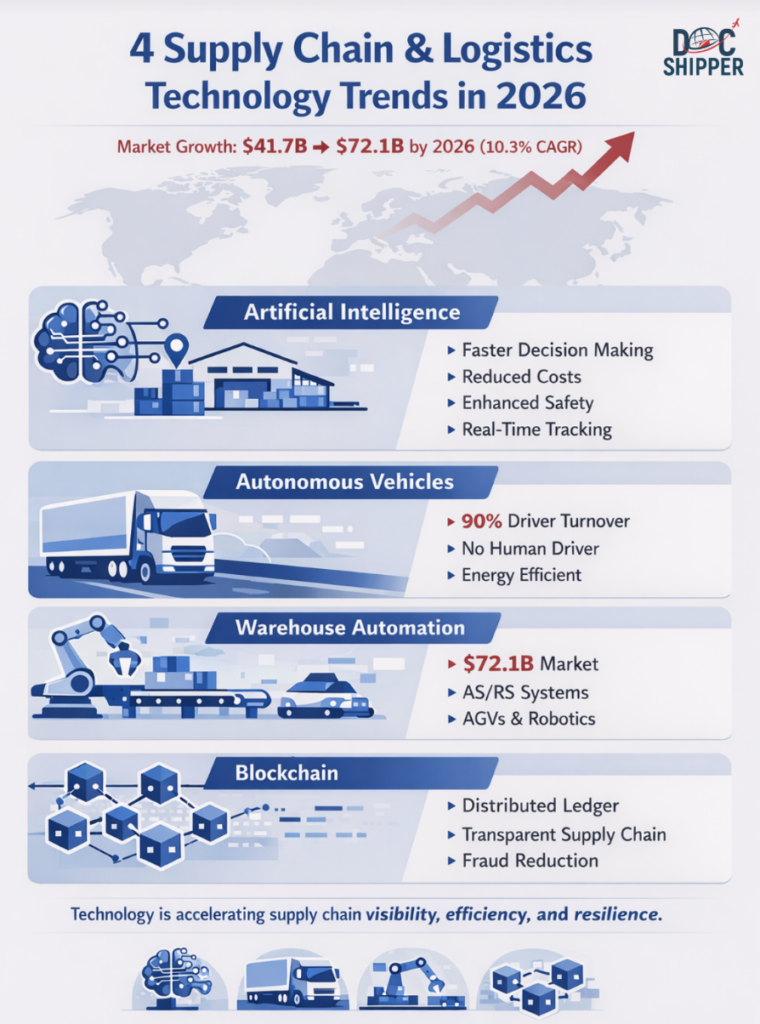
In 2025, the most useful supply chain trends in tech are the ones that tighten execution, not the ones that sound futuristic.

If you’re scanning supply chain news, you’ll see momentum around supply chain management technology, but the winners are using it to reduce exception time, improve freight consolidation, and protect OTIF.

We’ve watched importers roll out a new platform, only to realize their master data was messy.

SKUs didn’t match, supplier names duplicated, and nobody trusted the numbers, so planners went back to spreadsheets.

Let’s get concrete about what to deploy, and what to watch, so you can spend money where it moves the needle.

Looking for a Reliable Shipping & Sourcing Partner?

We handle the entire sourcing process, supplier research, negotiation, production, and inspections, so you can focus on what matters most: growing your business.

Practical AI, automation, and IoT use cases you can deploy now

Tip: start with one lane, one product family, and one measurable pain point, then scale.

That’s the fastest way to turn supply chain trends like AI and IoT into results you can explain to finance.

From experience, these use cases deliver value quickly because they target repeatable decisions.

They also fit real operations, cold chain monitoring, dock scheduling, and order fulfillment prioritization.

Here’s a simple workflow you can use to deploy “practical AI” without getting stuck in pilot mode.

  • Step 1: pick the decision, example, expedite or not, re-route or not, hold safety stock or not.
  • Step 2: define inputs you already have, TMS events, EDI messages, supplier lead times, sales forecast.
  • Step 3: set the action rule, who decides, within what SLA, and what’s the escalation path.
  • Step 4: run a 6 to 8 week test on one flow, track cost-to-serve and service level impact.
  • Step 5: standardize and scale, then renegotiate with carriers using better lane visibility.

When you do this well, you’ll also unlock genuine supply chain innovation.

You stop “discovering” issues late, and you start preventing them with earlier signals and automated responses.

To keep yourself honest, use this quick checklist before you buy sensors or launch automation.

  • Data readiness: SKU, supplier, and location master data is clean enough to trust.
  • Process ownership: one team owns exceptions and updates rules weekly.
  • Integration: your TMS, WMS, and ERP can exchange events via electronic data interchange or APIs.
  • Operational target: you can name the KPI, lead time, fill rate, detention, damage rate, or returns cycle time.
  • Compliance fit: devices and data handling won’t break customer or regulatory requirements.

DocShipper Advice

Before investing in AI, automation, or IoT, validate your roadmap with an expert.
DocShipper audits your master data, processes, and integrations, then pilots one lane so you get measurable wins in weeks, not years.

Cloud platforms, digital twins, and modern supply chain software to watch

Bold truth: tools won’t fix a broken operating model, but they will amplify a disciplined one.

That’s why these supply chain trends matter most when you connect planning, execution, and trade compliance into one loop.

You’ll hear a lot about supply chain software trends like control towers and digital twins.

The real win is when your planning assumptions match execution reality, down to customs brokerage holds, carrier cutoffs, and warehouse constraints.

We recently supported an importer who kept missing delivery promises because their “available inventory” ignored in-transit risk.

Once they centralized milestones and added exception rules, their customer service stopped guessing, and their warehouse stopped getting surprise surges.

Use this table to evaluate platforms without getting hypnotized by feature lists.

What you’re evaluating What “good” looks like in 2025
Cloud supply chain platform Fast integrations, shared data model, and role-based workflows for procurement, planning, and logistics
Digital twin Scenario testing for capacity, port disruption, multimodal transport switches, and cost-to-serve
Visibility and tracking Real-time tracking, exception management, and milestones aligned with Incoterms responsibilities
Blockchain traceability Targeted use on high-risk or regulated flows, proof of origin, and auditable chain-of-custody when needed
Trade compliance layer Classification support, document control, and guardrails for trade compliance and restricted party checks

For standards that often shape interoperability and data quality expectations, keep an eye on ISO guidance in logistics and supply chain management.

If your vendors can’t exchange events cleanly, your “visibility” ends up being a slide deck, not an operating system.

DocShipper Info

Choosing a new platform or control tower?
DocShipper helps you compare tools, model cost‑to‑serve scenarios, and design workflows so visibility, planning, and trade compliance finally operate as one connected loop.

How resilience, regionalization, and partner ecosystems reduce your risk exposure

Last year, during a late-night call, you might recall a supplier suddenly doubling lead times after a port lockdown, that moment made supply chain trends painfully real. From experience, you’ll notice fast that resilience now means spreading risk through regionalized sourcing and reliable partner ecosystems, not chasing the cheapest unit cost.

Here’s the thing, when you diversify production across regions and lock in logistics partners early, your exposure drops even if volumes fluctuate, a shift backed by data from World Economic Forum. We’ve helped clients rework Incoterms and supplier contracts so disruptions become manageable events instead of existential threats.

To make this tangible, here’s a quick comparison you can use when reassessing your network.

Centralized Global Sourcing Regionalized & Partner‑Led Model
Lower unit cost on paper Higher continuity during shocks
Long transit times, fragile lanes Shorter lead times, flexible routing
Transactional suppliers Strategic ecosystems with shared forecasts

DocShipper Alert

Relying on one region or a few transactional suppliers is a growing risk.
A single shock can erase years of savings, while orders stall.
DocShipper designs regionalized networks and partner ecosystems so disruptions become manageable, not existential.

Why sustainability, circularity, and ESG data are shaping future supply chains

Direct tip from the field, treat sustainability as an operational metric, not a marketing line, because supply chain trends now tie ESG data directly to sourcing approvals. You’ve probably dealt with suppliers who promise compliance verbally, then freeze when you ask for traceability documents.

We see regulations tightening fast, and frameworks referenced by OECD push you to prove carbon data, labor standards, and recycling flows at SKU level. This is where circular models and verified data streams stop being optional and start protecting your import rights.

Before you onboard or renew a supplier, run through this quick ESG readiness checklist.

  • Documented origin of raw materials and components.
  • Auditable emissions data for production and transport lanes.
  • Clear take‑back or recycling process for packaging or end‑of‑life goods.
  • Signed compliance with local labor and safety standards.

Conclusion

The next 3–5 years will reward supply chains built for reality, not theory. You might remember a shipment we handled where cleaner data and a backup supplier saved weeks at customs, proof that strategy shows up in daily operations.

To wrap this up clearly, here are the key takeaways you can act on immediately.

  • Resilience beats pure cost optimization in post‑Covid supply chain trends.
  • Regionalization and partner ecosystems cut disruption risk faster than renegotiating price.
  • Sustainability and ESG data now influence sourcing approvals and border clearance.
  • Operational visibility and verified data protect you when regulations tighten.

DocShipper Advice

ESG checks are no longer optional, they decide who you can buy from.
DocShipper structures your traceability, emissions data, and compliance evidence so suppliers pass audits and your shipments clear borders without costly surprises.

FAQ | Supply chain trends in 2025: how to build a faster, smarter, more resilient network

If you have limited time and budget, focus on the trends that materially change cost, risk, and service in the next 2–3 years:

  • **Network resilience vs. cheapest network**
  • Multi‑sourcing and regionalization instead of single mega-suppliers.
  • Backup ports, lanes, and Incoterms scenarios defined in advance.
  • **Decision automation, not just dashboards**
  • Rules and algorithms that decide when to expedite, reroute, or consolidate.
  • Clear guardrails: which decisions can be automated, which stay under human review.
  • **Embedded compliance**
  • Trade compliance, HS classification, and restricted party checks built into booking and onboarding workflows.
  • Standardized, digital documentation to cut border delays.
  • **Measurable sustainability**
  • CO₂ per lane and per SKU tracked and reported like a financial KPI.
  • Mode‑shift, consolidation, and packaging changes driven by hard data, not only marketing.

Use these four lenses as a quick filter: if a project doesn’t improve **resilience, automation, compliance, or sustainability**, park it for later.

Ask us anything!

Need Help with
Logistics or Sourcing ?

First, we secure the right products from the right suppliers at the right price by managing the sourcing process from start to finish. Then, we simplify your shipping experience - from pickup to final delivery - ensuring any product, anywhere, is delivered at highly competitive prices.

Component-15.png

Live Chat

Get instant assistance from our team—just click and start chatting!

Live Chat Now
image

Fill the Form

Prefer email? Send us your inquiry, and we’ll get back to you as soon as possible.

Contact us
image
Component-15.png

Call us

Reach out to us on WhatsApp for quick, convenient, and personal support.

Call us
image
Component-15.png