In short ⚡
Express Shipping from China (DHL, FedEx, UPS): Costs and When It Makes Sense depends on chargeable weight, carton dimensions, surcharges, customs charges and urgency. Express is generally best for light, urgent shipments, while consolidated air freight or LCL becomes more attractive as volume increases. The key cost and mode comparisons are:| Mode | Best for | Billing basis | When to consider it |
|---|---|---|---|
| Express courier | Samples, urgent parcels and light replenishment | Higher of actual and volumetric weight; commonly length × width × height ÷ 5,000 | When speed and door-to-door simplicity matter most |
| Consolidated air freight | Larger urgent shipments | Actual or volumetric weight; commonly using ÷ 6,000 | Once express becomes expensive at several dozen kilograms |
| LCL sea freight | Lower-urgency shipments | Measurement or weight, commonly assessed by W/M | Often around 1 to 2 CBM when delivery time is flexible |
| Express additional charges | Customs and delivery-related services | Fuel, remote-area, oversize, brokerage, disbursement and other applicable fees | Include these charges when comparing the complete landed cost |
This guide covers how express shipping works, chargeable and volumetric weight, duties and brokerage, restricted goods, express versus air and sea freight, and ways to reduce shipping costs.
We hope you’ll find this article genuinely useful, but remember, if you ever feel lost at any step, whether it’s finding a supplier, validating quality, managing international shipping or customs, DocShipper can handle it all for you!
Express shipping from China is usually the fastest door-to-door option for light, urgent shipments. DHL Express, FedEx and UPS collect the parcel from your supplier, transport it through their international network, clear it at destination and deliver it to you or your customer.
The trade-off is that express couriers charge for volume as well as weight. Duties, taxes and brokerage may also be invoiced on arrival, so a low supplier quote does not necessarily represent your landed cost.
DocShipper Alert
Check duties, taxes and brokerage before booking
How express shipping from China works
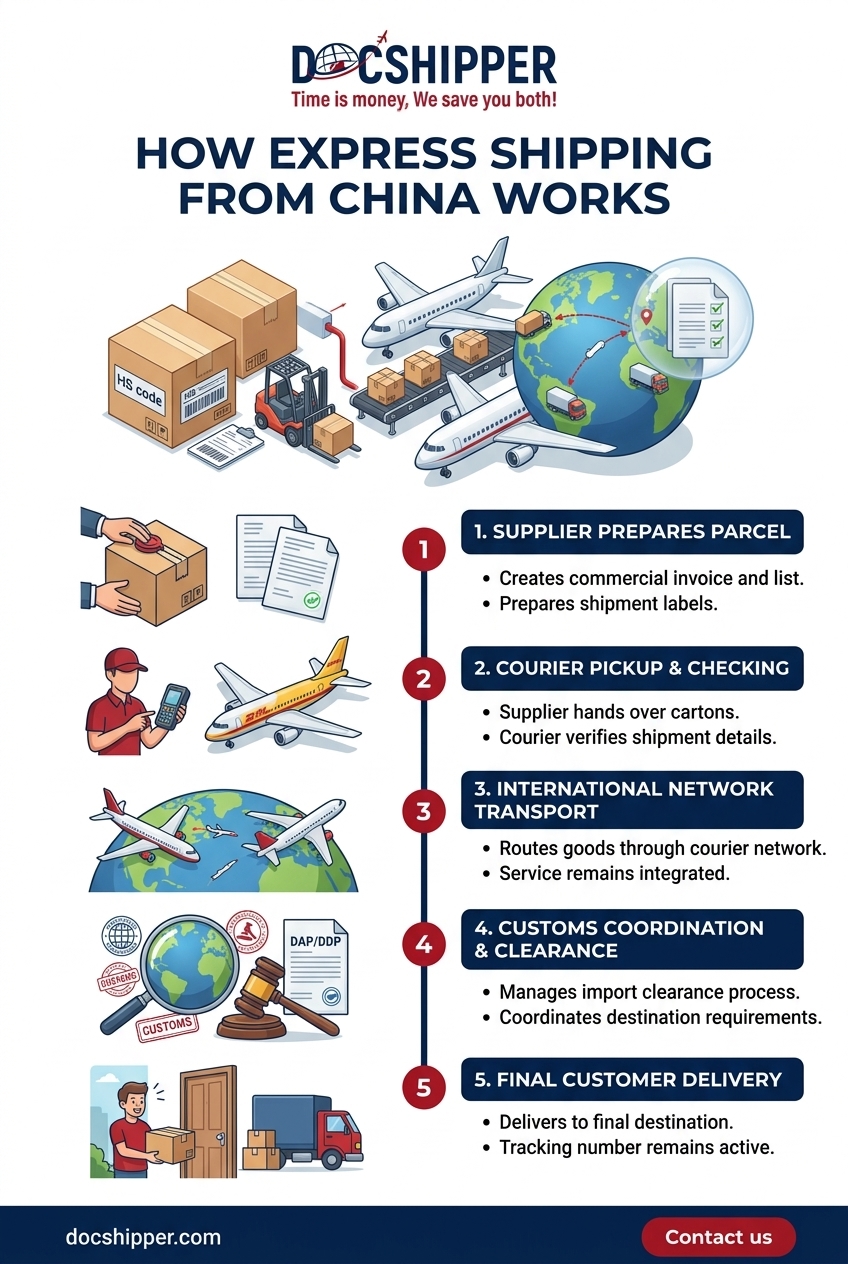
Express courier shipping is an integrated service rather than a simple airport-to-airport movement. The courier manages pickup, export handling, international transport, customs coordination and final delivery under one tracking number.
For a small importer, the process generally starts when the supplier prepares the commercial invoice, packing list and shipment label. DHL Express, FedEx or UPS then collects the cartons, checks the shipment details and routes the goods through its network. SF Express and EMS may also be available, depending on the origin, destination and product.
You can ship through your own courier account or use the supplier’s account. A supplier account may provide a competitive rate, but you still need to confirm who is responsible for the invoice, customs information, duties and any later adjustment. Ask for the account holder, billing party and Incoterm in writing before the parcel leaves China.
Most express shipments are arranged under either DAP or DDP. DAP means the seller or shipper delivers to the destination, while the importer generally remains responsible for import clearance, duties and taxes. DDP means the seller or logistics provider includes delivery and import charges, although you should confirm who acts as importer of record and whether the quote genuinely includes every customs cost.
Before booking, send the courier or forwarder the product description, HS code if available, commercial value, country of origin, carton dimensions, gross weight and consignee tax information. Incomplete or inconsistent data can delay clearance even when the physical transport is fast.
| Party | Typical responsibility |
| Supplier | Packaging, documents and handover to the courier |
| Courier | Pickup, international transport, customs coordination and delivery |
| Importer | Accurate product data, customs compliance and payment of charges under DAP |
| Seller or forwarder under DDP | Delivery and import charges, subject to the agreed scope and importer-of-record arrangement |
DocShipper Info
Prepare complete product and consignee details to avoid clearance delays
How express is priced: chargeable weight
Express couriers normally bill the higher of actual weight and volumetric weight. The express formula is length × width × height in centimetres, divided by 5,000, with fuel, remote-area, oversize and other applicable surcharges added separately.
Volumetric weight, also called dimensional weight, converts the space occupied by a carton into a billable weight. It matters when goods are light but bulky, such as packaging, clothing, plastic articles or certain household products.
Consider one carton measuring 50 × 40 × 40 cm and weighing 9 kg:
- Calculate the carton volume: 50 × 40 × 40 = 80,000 cm³.
- Calculate express volumetric weight: 80,000 ÷ 5,000 = 16 kg.
- Compare the two figures: actual weight is 9 kg and volumetric weight is 16 kg.
- Use the higher figure: the express chargeable weight is 16 kg.
- For air cargo, use the 6,000 divisor: 80,000 ÷ 6,000 = 13.3 kg.
- The same carton therefore represents 16 kg by express against 13.3 kg by air cargo.
These divisors correspond to 200 kg/m³ by express and approximately 167 kg/m³ by air cargo. The figures are reported by GetTransport, dated 16 July 2026. The express method makes bulky cartons relatively more expensive than compact, dense goods.
Do not compare quotes using kilograms alone. Ask whether the quote includes fuel surcharge, pickup, residential delivery, remote-area fees, address correction, peak-season charges, customs disbursement and brokerage. Also confirm the rounding rules and whether each carton is rated individually.
| Calculation | Result for the example |
| Carton dimensions | 50 × 40 × 40 cm |
| Actual weight | 9 kg |
| Express volumetric weight | 80,000 ÷ 5,000 = 16 kg |
| Air cargo volumetric weight | 80,000 ÷ 6,000 = 13.3 kg |
| Express chargeable weight | 16 kg, because it is higher than 9 kg |
DocShipper Tips
Review rounding rules and carton ratings before choosing your service
Looking for a Reliable Shipping & Sourcing Partner?


Duties, taxes and brokerage on arrival
Express shipments are generally cleared by the courier, which may advance duties and taxes before invoicing the receiver. Under a DAP arrangement, the recipient can therefore receive a customs or disbursement invoice in addition to the transport charge. Under DDP, the agreed seller or logistics provider should manage these costs, but you must verify the quote and importer-of-record arrangement.
A brokerage fee covers customs-related work performed by the courier or its broker. A disbursement fee may apply when the courier pays government charges on your behalf before delivery. Carrier fees vary by destination, service and account, so verify them on the relevant DHL, FedEx or UPS page when booking.
The importer of record is the party legally responsible for the accuracy of the customs declaration, applicable duties and compliance with import rules. If you sell through Amazon or Shopify, do not assume that the marketplace automatically becomes the importer. Confirm the consignee, tax identification requirements and delivery terms before shipping.
Low-value rules also need to be checked by destination. The United States suspended duty-free de minimis treatment for shipments from all countries on 29 August 2025. According to KPMG’s TaxNewsFlash, shipments valued at USD 800 or less require a formal entry type in the Automated Commercial Environment.
For the European Union, a flat customs duty of EUR 3 per item, calculated per tariff line rather than per parcel, applies to items valued at EUR 150 or less from 1 July 2026 until July 2028, according to VATCalc. This does not replace the need to check VAT, product-specific duties, customs declarations and carrier charges.
| Question | What to verify |
| Who pays duties? | The DAP or DDP term and the party named as importer of record |
| Who pays taxes? | Destination VAT or sales-tax rules and the agreed billing arrangement |
| Who clears the goods? | The courier, its broker or another customs representative |
| Are low-value exemptions available? | Current rules in the destination country, not only the parcel value |
| Could extra fees apply? | Brokerage, disbursement, storage, inspection or address-related charges |
DocShipper Alert
Verify VAT, duties and carrier fees for your destination before shipping
Restricted goods: batteries, liquids and magnets
Lithium batteries, liquids, powders, magnets, cosmetics and other sensitive goods may require carrier approval or may be refused by a particular express service. Acceptance depends on the product, packaging, quantity, destination, transport mode and supporting documents.
For lithium products, request the battery classification before booking. Common documents can include a Safety Data Sheet, UN38.3 test summary, battery specifications, product photographs and packing instructions. The relevant classifications may include UN 3480 for lithium-ion batteries shipped alone and UN 3481 for batteries packed with or contained in equipment.
From 1 January 2026, under the IATA Dangerous Goods Regulations 67th edition, lithium-ion cells and batteries packed with equipment above 2.7 Wh must be shipped by air at a state of charge of no more than 30%, or at an indicated capacity of no more than 25%. The rule is reported by Lion Technology. Batteries shipped alone were already subject to a state-of-charge limit.
- Send the exact product description and battery details to the carrier before purchasing the label.
- Provide the MSDS, UN38.3 documentation and photographs if requested.
- Confirm whether the shipment is packed with equipment, contained in equipment or shipped alone.
- Check the required state of charge, marks, labels and outer packaging.
- Obtain written acceptance before the supplier hands the shipment to DHL, FedEx or UPS.
Never describe a restricted product vaguely as “accessories” or “electronic goods”. An inaccurate declaration can cause a refusal, return, storage charge or customs problem. If express acceptance is unavailable, compare approved air cargo, sea freight or a specialist dangerous-goods service instead.
Why Choose DocShipper
Lower risk, transparent pricing, and a single point of contact from pickup to delivery.
-
One single point of contactA dedicated consultant coordinating every step and keeping you informed.
-
9,200+ operations / 6,000+ clientsProven processes on China ↔ EU/US lanes (FCL, LCL, air, road, rail).
-
No hidden feesTransparent quotes and document guidance to avoid surprises.
Express vs air freight vs sea: when to switch
Express is best for samples, urgent replenishment and light parcels where delivery speed and door-to-door simplicity matter more than the lowest transport cost. Consolidated air freight usually becomes more attractive as weight and volume grow, while LCL sea freight is suitable when the shipment can tolerate a longer transit process.
There is no universal kilogram threshold because the decision depends on carton dimensions, destination, service level, customs scope and urgency. As a practical decision rule, compare express with consolidated air once the shipment reaches several dozen kilograms, then validate the exact break-even point with a quote. For sea freight, the brief indicates that LCL often becomes relevant around 1 to 2 CBM when time allows.
Air cargo uses a 6,000 volumetric divisor, compared with 5,000 for express. LCL is commonly assessed by measurement or weight, with the cited reference using 1 CBM equal to 1,000 kg and a 1 W/M minimum. These are different billing bases, so a comparison must use the complete shipment dimensions rather than a supplier’s quoted “shipping per kilo”.
For a broader air-cargo cost comparison, consult the existing air freight cost guide. For sea shipments, compare the operational differences between FCL and LCL before selecting a mode.
| Mode | Best for | Billing basis | Customs handling |
| Express courier | Samples, urgent parcels and light replenishment | Higher of actual and volumetric weight, commonly using ÷ 5,000 | Courier-led clearance, with duties and brokerage potentially billed to the receiver |
| Consolidated air freight | Larger urgent shipments where express volume pricing is too high | Actual or volumetric weight, commonly using ÷ 6,000 for air cargo | Forwarder or broker coordination, depending on the service |
| LCL sea freight | Lower-urgency shipments with enough volume to justify consolidation | Measurement or weight, commonly assessed by W/M | Forwarder and destination broker coordination |
How to pay less for express
The most effective saving is often packaging rather than carrier negotiation. Ask the supplier to remove unnecessary outer cartons, reduce empty space and keep cartons within standard dimensions, provided the goods remain protected.
Consolidate purchases from several suppliers before dispatch when the deadline allows. One correctly packed shipment can be easier to compare and clear than several small parcels, although the consolidation handling charge and additional warehouse time must be included in the calculation.
- Request the actual and dimensional weight for every carton.
- Recalculate express chargeable weight using length × width × height ÷ 5,000.
- Ask for a complete quote showing fuel, remote-area, oversize, pickup and customs-related charges.
- Compare the supplier’s account rate with your own DHL, FedEx or UPS account rate.
- Check whether air consolidation is cheaper once the shipment reaches several dozen kilograms.
- Compare LCL when the shipment approaches the 1 to 2 CBM range and the deadline is flexible.
- Confirm DAP or DDP, importer of record, duties, taxes and brokerage before approving the shipment.
Do not choose a carrier solely because its base transport line is lower. A quote with a higher line-haul price can be cheaper overall if it uses a better volumetric calculation, includes pickup and has clearer customs billing.
Send a comparison request with the origin city, destination postcode, product description, HS code if known, carton count, dimensions, gross weight, commercial value, deadline and battery or liquid information. That data allows express, consolidated air and LCL options to be compared on the same basis.
Conclusion
Express shipping from China is valuable when the shipment is light, urgent and operational simplicity matters. It becomes less attractive when cartons are bulky, the shipment grows beyond several dozen kilograms or customs charges make the apparent courier rate misleading.
- Express is the fastest door-to-door option for light, urgent parcels.
- Couriers charge volume at 200 kg/m³, using a 5,000 volumetric divisor.
- Budget duties, taxes, brokerage and disbursement charges before booking.
- Check lithium battery, liquid, powder and magnet restrictions in advance.
- Compare consolidated air freight as volume grows and LCL when the shipment reaches the relevant sea-freight range.
Not sure whether express is the right choice? Send us your shipment weight, dimensions, destination and deadline. We will compare express, air freight and LCL options and help coordinate customs on arrival.
FAQ | Express Shipping from China: Costs, Duties and When to Switch Modes
No. Even a free sample must have a reasonable customs value because duties, taxes and import controls are generally based on the goods’ value. Marking the shipment as “no commercial value” or using an artificially low value can trigger a customs query, reassessment, penalty or shipment delay. Use wording such as “commercial sample” only when accurate, and show the actual unit value, quantity and intended use.
First, check the courier’s tracking notice to identify the missing information or charge. Customs may request a corrected commercial invoice, proof of payment, an importer tax number, an import permit or a clearer product description. Respond quickly and keep the invoice, packing list, purchase order and payment record consistent. If the shipment is not cleared within the carrier’s free period, storage, handling or return charges may apply.
Not necessarily. Courier liability is often limited by the carrier’s conditions and may not cover the full commercial value, certain product categories or indirect losses. For expensive or fragile goods, ask whether the quote includes declared-value protection or arrange separate cargo insurance before pickup. Keep photographs of the packaging and goods, and report visible damage immediately with the delivery receipt marked accordingly.
Express transport does not remove destination-country product requirements. Products such as cosmetics, food supplements, medical devices, telecom equipment and certain chemicals may require registration, labelling or an import permit even when the parcel is small. Confirm the requirements with the destination customs authority or a licensed broker before dispatch. If approval is required, provide the licence details to the courier in advance rather than waiting for customs to request them.
Residential delivery is usually possible, but it may involve an additional fee, delivery appointment or stricter recipient identification. PO boxes are often unsuitable because couriers may require a physical address and signature. Provide the recipient’s full name, phone number, company name where applicable and a complete street address. Also check whether the destination is classified as a remote area before comparing quotes.
The shipping party may remain responsible for return transport, storage, duties, brokerage and disposal charges, depending on the courier account and agreed Incoterm. DDP does not automatically eliminate every cost if the shipment is misdeclared, prohibited or rejected by the recipient. Before dispatch, confirm the courier’s abandoned-shipment policy, verify the recipient’s willingness to import the goods and make sure the product description and customs documents are accurate.
Need Help with
Logistics or Sourcing ?
First, we secure the right products from the right suppliers at the right price by managing the sourcing process from start to finish. Then, we simplify your shipping experience - from pickup to final delivery - ensuring any product, anywhere, is delivered at highly competitive prices.


Fill the Form
Prefer email? Send us your inquiry, and we’ll get back to you as soon as possible.
Contact us