In short ⚡
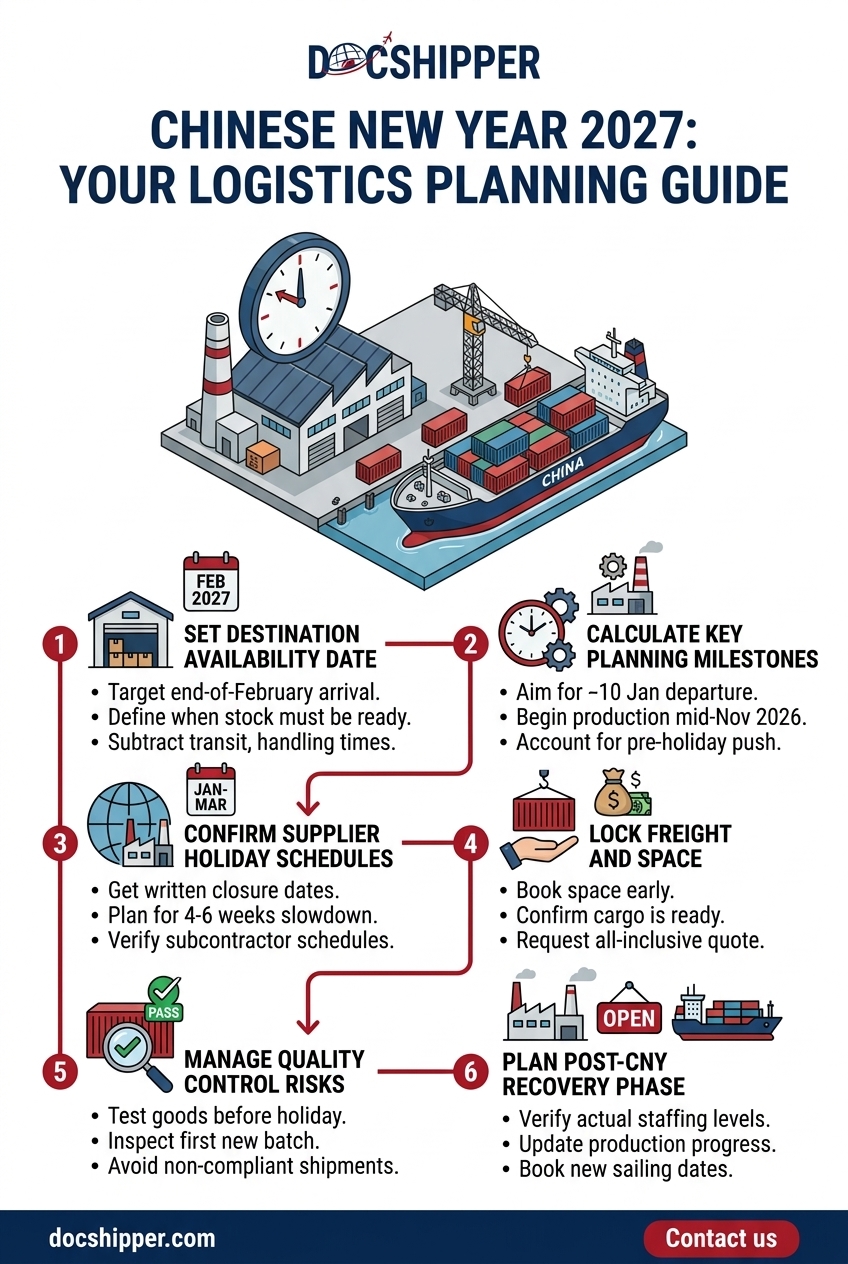
Chinese New Year Shipping: How to Plan Orders and Freight Around the Holiday by working backward from your required arrival date. For end-of-February 2027 inventory in a US or EU warehouse, target departure from China around 10 January and production from mid-November 2026. Use these planning steps:- Confirm each supplier’s final order, production, dispatch and restart dates, including subcontractors and packaging suppliers.
- Work backward from the required arrival date through delivery, customs, transit, departure, inspection, production and order placement.
- Book sea freight once the production date is credible, and check alternative sailings, equipment availability and peak-season rate pressure.
- Separate urgent and deferrable units, using air or rail for urgent stock and sea freight for the balance when appropriate.
- Inspect the final pre-holiday batch and the first post-holiday batch using the approved specifications, packaging requirements and golden sample.
- After the holiday, reconfirm staffing, materials, production progress, backlog and realistic cargo-ready dates before committing to sales or customer deliveries.
Key planning considerations include the 2027 holiday dates and 4-to-6-week factory slowdown, backward scheduling, freight booking and rates, air or rail alternatives, quality inspections, and post-holiday restart and backlog management.
We hope you’ll find this article genuinely useful, but remember, if you ever feel lost at any step, whether it’s finding a supplier, validating quality, managing international shipping or customs, DocShipper can handle it all for you!
Chinese New Year shipping requires more than avoiding an eight-day public holiday. Chinese factories often reduce production or close for 4 to 6 weeks around the holiday, while export volumes, freight demand and quality risks increase before and after the break.
The safest approach is to work backward from the date your stock must arrive. For inventory needed in a US or EU warehouse by the end of February 2027, plan for departure from China around 10 January 2027 and production starting by mid-November 2026.
DocShipper Info
Build production, inspection and freight milestones around the full 4 to 6-week disruption.
When is Chinese New Year 2027 and how long do factories stop?
Chinese New Year 2027 falls on 6 February, with the official holiday scheduled from 5 to 12 February. However, factories usually slow down or stop for 4 to 6 weeks from late January to early March because employees travel home and some return late or do not return.
The official calendar is therefore only the starting point for your CNY production schedule. The Lantern Festival falls on 20 February 2027, but production and logistics may still be recovering after that date. Confirm your supplier’s exact closure and restart dates in writing rather than relying on the national holiday alone.
Ask each factory for four dates: the final date for receiving orders, the final production date, the last dispatch date before closure and the expected date for normal production to resume. You should also ask whether key subcontractors, packaging suppliers and quality-control teams follow the same schedule.
The official dates should be checked against the State Council General Office notice when it is published. The 2027 dates cited here are reported by NewBuyingAgent, dated 30 May 2026, and remain subject to confirmation through the official notice.
| Milestone | 2027 date or planning point | What to do |
| Chinese New Year | 6 February 2027 | Do not treat this as the only closure date. |
| Official holiday | 5 to 12 February 2027 | Confirm the factory’s actual operating calendar. |
| Lantern Festival | 20 February 2027 | Expect recovery and backlog risk to continue. |
| Practical slowdown | Approximately 4 to 6 weeks | Build this period into production and freight planning. |
DocShipper Tips
Share your target date with a logistics expert before committing to suppliers.
Work backward from your arrival date
To have goods in a US or EU warehouse by the end of February 2027, they should leave China around 10 January 2027, which means production should start by mid-November 2026. Your actual order date must be earlier if the product has a long lead time, custom packaging or several production stages.
Start with the date the inventory must be available for sale, not the date you want the container to depart. Subtract the realistic transit time for your destination, port handling, customs clearance, final delivery and a contingency buffer. Our guide to sea freight transit times from China can help you establish the transport part of this calculation.
Then subtract production, pre-shipment inspection, packing and export preparation. If your supplier cannot confirm a production completion date early enough to meet the departure target, do not wait for the problem to resolve itself. Reduce the initial quantity, consolidate finished goods from several suppliers, or reserve air or rail capacity for the urgent part.
The table below gives a practical anchor for end-of-February availability. The 10 January departure point is the brief’s planning assumption for US or EU warehouse stock, not a universal port cut-off. The final date depends on the origin, destination, mode, sailing schedule and customs requirements.
| Destination or mode | Target arrival | Planning departure | Production and order action |
| US warehouse, sea freight | End of February 2027 | About 10 January 2027 | Start production by mid-November 2026; confirm the lane transit time. |
| EU warehouse, sea freight | End of February 2027 | About 10 January 2027 | Start production by mid-November 2026; add customs and inland delivery time. |
| Urgent US or EU inventory, air freight | End of February 2027 | Calculate from the confirmed flight and delivery schedule | Reserve only the urgent quantity after comparing chargeable weight and cost. |
| US or EU inventory, rail freight | End of February 2027 | Calculate from the confirmed rail schedule | Use rail as an intermediate option when sea is too slow and air is unsuitable. |
For example, the complete known planning chain is: end-February 2027 warehouse availability, departure from China around 10 January 2027, production starting by mid-November 2026, and order placement early enough to support that production start. Do not turn these dates into a supplier promise until the factory and forwarder confirm them.
Looking for a Reliable Shipping & Sourcing Partner?


Book freight early: space and rates before the holiday
Exporters rush to ship before Chinese New Year, so vessel space can tighten and freight rates can rise during the 4 to 6 weeks before the holiday. Book as soon as the production completion date is credible, while keeping the booking aligned with the factory’s actual cargo-ready date.
Ask your forwarder to check the departure port, alternative sailing dates, equipment availability, transshipment risk and destination delivery schedule. A booking made before the goods are ready is useful only if the supplier can meet the cargo cut-off. Confirm cargo-ready status, packing completion and inspection timing before locking the final shipment plan.
Use a dated market reference rather than assuming that one quote represents the whole season. For example, the Freightos Baltic Index data reported by sourcing.center for week 40 of 2026 showed China and East Asia rates of USD 8,319 per FEU to the US West Coast, USD 9,606 per FEU to the US East Coast, USD 3,260 per FEU to North Europe and USD 3,555 per FEU to the Mediterranean.
These figures are historical reference points, not a quotation for Chinese New Year 2027. The data was published on 7 October 2026 by sourcing.center using Freightos Baltic Index data. Request a current offer and ask whether it includes origin charges, destination charges, customs, delivery, insurance and possible peak-season surcharges.
| China and East Asia lane | FBX week 40, 2026 |
| US West Coast | USD 8,319 per FEU |
| US East Coast | USD 9,606 per FEU |
| North Europe | USD 3,260 per FEU |
| Mediterranean | USD 3,555 per FEU |
Air, rail or split shipments as a plan B
If production slips, ship the most urgent part by air or rail and move the balance by sea after the holiday. This protects your best-selling stock without automatically paying an express price for the entire order.
First, separate the order into essential and deferrable units. Essential units may include fast-moving SKUs, promotional stock or components that would stop your sales if unavailable. Keep the remaining units in the sea shipment if their later arrival will not create a stock-out.
Compare modes using chargeable weight, which is the weight used to price cargo when its volume is greater than its actual scale weight. The reference divisors reported by GetTransport are 5,000 cubic centimetres per kilogram for express couriers, 6,000 cubic centimetres per kilogram for IATA air cargo, and 1,000 kilograms per cubic metre for LCL, with a 1 W/M minimum.
For instance, do not compare an air quote based only on kilograms with an LCL quote based on cubic metres. Measure the packed cartons, calculate the applicable chargeable weight, then compare the urgent quantity across air freight, rail freight and sea freight. The volumetric references come from GetTransport, dated 16 July 2026.
When several suppliers have partial quantities ready, consolidation can reduce fragmented shipments and simplify control. Coordinate collection, carton labelling and inspection before combining cargo through a consolidated China shipment.
Quality risk around the holiday
Rushed pre-holiday production and new workers after the holiday increase the risk of defects. Schedule a pre-shipment inspection for goods made immediately before the closure and repeat the inspection for the first production batch after the restart.
Send the inspector the approved specification, purchase order, packaging requirements and golden sample. A golden sample is the agreed physical reference for appearance, dimensions, materials, labelling and workmanship. It gives the inspection team something precise to compare against instead of relying on a general description.
Ask the factory to confirm which production batch is being inspected and whether any subcontractor or replacement material is involved. Check quantities, carton marks, product function, finish, packaging and loading condition before release. If the first post-CNY batch fails, correct it before the factory builds the full replenishment order.
Do not remove quality control simply because the vessel is approaching its cut-off. A late inspection can delay departure, but shipping non-compliant goods can create a larger delay through returns, rework, customer complaints or customs problems.
Why Choose DocShipper
Lower risk, transparent pricing, and a single point of contact from pickup to delivery.
-
One single point of contactA dedicated consultant coordinating every step and keeping you informed.
-
9,200+ operations / 6,000+ clientsProven processes on China ↔ EU/US lanes (FCL, LCL, air, road, rail).
-
No hidden feesTransparent quotes and document guidance to avoid surprises.
After the holiday: restart and backlog
Factories reopen gradually, and ports, trucking networks and suppliers may take several weeks to clear the backlog. Confirm staff levels, material availability and revised ship dates before committing to February or March sales.
Contact the supplier before the expected restart and request a written update. Confirm the date production resumes, the number of workers available, the status of raw materials, the first batch to be completed and the date cargo can realistically be collected.
Also check your forwarder’s post-holiday plan with the relevant origin port and carrier. Port authorities, trucking providers and warehouses may face concentrated demand even when the factory has reopened. Ask for the next available sailing rather than assuming that the first planned departure remains valid.
Do not use a supplier’s reopening date as your inventory availability date. Reopening means that work has started, not that your order is complete, inspected, exported and delivered. Update your sales forecast and customer promises only after the production and freight milestones are reconfirmed.
DocShipper Tips
Use this checklist to coordinate suppliers, inspections, freight and safety stock before Chinese New Year.
Your Chinese New Year checklist
Confirm the factory’s closure dates in writing, place orders early, reserve freight, schedule inspections, protect safety stock and agree on post-holiday priorities. Use the following sequence to turn the calendar into an operating plan.
- Set the date when stock must be available in your warehouse or sales channel.
- Work backward through delivery, customs, transit, departure, inspection, production and order placement.
- Ask every supplier for final order, production, dispatch and restart dates.
- Confirm the target departure with your forwarder and request alternative sailings.
- Reserve sea freight once the production date is credible, then review air or rail for urgent units.
- Send the golden sample, product specification and packaging requirements to the inspection team.
- Inspect the final pre-holiday batch before release and inspect the first post-holiday batch before scaling production.
- Consolidate compatible orders before the holiday where this improves control or reduces fragmented freight.
- Reconfirm staff, materials, production progress and cargo-ready dates after the holiday.
- Keep a safety-stock plan for the period in which factories and logistics providers are still recovering.
Keep a written record of every confirmed date. If one supplier misses the production milestone, decide immediately whether to change the quantity, mode, sailing or sales forecast rather than allowing the delay to move through the whole plan.
Conclusion
Chinese New Year shipping is manageable when you plan from the required arrival date instead of the holiday date. For end-February 2027 stock, the working plan is production from mid-November 2026, departure from China around 10 January 2027, and early freight booking once production is confirmed.
- CNY 2027 falls on 6 February, while factories may slow down for 4 to 6 weeks.
- For end-February availability in a US or EU warehouse, plan for departure around 10 January 2027.
- Book freight as soon as the production date is firm and monitor space and rate pressure.
- Use air or rail for the urgent quantity instead of moving the entire order at premium cost.
- Inspect goods produced just before and just after the holiday.
- Confirm the restart, workforce, backlog and new ship dates before planning post-CNY sales.
Ordering from China ahead of Chinese New Year 2027? Tell us your arrival date and volumes. We will build the backward schedule, compare sea, air and rail options, arrange consolidation and quality control, and book the right freight plan through DocShipper’s China freight services.
FAQ | Chinese New Year Shipping: How to Plan China Orders for 2027
Treat the factory’s reopening date as provisional until its entire supply chain is confirmed. Ask for written confirmation that raw materials, packaging, printing, subcontracting and quality-control resources will be available for your order. If one critical partner remains closed, request a revised cargo-ready date or approve an alternative supplier only after checking samples and specifications.
Base the calculation on your actual sales exposure, not just the official holiday. Multiply your average daily demand by the expected production and logistics disruption period, then add a buffer for demand fluctuations and delayed replenishment. Keep this stock physically available and sellable; goods still waiting for production, inspection, customs or delivery should not be counted as safety stock.
Prepare the commercial invoice, packing list, purchase order, bill of lading or air waybill instructions, HS classification and any required certificate of origin or import permit before the shipment is released. Share the documents with your customs broker early so classification or compliance issues can be resolved while the supplier and forwarder are still reachable. Do not assume that a factory closure automatically stops customs operations, but allow extra time for missing or corrected paperwork.
Avoid releasing the final payment solely because the supplier is approaching its holiday shutdown. Link the balance to agreed milestones such as completed production, a satisfactory inspection and confirmed packing or cargo-ready status. If the supplier requires earlier payment, document the exception, verify the goods independently and clarify what happens if the shipment is incomplete or fails inspection.
First confirm whether the factory has already purchased materials, reserved production capacity and scheduled subcontractors for your order. For a new supplier or a complex product, allow additional time for sampling, tooling, artwork approval and compliance checks rather than relying on the supplier’s standard lead time. If the deadline is fixed, split the order into a small urgent quantity and a larger post-holiday batch only after confirming that both quantities can be produced to the same specification.
Contact the forwarder immediately and ask whether the cargo can be rolled to the next sailing, moved through another port or switched to a different service. Confirm the financial impact, new cut-off, equipment availability and revised arrival date in writing. Also check whether the commercial invoice, packing list, export declaration or shipping instructions need updating. A booking is not a shipment until the cargo is packed, inspected, accepted and loaded.
Need Help with
Logistics or Sourcing ?
First, we secure the right products from the right suppliers at the right price by managing the sourcing process from start to finish. Then, we simplify your shipping experience - from pickup to final delivery - ensuring any product, anywhere, is delivered at highly competitive prices.


Fill the Form
Prefer email? Send us your inquiry, and we’ll get back to you as soon as possible.
Contact us