In short ⚡
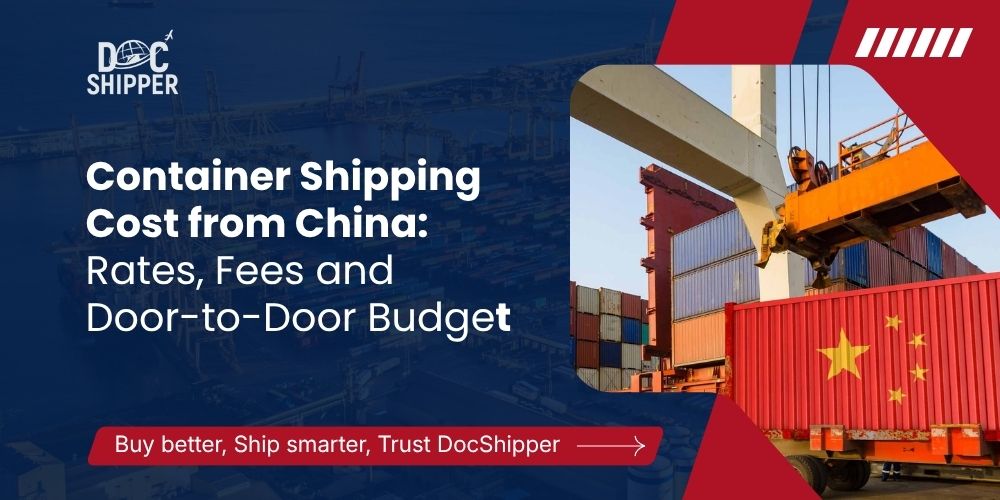
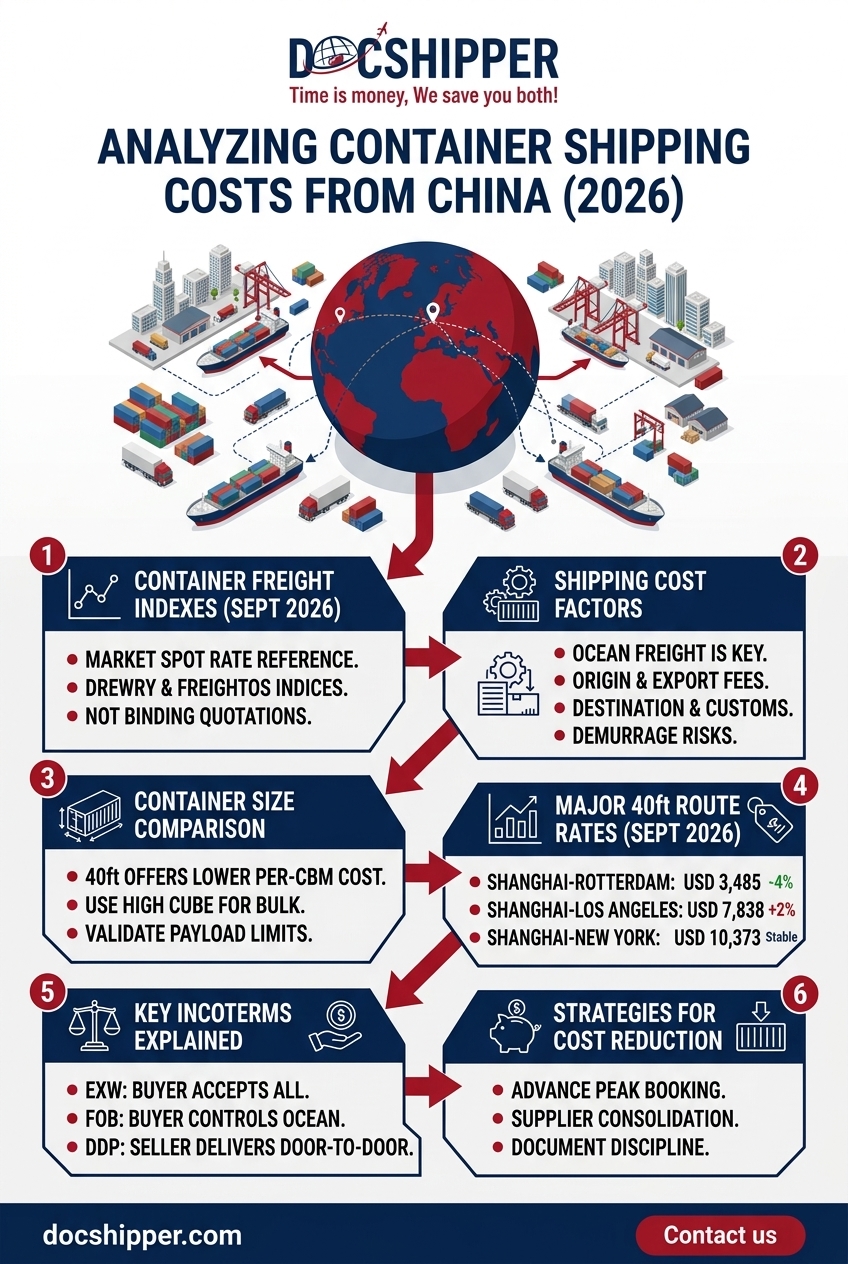
Container Shipping Cost from China: Prices by Route and Container Size depend on the route, container size, Incoterm, cargo and destination services. On 24 September 2026, 40ft ocean spot rates were USD 3,485 from Shanghai to Rotterdam, USD 3,835 to Genoa, USD 7,838 to Los Angeles and USD 10,373 to New York, excluding additional delivery costs. Key route rates and container-size guidance:| Route or equipment | Date or typical volume | Reference rate or guidance | Key consideration |
|---|---|---|---|
| Shanghai to Rotterdam, 40ft | 24 September 2026 | USD 3,485 | Ocean spot rate; additional charges apply |
| Shanghai to Genoa, 40ft | 24 September 2026 | USD 3,835 | Ocean spot rate; additional charges apply |
| Shanghai to Los Angeles, 40ft | 24 September 2026 | USD 7,838 | Ocean spot rate; additional charges apply |
| Shanghai to New York, 40ft | 24 September 2026 | USD 10,373 | Ocean spot rate; additional charges apply |
| 20ft container | About 33 m3 | No specific rate provided | Suitable for dense, heavy or smaller FCL shipments |
| 40ft container | About 67 m3 | Usually less than twice the price of a 20ft | Lower cost per cubic metre when sufficiently full |
| 40ft High Cube | About 76 m3 | No specific rate provided | Suitable for bulky, light cargo and taller cartons |
Rates by route, 20ft versus 40ft and High Cube selection, quote inclusions, Incoterms, market drivers, and cost-reduction strategies are covered in detail.
We hope you’ll find this article genuinely useful, but remember, if you ever feel lost at any step, whether it’s finding a supplier, validating quality, managing international shipping or customs, DocShipper can handle it all for you!
The container shipping cost from China depends on the route, container size, Incoterm, cargo characteristics and destination services. On 24 September 2026, a 40ft container cost about USD 3,485 from Shanghai to Rotterdam, USD 3,835 to Genoa, USD 7,838 to Los Angeles and USD 10,373 to New York in the Drewry World Container Index.
These figures are ocean spot rates, not complete delivery prices. To build a reliable budget, add origin handling, export clearance, destination terminal charges, customs, duties, VAT, inland trucking and possible storage or demurrage.
How much does a container from China cost in 2026?
On 24 September 2026, the Drewry World Container Index put a 40ft container at about USD 3,485 from Shanghai to Rotterdam, USD 3,835 to Genoa, USD 7,838 to Los Angeles and USD 10,373 to New York. These are ocean spot rates, so port, customs and delivery costs are extra.
A shipping index measures the market price for a defined ocean move at a specific date. The Drewry WCI provides a reference for selected major routes, while the Freightos Baltic Index, or FBX, tracks container freight prices using its own methodology and route definitions. Neither index is a binding quotation for your cargo.
The two sources therefore do not always show the same number. The Freightos update dated 8 September 2026 indicated approximately USD 4,500 per FEU for Asia to North Europe, USD 4,700 for Asia to the Mediterranean, USD 7,600 for the transpacific West Coast and USD 9,500 for the transpacific East Coast.
For the same reason, compare the route, container type, date, surcharge basis and quotation validity before judging whether a forwarder is expensive. The market was also being influenced by capacity management: Drewry reported 15 blank sailings announced for the week after 24 September, compared with 9 in the current week. A blank sailing is a cancelled scheduled voyage, which reduces available capacity and can support higher rates.
China to Europe
The 24 September WCI rates were USD 3,485 from Shanghai to Rotterdam and USD 3,835 from Shanghai to Genoa per 40ft container. The Freightos figures from 8 September were approximately USD 4,500 per FEU to North Europe and USD 4,700 to the Mediterranean.
The difference between these figures does not automatically indicate a contradiction. Shanghai to Rotterdam and Shanghai to Genoa are specific port pairs, whereas an index covering a regional trade lane can include several origins, destinations, equipment types and quotation conditions.
China to the United States
The WCI reported USD 7,838 from Shanghai to Los Angeles and USD 10,373 from Shanghai to New York on 24 September 2026. The corresponding Freightos reference from 8 September was approximately USD 7,600 for the transpacific West Coast and USD 9,500 for the East Coast.
These figures show why destination selection matters when you compare a 40ft container price from China to the USA. The transpacific rates were more than twice the Shanghai to Rotterdam WCI rate in the September data, before destination charges and inland delivery.
| Route or indicator | Dated reference | Container basis | Rate | Trend or note |
| WCI composite | 24 September 2026 | 40ft | USD 4,468 | -1% week on week |
| Shanghai to Rotterdam | 24 September 2026 | 40ft | USD 3,485 | -4% week on week |
| Shanghai to Genoa | 24 September 2026 | 40ft | USD 3,835 | -5% week on week |
| Shanghai to Los Angeles | 24 September 2026 | 40ft | USD 7,838 | +2% week on week |
| Shanghai to New York | 24 September 2026 | 40ft | USD 10,373 | Stable week on week |
| Asia to North Europe | 8 September 2026 | FEU | Approximately USD 4,500 | Freightos reference |
| Asia to Mediterranean | 8 September 2026 | FEU | Approximately USD 4,700 | Freightos reference |
| Transpacific West Coast | 8 September 2026 | FEU | Approximately USD 7,600 | Freightos reference |
| Transpacific East Coast | 8 September 2026 | FEU | Approximately USD 9,500 | Freightos reference |
For a market reference, consult the Drewry World Container Index and compare it with the Freightos weekly update. Always request a route-specific quote before committing to an order.
Looking for a Reliable Shipping & Sourcing Partner?


20ft or 40ft: which container size is cheaper?
A 40ft container holds about twice the volume of a 20ft but usually costs much less than twice the price. It is therefore cheaper per cubic metre when you have enough goods to use the available space, while a 20ft can be more suitable for dense or heavy cargo.
Container selection starts with two checks: the cargo volume and the cargo weight. A shipment can fit within the internal volume of a container but still exceed its practical payload or create a poor weight distribution, so your supplier and forwarder must verify the carrier’s equipment specifications.
Use a 40ft High Cube when your products are bulky, cartons are light or packaging creates unused vertical space. The extra internal height can improve loading efficiency, but it does not eliminate the need to check maximum gross weight, local road limits and the shipping line’s equipment availability.
If your goods do not fill a container, compare FCL with LCL rather than assuming that a partly empty FCL is the cheapest solution. LCL means Less than Container Load, where cargo shares a container with other shipments. The decision should include consolidation, handling and destination fees, not only the advertised ocean price.
| Equipment | Typical volume | Best fit | Main caution |
| 20ft | About 33 m3 | Dense, heavy or smaller FCL shipments | Weight can be reached before volume |
| 40ft | About 67 m3 | Large orders with enough cartons to fill the space | Check weight distribution and road limits |
| 40ft High Cube | About 76 m3 | Bulky, light cargo and taller cartons | Confirm equipment availability and specifications |
These volumes are typical planning figures and should be verified against the carrier’s equipment specifications. If several Chinese factories are supplying one order, consolidation can help you approach a full container without placing separate bookings for each supplier.
DocShipper Tips
Compare volume, payload, loading efficiency and LCL costs before booking a partly empty container.
DocShipper Alert
An ocean index excludes many costs, including customs, taxes, trucking and potential delay charges.
What is included in a container shipping quote?
A complete door-to-door quote should identify pickup and export clearance in China, ocean freight and surcharges, destination terminal handling, customs clearance, import duties and taxes, and trucking to your warehouse. A published index rate normally represents only the ocean leg.
Start by asking the forwarder to separate every cost line. Origin THC means terminal handling at the export port. Destination THC covers handling at the arrival terminal. BAF, or Bunker Adjustment Factor, is a fuel-related surcharge that may be included in the freight rate or shown separately, depending on the carrier and quotation.
Customs brokerage, inspection, duties and VAT should also appear separately. Duties and VAT depend on the product classification, customs value and destination rules, so they cannot be calculated from the ocean rate alone. The same applies to inland trucking, which varies according to pickup address, delivery address, equipment, distance and local access restrictions.
Demurrage and detention require particular attention. Demurrage can apply when the container stays at the terminal beyond the free period, while detention can apply when equipment is kept outside the terminal for too long. Storage, inspections, port congestion and documentation errors can create additional charges if the cargo is not cleared and collected on time.
FOB, EXW and DDP: who pays?
Under EXW, the buyer generally takes responsibility from the supplier’s premises, including pickup and export-related operations that may be difficult to manage in practice. Under FOB, the supplier usually handles the goods until loading at the named Chinese port, while the buyer controls the main ocean freight and destination operations.
Under DDP, the seller arranges delivery to the agreed destination and generally includes import-related costs in the commercial arrangement. However, the exact allocation depends on the contract and the seller’s ability to act as importer. Compare Incoterms 2020, the named place and the exclusions rather than comparing only the headline price.
| Cost item | Usually visible in an ocean index? | What to verify |
| Ocean freight | Yes, as the principal reference | Route, equipment, validity and included surcharges |
| Origin THC and export clearance | No | Chinese port, documentation and export handling |
| Destination THC and port fees | No | Arrival port, terminal and free period |
| Customs brokerage | No | Broker scope and documentation requirements |
| Import duties and VAT | No | Commodity classification and customs value |
| Inland trucking | No | Pickup, delivery address, equipment and access |
| Demurrage, detention and storage | No | Free time, triggering events and tariff basis |
A worked budget using the dated Shanghai to Rotterdam reference starts with the following verified line: ocean freight, USD 3,485 per 40ft container on 24 September 2026. The complete calculation must then add the destination-specific amounts received from local quotations.
Worked budget structure:
- Ocean freight: USD 3,485
- Origin THC and export clearance: amount to be confirmed in the origin quotation
- Destination THC and port fees: amount to be confirmed for Rotterdam
- Customs brokerage: amount to be confirmed
- Import duties and VAT: calculated from the goods and customs classification
- Inland trucking to the warehouse: amount to be confirmed from the delivery address
- Demurrage, detention, storage or inspection: contingency line to be confirmed from the quotation terms
- Door-to-door budget: USD 3,485 plus all verified additional lines above
This format avoids presenting an ocean index as a false all-in price. It also gives you a practical way to compare forwarder quotations that use different Incoterms or package destination services differently.
DocShipper Alert
Monitor blank sailings, fuel surcharges, seasonal demand and quotation validity before relying on today’s rate.
Why Choose DocShipper
Lower risk, transparent pricing, and a single point of contact from pickup to delivery.
-
One single point of contactA dedicated consultant coordinating every step and keeping you informed.
-
9,200+ operations / 6,000+ clientsProven processes on China ↔ EU/US lanes (FCL, LCL, air, road, rail).
-
No hidden feesTransparent quotes and document guidance to avoid surprises.
What drives container rates from China?
Rates move with demand, carrier capacity management, fuel prices, route disruptions and seasonal peaks before Chinese New Year and during the Q3-Q4 shipping season. These variables can change the price between the day you budget an order and the day the carrier confirms the booking.
Blank sailings are one capacity-management tool. In the week of 24 September 2026, Drewry commentary reported 15 blank sailings announced for the following week, compared with 9 in the current week. Fewer scheduled departures can reduce available slots, particularly when demand is already strong.
Fuel also affects the rate structure through bunker-related surcharges. Judah Levine, Head of Research at Freightos, wrote on 8 September 2026: “Climbing fuel costs are likely setting an elevated floor for container rates, but ocean prices are still largely being driven by demand trends and disruptions to capacity.” Read the statement in the Freightos market update.
Seasonality affects both the base rate and the availability of equipment. Before Chinese New Year, factories and exporters often try to ship before the production shutdown. Later in the year, retail replenishment and peak-season demand can tighten space. Route disruptions may also increase transit-related surcharges or alter carrier capacity.
| Driver | How it affects your budget | What to monitor |
| Demand | Stronger demand can push up spot rates and reduce available space | Weekly indices and booking acceptance |
| Blank sailings | Cancelled voyages reduce scheduled capacity | Carrier announcements and sailing schedules |
| Fuel | Can raise bunker-related surcharges and the rate floor | BAF wording and quotation validity |
| Seasonality | Peak periods can increase rates and equipment pressure | Chinese New Year and Q3-Q4 planning |
| Route disruption | Can change capacity, surcharges and routing choices | Carrier notices and forwarder advisories |
How to reduce the cost of shipping a container from China
Book before peak periods, consolidate suppliers, optimise the loading plan, compare FOB and other Incoterms, and request a door-to-door quotation with clear exclusions. The objective is not simply to obtain the lowest ocean rate, but to reduce the total logistics bill and avoid preventable destination charges.
First, prepare the commercial and packing information before requesting prices. Give the forwarder the supplier cities, cargo-ready date, number of cartons, dimensions, gross weight, commodity description, HS code if available, preferred port, destination address and desired Incoterm. Incomplete information produces allowances that can later become extra charges.
Second, examine whether several suppliers can deliver to one consolidation point in China. Combining orders can help use a 40ft container more efficiently, but the plan must include domestic transfers, warehouse handling, loading coordination and the risk that one late supplier delays the entire shipment.
Third, compare quotations on the same basis. Ask each provider to show the ocean rate, validity, surcharges, origin services, destination services, customs scope, delivery conditions, free time and exclusions. Confirm whether duties and VAT are included, excluded or merely estimated, and make sure the quote states whether it is port-to-port or door-to-door.
Finally, protect the budget with document discipline. Commercial invoices, packing lists, certificates and product details should be checked before arrival. Correct data helps reduce customs delays, inspections, storage and demurrage exposure.
| Cost lever | Potential benefit | Action required |
| Book ahead of peak periods | More choice of sailing and equipment | Confirm cargo-ready date and booking window early |
| Consolidate suppliers | Better use of FCL capacity | Coordinate factory delivery and loading instructions |
| Optimise packaging | More saleable volume per container | Review carton dimensions, palletisation and loading plan |
| Compare Incoterms | Greater control over freight and destination costs | Compare EXW, FOB and DDP responsibilities in writing |
| Request door-to-door quotes | Fewer unpriced cost lines | Require origin, destination, customs and trucking details |
| Prepare documents early | Lower risk of clearance delays and storage | Validate invoice, packing list, HS code and product data |
When an order is split between factories, the logistics file should include a consolidation plan rather than separate freight estimates only. This is particularly useful when you are close to filling a container but need one provider to coordinate several pickups and one export booking.
DocShipper Tips
Prepare accurate cargo data, consolidate suppliers and compare complete door-to-door quotations on identical terms.
Conclusion: budgeting your container from China
Use a dated ocean index to establish the market reference, then add every cost required to move the goods from the Chinese supplier to your warehouse. A trustworthy budget separates ocean freight from origin charges, destination charges, customs, taxes, trucking and delay risks.
- On 24 September 2026, the WCI showed about USD 3,485 from Shanghai to Rotterdam and USD 7,838 from Shanghai to Los Angeles per 40ft container.
- Index rates cover the ocean leg only and do not represent a complete door-to-door price.
- A 40ft container usually offers a lower cost per cubic metre than a 20ft when the shipment has enough volume.
- Fuel, blank sailings, demand, route disruptions and seasonal peaks can move rates quickly.
- Consolidating several Chinese suppliers and comparing Incoterms can improve control over the final bill.
Planning a container from China? Tell us your volume, pickup city and destination. We can prepare a door-to-door FCL or LCL quotation with customs and help coordinate several suppliers in one shipment.
FAQ | Container Shipping Cost from China in 2026: Rates, Fees and Door-to-Door Budget
Usually not. Ocean freight covers the transport service, but marine cargo insurance is normally quoted separately. It can protect you against risks such as damage, loss, theft or general average, depending on the policy. Check the insured value, exclusions, deductible and whether coverage applies from the supplier’s warehouse or only from the Chinese port.
A container can meet its volume limit but exceed its permitted gross weight or a local road limit. The carrier may require cargo to be removed and repacked, charge a correction fee or refuse the booking. Ask the supplier to provide accurate gross weights and submit the Verified Gross Mass (VGM) before the carrier’s deadline. Weight distribution also matters, especially for dense products loaded into a 40ft container.
Yes, but they require advance approval and additional documentation. Before booking, provide the forwarder with the product’s safety data sheet, UN number, proper shipping name, hazard class and packing details. The carrier must accept the cargo, and extra inspection, handling, documentation or equipment charges may apply. Never describe regulated goods as ordinary cargo to obtain a lower rate.
It depends on the customs rules of the importing country and the agreed valuation method. In some jurisdictions, freight and insurance up to the entry point are added to the goods value; in others, certain post-import transport costs may be excluded if they are separately documented. Ask your customs broker to confirm the calculation before importing, because an incorrect customs value can lead to reassessment, penalties or clearance delays.
The shipment may need to wait for the missing cargo, move without it or be rebooked on a later sailing. Waiting can create warehouse storage and missed-cutoff costs, while shipping separately may result in extra pickup, handling or LCL charges. Set a factory delivery deadline and a backup plan in writing, particularly when several suppliers must load into one container.
A booking confirms transport capacity, but some charges depend on events that occur later. Costs can increase if the cargo details change, the container is rolled, customs requests an inspection, the free time expires or the delivery address requires special equipment or access arrangements. To control this risk, request written confirmation of the rate validity, included surcharges, free time and the tariff for changes, storage, demurrage and detention.
Need Help with
Logistics or Sourcing ?
First, we secure the right products from the right suppliers at the right price by managing the sourcing process from start to finish. Then, we simplify your shipping experience - from pickup to final delivery - ensuring any product, anywhere, is delivered at highly competitive prices.


Fill the Form
Prefer email? Send us your inquiry, and we’ll get back to you as soon as possible.
Contact us