In short ⚡
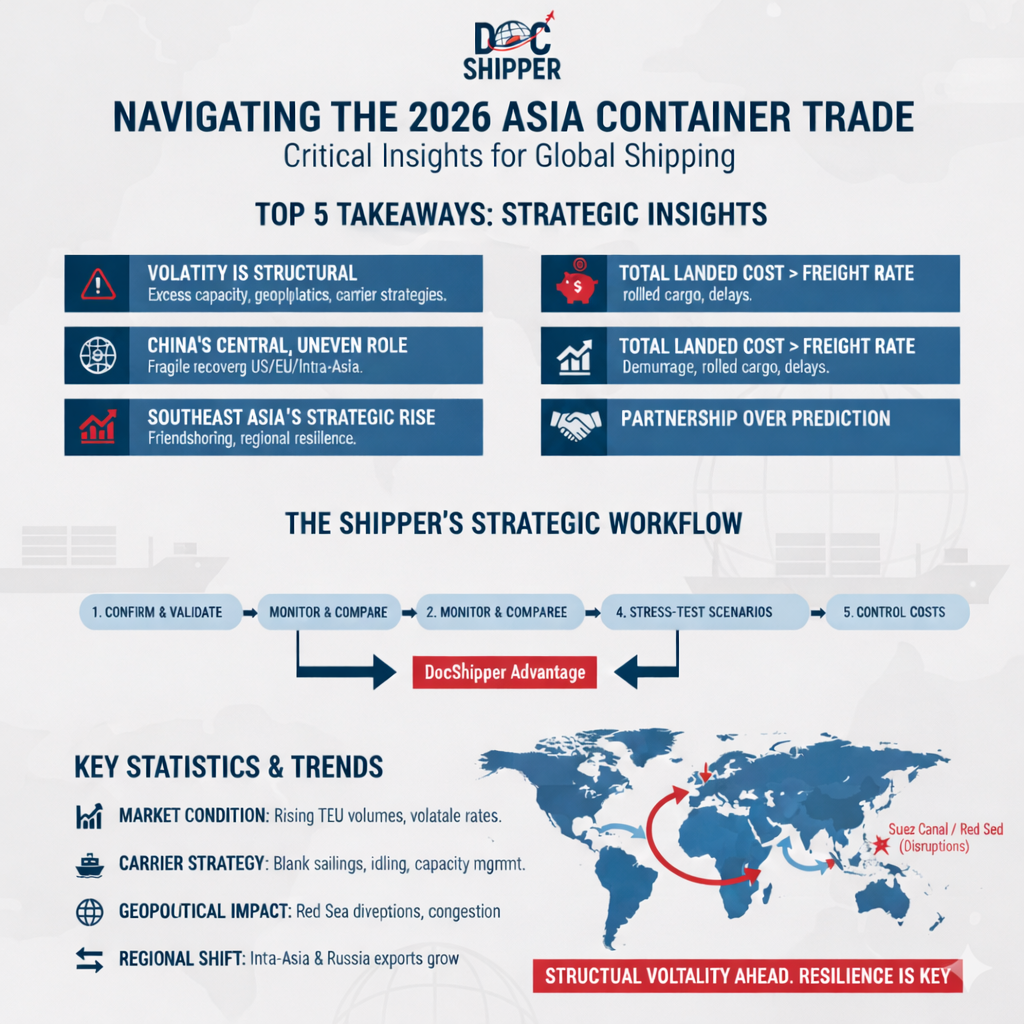
Asia Container Trade refers to the movement of containerized cargo across Asia and between Asia and global markets, shaped in 2025 by rising TEU volumes alongside volatile freight rates, excess capacity, blank sailings, and geopolitical disruptions. China remains central, while Southeast Asia gains strategic importance through feeder services and friendshoring-driven trade shifts.
We hope you’ll find this article genuinely useful, but remember, if you ever feel lost at any step, whether it’s finding a supplier, validating quality, managing international shipping or customs, DocShipper can handle it all for you!
Why global container shipping remains volatile despite trade growth
You’re probably puzzled. Asia container trade volumes are growing again, yet the global shipping market still feels unstable.
From what we see daily at DocShipper, this disconnect comes from structural issues in ocean freight, not from a lack of containerized cargo demand.
UNCTAD data confirms it, global TEU volumes are rising, but freight rates, capacity management, and shipping alliances keep the market fragile.
How falling freight rates and excess capacity reshape carrier strategies
We recently handled a case where a China exports shipper locked annual contracts on the Trans-Pacific route, only to see spot rates collapse weeks later.
That frustration is now common across the Asia container trade as excess TEU capacity floods key shipping lanes.
Here’s what you see behind the scenes as carriers adapt.
- Aggressive capacity management through vessel idling and slow steaming
- Rate discipline attempts as contract and spot rates finally converge
- Yield over volume strategies on Asia-US container ship trade lanes
This is why understanding the real freight rate mechanics matters before you sign long-term deals.
Geopolitics, Red Sea disruption, and port congestion as structural risks
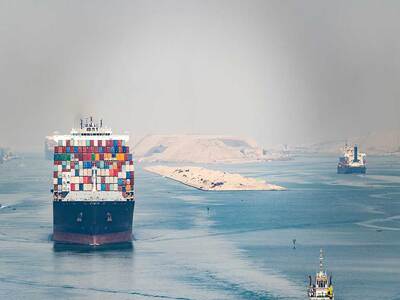
Here’s a direct tip. Always assume disruption when planning Asia container trade in 2025.
Red Sea diversions, Middle East instability, and cascading port congestion now shape vessel scheduling more than pure demand.
We’ve seen china us trade impact container ports when vessels reroute via the Cape of Good Hope.
To keep control, use this short operational checklist we apply with clients.
- Double-check demurrage and detention clauses in your bill of lading
- Model landed cost with bunker surcharges included
- Secure backup feeder services for hub-and-spoke networks
Ignoring these steps weakens your supply chain resilience fast.
What new alliances and blank sailings signal for shippers
Let’s be clear. Blank sailings are no longer temporary fixes.
They’re a deliberate tool tied to carrier consolidation and new shipping alliances across Asia container trade lanes.
You’ll notice this more on China exports to North America.
| Signal | What it means for you |
| Blank sailings | Higher risk of rolled cargo and longer lead times |
| Alliance reshuffling | Fewer carrier choices, tougher negotiations |
| Capacity pooling | Better utilization but less schedule flexibility |
This is where working with a neutral logistics provider helps protect your vessel scheduling.
China’s container trade reality: slow recovery with shifting trade lanes
If you ship from China, you already feel how Asia container trade recovery remains uneven.
China exports are moving, but trade imbalance and rerouted shipping lanes keep pressure on the system.
The WTO highlights this transition as structural, not cyclical.
Why China’s container market rebound remains fragile
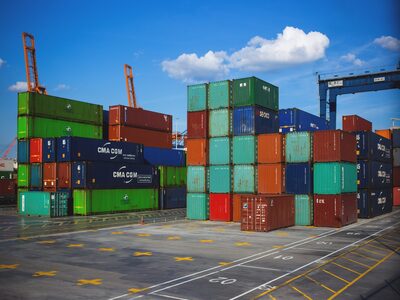
A bold statement upfront. The rebound is real, but it’s thin.
Demand forecasting stays difficult because production restarts don’t always match overseas consumption.
We see shipping container trader inventories building again in Shanghai and Ningbo.
Here’s the short workflow we advise before committing volumes.
Step-by-step validation process
Step 1, confirm factory output and Incoterms.
Step 2, compare spot vs contract rates weekly.
Step 3, stress-test transit time scenarios.

Diverging export performance between the US, EU, and regional partners
Ever wondered why lanes behave so differently?
China-US container trade remains volatile, while intra-Asia and Russia-linked exports grow.
From our operations, china us container ship trade suffers most from demand swings.
- Weak retail replenishment in the US
- Stricter import/export regulations in the EU
- Faster customs clearance on regional lanes
This divergence forces constant trade lane optimization.
Looking for a Reliable Shipping & Sourcing Partner?
China’s role in Asia‑Pacific volumes and global capacity balance
We’ll end this section with perspective.
China remains central to Asia container trade, even as nearshoring accelerates.
Ports like Shanghai still anchor global TEU capacity and feeder services.
This is why aligning your freight forwarding, Container sourcing, and third-party logistics decisions matters more than ever.
When you need clarity or a resilient shipping solution, we’re here.
Get in touch and let’s stabilize your Asia container trade strategy together.
Southeast Asia container market under pressure but gaining strategic relevance
The Asia container trade picture changes fast, and Southeast Asia sits right at the center of that shift in 2025.
You’re seeing softer freight rates on intra‑Asia shipping lanes, yet the region’s role in hub‑and‑spoke networks, feeder services, and transshipment keeps growing.
We see this daily while managing containerized cargo through Vietnam, Thailand, Indonesia, and Malaysia, especially when China exports reroute or pause.
DocShipper Advice
Lower rates can mask feeder delays and inventory risks.
DocShipper aligns carriers, ports, and Incoterms to protect landed costs.
Rate erosion and inventory pressure across intra‑Asia routes
A few months ago, we worked with a buyer moving electronics from Ho Chi Minh to Singapore using a feeder linked to a China mainline.
Spot rates collapsed mid‑contract, blank sailings followed, and inventory sat longer at origin than expected.
This is the reality of intra‑Asia ocean freight today, with excess TEU capacity and uneven demand forecasting.
You’ll notice fast how freight rates on Southeast Asia trade lanes now behave more like a pressure valve for the Asia container trade.
When Trans‑Pacific routes soften, carriers redeploy vessels into short‑sea Asia routes, triggering rate erosion.
At the same time, importers reduce safety stock, increasing trade imbalance and rolling inventory risk downstream.
Here’s a short checklist we use to help you control landed cost exposure when rates slide unpredictably.
- Track spot vs contract spreads weekly to anticipate renegotiation windows.
- Validate demurrage and detention clauses before confirming vessel scheduling.
- Confirm hinterland connections so feeder delays don’t freeze inventory.
Regional volatility isn’t new, but combined with carrier consolidation and alliance reshuffling, it hits harder today.
UNCTAD recently highlighted how regional container markets absorb global shocks faster than long‑haul routes.
Friendshoring, regional trade growth, and implications for supply chains

Direct tip, don’t treat Southeast Asia as a cheap overflow zone anymore.
You’re looking at a structural shift driven by friendshoring, nearshoring, and selective reshoring away from single‑origin China exports.
We’re seeing it clearly with factories in Vietnam or Indonesia shipping semi‑finished goods back to China for final assembly.
This reshapes shipping lanes, intermodal transport choices, and Incoterms negotiations like Free On Board versus CIF.
From experience, mistakes happen when buyers underestimate customs clearance complexity and local import/export regulations.
Here’s a simple workflow we recommend when you re‑optimize Asia container trade lanes through Southeast Asia.
Step 1 validate supplier production timelines.
Step 2 match Incoterms to risk tolerance.
Step 3 align freight forwarding and third‑party logistics partners early.
Step 4 lock bunker surcharge and terminal handling charges.
Step 5 stress‑test inventory buffers.
Friendshoring doesn’t mean simple, it means resilient if you structure it correctly.
The World Economic Forum keeps pointing to regionalization as a long‑term supply chain resilience lever.
To show the difference, here’s a quick comparison we share with clients.
| Aspect | Pure China sourcing | China + Southeast Asia |
| Freight rates | High exposure to Trans‑Pacific swings | More balanced intra‑Asia options |
| Port congestion | Mega‑hub dependent | Distributed port infrastructure |
| Supply chain resilience | Lower flexibility | Higher redundancy |

Conclusion
The Asia container trade in 2025 tells a clear story if you look beyond headline freight rates.
Southeast Asia feels squeezed by excess capacity and soft demand, yet it gains strategic weight as China exports adjust.
We see many importers stuck here, unsure whether to chase low spot rates or protect long‑term shipping resilience.
Here’s what you should take away before making your next logistics decision.
- Falling freight rates don’t mean lower total landed cost without disciplined cost control.
- Blank sailings and capacity management remain structural risks on intra‑Asia routes.
- Friendshoring in Southeast Asia improves supply chain resilience when designed properly.
- Strong freight forwarding and 3PL partners matter more than ever.
- Trade lane optimization beats chasing the cheapest spot rate.
At DocShipper, we help you translate Asia container trade trends into concrete shipping solutions without guesswork.
You don’t need perfect forecasts, you need adaptable logistics decisions, and that’s exactly where we work with you.
FAQ | Asia and China container trade in 2025: what the shipping market means for global logistics decisions
The most frequent errors we see are:
- **Chasing the lowest rate only** and ignoring schedule reliability, rollover risk, and storage costs.
- **Not checking Incoterms alignment** (e.g. using FOB or CIF blindly without matching risk tolerance and operational capability).
- **Underestimating disruption time** from blank sailings, diversions, or port congestion.
- **Ignoring detention/demurrage clauses**, which can erase any savings from a “cheap” rate.
- **Relying on a single carrier or port**, which kills flexibility when things go wrong.
To avoid them, set a simple checklist before every booking: lane alternatives, Incoterms, D&D terms, inventory impact, and backup options.
Instead of fixed “X days” assumptions, move to scenario‑based planning:
- Define **three lead‑time scenarios** per lane: optimistic, realistic, worst case (including rerouting and blank sailings).
- Map **SKUs by criticality**:
- A‑items (high value / no‑stock risk) → higher safety stock or dual‑lane options.
- B/C‑items → more flexible on lead time, lower buffers.
- Where possible, **split shipments**: one batch via faster/more reliable routes, the rest on cheaper capacity.
- Use **nearby regional hubs** (e.g. Singapore, Port Klang) for buffer inventory instead of holding everything at origin.
- Review **reorder points and safety stocks** every time your average transit time shifts by more than 10–15%.
Three areas cause most unpleasant surprises:
- **Demurrage & detention**
- Check free days at POL/POD, storage tariffs after free time, and conditions for extension.
- Negotiate in advance during tendering, not once containers are already stuck.
- **Bunker and emergency surcharges**
- Clarify which surcharges are **fixed vs variable**, and how often they can be adjusted.
- Ask for clear triggers for EBS, PSS, war risk, congestion, etc.
- **Liability and force majeure**
- Understand what happens during disruptions: who pays for rerouting, additional handling, or extra days at sea.
Have your freight forwarder or legal team review a **sample bill of lading + quotation** and highlight each cost line before you sign anything.
The key is controlled complexity, not chaos:
- Start with **1–2 product families**, not your whole catalog.
- Design a **simple lane architecture**, e.g.:
- Components from Vietnam → assembly in China → export to EU/US; or
- Dual‑sourcing: one supplier in China + one in Vietnam/Thailand for the same SKU.
- Standardize **Incoterms and documentation** across suppliers so your operations team isn’t managing 10 different models.
- Use **one lead 3PL/freight forwarder** to orchestrate cross‑border flows instead of many small local providers.
- Measure success on 3 KPIs: **lead‑time stability, landed cost per unit, and stock‑out rate**. If all three improve or stay stable, you’re structuring friendshoring correctly.
You can’t stop blank sailings, but you can reduce their damage:
- **Diversify by carrier and alliance**, especially on critical lanes (e.g. at least two service options China–USWC or China–EU).
- Ask your forwarder for **visibility on planned blank sailings** 4–6 weeks ahead and map which sailings your bookings use.
- For time‑sensitive goods, **ship earlier in the cycle** or split volumes over two consecutive sailings.
- Build **standard operating procedures**: what happens if cargo is rolled (priority rebooking, alternative ports, potential mode change).
- For must‑arrive‑by‑date shipments, consider **premium or guaranteed space products** on a portion of your volume.
Smaller volumes don’t mean no leverage, but you need to be strategic:
- **Bundle lanes and volumes** with one or two core forwarders instead of scattering shipments across many.
- Be **predictable**: share realistic forecasts; forwarders give better terms to shippers who plan.
- Focus negotiations on **what hurts you most**: D&D terms, free days, schedule reliability, or flexibility on cut‑off times.
- Accept that you may not get the absolute lowest rate, but push for **strong service SLAs** (communication, alternatives during disruptions, documentation accuracy).
- Use **tenders or mini‑bids** at least annually to benchmark offers, even if you stay with the same partner afterward.
Need Help with
Logistics or Sourcing ?
First, we secure the right products from the right suppliers at the right price by managing the sourcing process from start to finish. Then, we simplify your shipping experience - from pickup to final delivery - ensuring any product, anywhere, is delivered at highly competitive prices.
Fill the Form
Prefer email? Send us your inquiry, and we’ll get back to you as soon as possible.
Contact us