In short ⚡
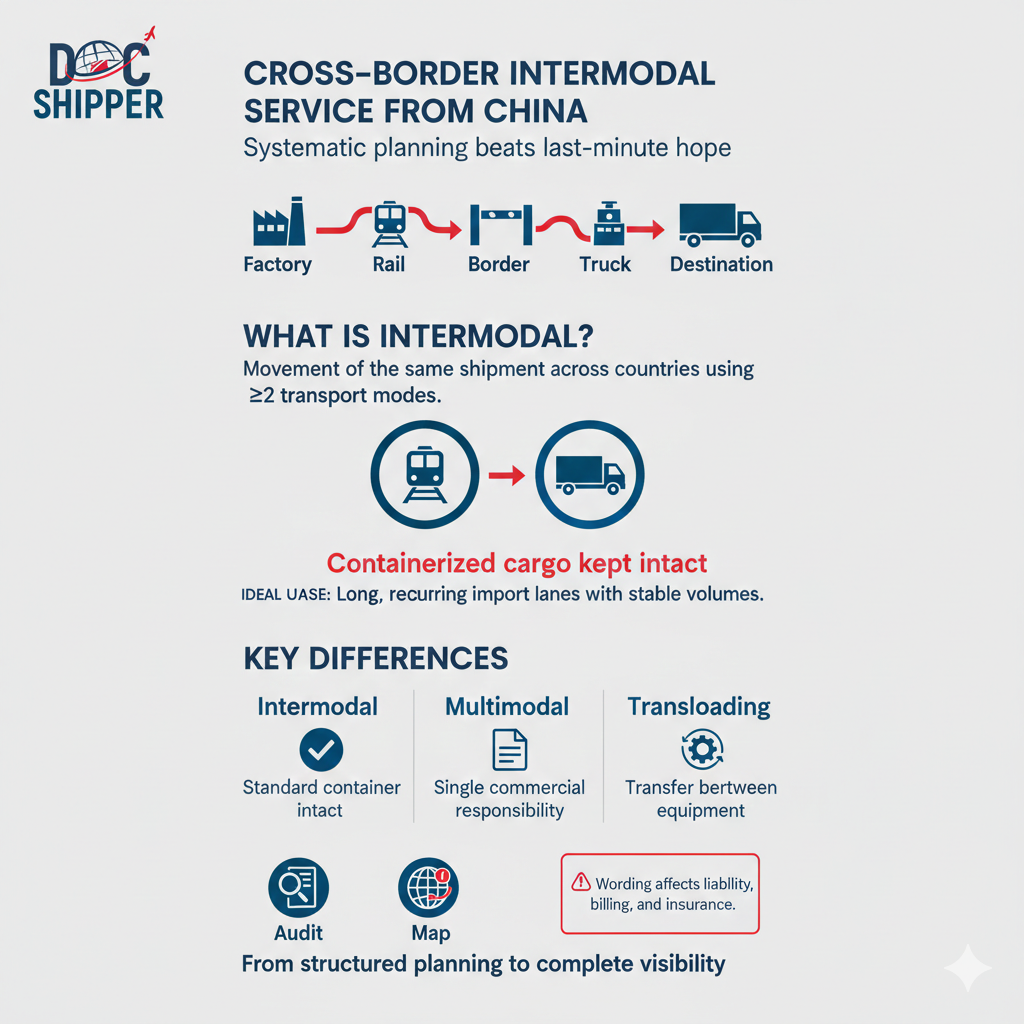
Cross-border intermodal service is the movement of the same shipment across countries using at least two transport modes, typically intermodal rail service plus cross-border trucking, while keeping goods in containerized cargo or a sealed trailer for most of the journey. It’s best suited to long, recurring lanes where you can plan transit time systematically and reduce trucking volatility, border delays, and handling costs.
We hope you’ll find this article genuinely useful, but remember, if you ever feel lost at any step, whether it’s finding a supplier, validating quality, managing international shipping or customs, DocShipper can handle it all for you!
What cross-border intermodal service is and when you should use it
Cross-border intermodal service is when you move the same shipment across countries using at least two modes, typically intermodal rail service plus cross-border trucking, while keeping your goods in containerized cargo (or a sealed trailer) for most of the journey.
You use it when your pain is predictable, recurring, and expensive: volatile trucking capacity, long linehaul operations, border wait times, or missed delivery appointments that trigger chargebacks.
From experience, the moment you start importing out of China at scale, you’ll notice fast that trucking-only plans look “simple” until a port appointment slips, a rail ramp is full, or a customs inspection lands on the wrong day.
As a baseline, intermodal shines when your lanes are long, your volumes repeat, and you’re willing to plan transit time like a system, not a guess.
Here are the situations where a cross-border intermodal transport plan usually makes sense.
- Long inland distances from port to final market, where rail linehaul beats pure trucking on cost and emissions.
- Recurring import programs from China with steady SKUs, where capacity planning and fixed schedules reduce chaos.
- Need for supply chain visibility, using unified track and trace and fewer handoffs than ad-hoc transshipment.
- Mixed volumes, where freight consolidation and load optimization reduce half-empty moves.
- Border-sensitive cargo, where bonded warehouse options and tight customs brokerage processes cut dwell time.
One quick reality check, intermodal doesn’t delete risk, it moves it earlier into planning and documentation.
That’s a good trade, if you’re ready for it.
Intermodal vs. multimodal vs. transloading: key differences for your supply chain

Last quarter, we saw a buyer moving factory pallets from Shenzhen to the US Midwest, and they kept saying “intermodal” while their provider was actually doing transloading at the port to 53’ domestic trailers.
They got hit with a surprise warehouse fee because nobody agreed on where liability switched, and the transport documentation didn’t match the physical flow.
So let’s make the terms painfully clear, because wording affects your bill of lading, your waybill, your claims process, and even your insurance premium.
Use this simple comparison to pick the right model for your cross-border intermodal service lane.
| Model | What it means in practice | Best for | Common trap |
| Intermodal | Multiple modes with standardized units, usually containerized cargo kept intact, rail plus truck is most common. | Stable lanes, long distances, predictable schedules, strong track and trace. | Forgetting ramp cutoffs and buffer time, then missing rail departures. |
| Multimodal | Multiple modes under one commercial responsibility, often with a single through document and through rate. | When you want one party to manage handoffs, including international freight forwarding. | Assuming “single responsibility” means “no paperwork”, import export documentation still matters. |
| Transloading | Transfer cargo between equipment types, container to trailer, trailer to container, often at a logistics hub or cross-docking facility. | Cost optimization, domestic trailer efficiency, weight limits, or different equipment standards. | Damage risk and inventory variance if packaging is weak or counts aren’t controlled. |
One direct tip we give clients, if the plan includes a physical transfer, treat packaging like a piece of equipment, not an afterthought.
That’s where “cheap cartons” become “expensive claims”.
DocShipper Alert
DocShipper audits your current flows, aligns contracts and documents, and builds a clear transport scheme that actually matches your physical moves.
Typical cross-border intermodal flows between Asia, North America and Europe
Here’s a practical tip, map your shipment as a freight corridor with nodes, not as “China to destination”.
When you do that, you naturally spot where customs clearance, hinterland connections, and rail ramps can break your schedule.
A typical cross-border intermodal service for China exports connects ocean, port drayage, rail linehaul, then final-mile trucking.
You’ll also see variations depending on free trade agreement usage, border rules, and where your 3PL services have strong carrier contracts.
Below are common flows we plan around in multimodal logistics, without pretending there’s a single “best” lane.
- China to US/Canada inland, ocean to West Coast port, cross-docking or direct container to rail ramp, intermodal rail service to inland terminal, then last mile delivery by truck.
- China to Mexico via US gateways, ocean to US port, rail to border region, cross-border trucking through the gateway with customs brokerage on both sides, then domestic linehaul and delivery.
- China to Europe inland, ocean to North Sea or Mediterranean ports, drayage to rail hub, rail to inland terminal, then truck to DC, often involving bonded warehouse staging.
- China to Central/Eastern Europe, ocean to EU port plus rail hinterland connections, or rail corridors where available, then truck distribution.
One more nuance you’ll appreciate, your incoterms choice affects who controls the forwarder, who pays detention, and who owns the timing buffers.
Get that wrong, and even perfect operations feel “late”.
DocShipper Advice
DocShipper maps your freight corridor, compares realistic route options and builds door to door visibility so every handoff is controlled, not guessed.
How cross-border intermodal moves work step by step

A cross-border intermodal service only looks smooth from far away.
Up close, it’s a chain of handoffs, appointments, and transport documentation checks, where one missing data point can stall the whole carriage of goods.
We’ve watched importers do everything right on pricing, then lose a week because the tariff classification didn’t match the commercial invoice, and the customs inspection triggered a hold as soon as the container hit the rail ramp.
This is also where global standards matter, the World Customs Organization (WCO) pushes harmonization, but your actual outcome still depends on your exact paperwork and local enforcement.
To keep it operational, here’s the workflow you can use to plan and brief your logistics provider.
- Step 1, confirm Incoterms, cargo ready date, and equipment type (container, trailer, FTL/LTL, bonded or not).
- Step 2, book ocean or main leg, then lock drayage appointments at origin and destination ramps.
- Step 3, prepare import export documentation, commercial invoice, packing list, bill of lading, certificates if needed.
- Step 4, validate trade compliance, tariff classification, partner IDs, and any license requirements.
- Step 5, execute origin pickup, ramp in-gate, rail linehaul operations, border handoff, then destination delivery.
- Step 6, monitor shipment tracking and exceptions, then close out with charges review and claims management if needed.
Notice what’s missing from that list, hope.
Hope isn’t a plan, timestamps are.
DocShipper Info
DocShipper coordinates Incoterms, bookings, transport documentation and compliance so your door to door flow is structured, timestamped and fully monitored end to end.
From shipper to border: drayage, ramps, rail legs and customs handoffs
We’ve seen this movie, your supplier in China says “cargo ready Friday”, then finishes Saturday night, and suddenly your Monday rail cutoff is gone.
Your container sits, storage clocks start, and your best through rate turns into a bundle of accessorials.
In a real cross-border intermodal service, the origin-to-border portion is where you either win with disciplined handoffs or bleed money quietly.
Use this checklist to stress-test the origin segment before you book.
- Factory readiness, packaging strength for transfers, correct labels, and verified carton counts.
- Pickup plan, drayage appointment, equipment match, and driver instructions in writing.
- Ramp strategy, cutoff times, peak season capacity, and contingency ramp options.
- Documentation, bill of lading instructions, waybill requirements for rail, and consignee details.
- Compliance, tariff classification aligned across invoice, packing list, and broker entry data.
- Visibility, supply chain visibility access, milestone events, and exception alerts for holds.
If you want one insider observation, ramp cutoffs act like flight gates.
Arrive late and nobody cares why.
DocShipper Advice
DocShipper strengthens packaging, plans ramps, and synchronizes drayage plus customs data so your cross-border intermodal service leaves on time and arrives clean.
Border crossings, customs clearance and last-mile delivery in destination markets
Wondering where most importers get stuck?
It’s not always the linehaul, it’s the border moment when customs clearance meets imperfect data, and the container lands in a queue for customs inspection.
In a well-run cross-border intermodal service, you treat border and destination like a single system, brokerage, delivery appointments, and warehouse receiving slots all aligned.
That’s where good customs brokerage and trade compliance discipline saves you days, not pennies.
Here are the biggest levers you can control at the border and on the last mile.
- Pre-clear whenever possible, send entry data early, and align packing list details with the broker’s template.
- Right warehouse choice, use a bonded warehouse if you need duty deferral or staged releases.
- FTA and duties planning, if a free trade agreement may apply, prove origin correctly or don’t claim it.
- Appointment discipline, book delivery slots before arrival, especially for retail DCs with strict receiving windows.
- Tracking that’s actionable, shipment tracking should show milestones, not just “in transit”.
When we manage these moves at DocShipper, we focus on timing buffers and documentation alignment first, then negotiate capacity and rates.
That order feels boring, but it’s how you stop border surprises from becoming “normal”.
DocShipper Alert
DocShipper secures pre-clearance, bonded options and delivery appointments so customs, carriers and warehouses move in sync, not against you.
Main advantages and limits of cross-border intermodal for your business
You’ve probably lived this one already, a container leaves China on time, then your cross-border intermodal service hits a rail bottleneck and your launch date starts slipping. From experience, this is where you realize intermodal is not magic, but handled right, it can be a cost-stability weapon for long China-to-West lanes.
We’ve seen importers switch after a fuel surcharge shock on pure trucking, and suddenly their budgeting made sense again. According to UNCTAD freight flow studies, combining rail and road across borders reduces exposure to trucking volatility, but you must accept less flexibility on short-notice changes.
Here’s a clear side-by-side we often share internally to help you decide.
| Aspect | Main advantage | Main limitation |
| Cost structure | Lower linehaul costs on long distances with rail legs | Extra handling fees at ramps and borders |
| Transit reliability | More predictable schedules on main corridors | Sensitive to rail congestion and border checks |
| Carbon footprint | Reduced emissions per ton-km, especially rail-heavy | Limited green benefit on very short routes |
| Operational control | Clear planning windows weeks in advance | Less room for last-minute re-routing |
DocShipper Info
DocShipper models total landed cost, risk and emissions so you pick the mix that fits your cash flow, service level and sustainability goals.
How to choose and optimize a cross-border intermodal service
Direct tip from the field, never start with the quote when selecting a cross-border intermodal service. You’ll get burned if you don’t first map who controls each leg, especially at border rail ramps where responsibility gets blurry fast.
We’ve stepped in after a Chinese supplier booked “cheap intermodal” without checking transloading rules, and the cargo sat idle for five days. That’s why we build decisions around process visibility, aligned with best practices promoted by FIATA on intermodal freight coordination.
Before you sign anything, run through this short checklist we use with clients moving from China.
- Border ownership clarity, who handles customs, rail release, and handoff.
- FTL vs LTL fit, full loads behave very differently on rail than consolidations.
- Packaging resilience, rail vibration is not road vibration, adjust cartons.
- Tracking depth, GPS on trucks is useless if rail legs go dark.
- Insurance scope, confirm coverage continuity across transport modes.
Once selected, optimization follows a simple workflow we apply again and again.
Define lane → validate ramps → align Incoterms → lock cut-off times → monitor exceptions weekly. That rhythm alone can shave days off cycle time, and yes, this is where our team at DocShipper adds value without overengineering.
DocShipper Advice
DocShipper clarifies border ownership, validates ramps, aligns Incoterms and monitors exceptions weekly so your China programs run on rules, not luck.
Conclusion
So here’s the real question, are you using cross-border intermodal service by design or by habit? If you’re shipping from China and juggling road freight, rail legs, and borders, intention makes the difference between savings and stress.
We see importers succeed when they keep decisions grounded in facts and institutions like the World Trade Organization frameworks on trade facilitation, not assumptions. Keep these final takeaways close.
- Intermodal cuts cost volatility on long corridors, not on rushed shipments.
- Control at borders matters more than the carrier brand on paper.
- Packaging and insurance must match rail realities, not road habits.
- Visibility beats cheap rates when delays hit.
Looking for a Reliable Shipping & Sourcing Partner?
FAQ | Cross-border intermodal service: how to cut delays and costs in international freight
The same traps come up again and again. The big ones are:
- Treating rail cut-off times like “rough guidelines” instead of hard deadlines.
- Letting the supplier choose a “cheap” provider without checking who owns border and ramp handoffs.
- Underestimating packaging needs for rail vibration and extra handling.
- Providing incomplete or inconsistent commercial invoices and packing lists.
- Not clarifying who pays storage, demurrage, and detention if a border delay occurs.
To avoid these:
- Lock cut-offs and responsibilities in writing.
- Share a detailed lane map with all parties (factory, 3PL, broker).
- Upgrade packaging and labelling before your first intermodal run.
You can do a quick self-diagnosis with four questions:
1) Distance:
- Is your port-to-destination distance typically >700–800 km?
2) Volume pattern:
- Do you ship at least weekly on the same origin–destination pairs?
3) Flexibility:
- Can your operations accept a bit less “on-demand” flexibility in exchange for cost stability?
4) Internal discipline:
- Can your team reliably respect cargo-ready dates and documentation deadlines?
If you answer “yes” to at least three of these, there’s a strong chance intermodal will pay off once properly set up.
You need to design for shocks and extra touches, not just road conditions. Focus on:
- Packaging:
- Use stronger cartons and proper palletization (no overhang, corner protectors, stretch wrap).
- Avoid mixed-SKU cartons that make recounts and inspections messy.
- Unitization:
- Maximize palletized cargo and minimize loose cartons.
- Use slip sheets or strapping where forklifts and clamp trucks are common.
- Load securing inside the container:
- Block and brace with air bags, beams, or wood bracing to stop cargo shifting.
- Handling instructions:
- Clear labels (fragile, this side up, center of gravity) in the local language where relevant.
Before you launch the lane at scale, run a test shipment, document every handling point, and adjust packaging for the worst segment, not the best.
Go beyond price and ask very specific, operational questions:
- “Which exact ramps and border crossings will you use, and why?”
- “Who is responsible at each handoff: origin pickup, ramp in-gate, customs, rail release, final delivery?”
- “How do you handle missed cut-offs or rail congestion—what’s the contingency?”
- “What visibility will I get on the rail legs and at border queues (events, not just ‘in transit’)?”
- “Can you share recent on-time performance and a sample exception report for a similar lane?”
- “How is insurance structured across modes, and where are the typical gaps?”
If they can’t answer these clearly or avoid sharing real performance data, you should treat it as a red flag.
You can build flexibility around a more rigid backbone. For example:
- Hybrid model:
- Use intermodal for your predictable base volume and pure trucking for peaks and urgent orders.
- Buffer inventory:
- Hold safety stock closer to your main markets so slight rail delays don’t hit customers.
- Tiered service levels:
- Offer “standard” delivery based on intermodal and “express” based on direct trucking or air for priority SKUs.
- Calendar discipline:
- Fix cut-off days per week or month, and align your sales and purchasing teams to those cycles.
In practice, the most resilient setups use intermodal as the cost-stable backbone and keep faster options as a controlled exception, not the default.
Read more
Looking for more? Check out these articles.
Need Help with
Logistics or Sourcing ?
First, we secure the right products from the right suppliers at the right price by managing the sourcing process from start to finish. Then, we simplify your shipping experience - from pickup to final delivery - ensuring any product, anywhere, is delivered at highly competitive prices.
Fill the Form
Prefer email? Send us your inquiry, and we’ll get back to you as soon as possible.
Contact us