In short ⚡
Freight broker services connect shippers with licensed carriers and manage the entire transport process, from freight quotes and rate negotiation to load tender, dispatch, shipment tracking, billing support, and claims. A freight broker doesn’t move the freight themselves; they secure capacity, vet carriers for safety and compliance, and handle paperwork, exceptions, and disputes so shippers avoid running their own carrier operations.
We hope you’ll find this article genuinely useful, but remember, if you ever feel lost at any step, whether it’s finding a supplier, validating quality, managing international shipping or customs, DocShipper can handle it all for you!
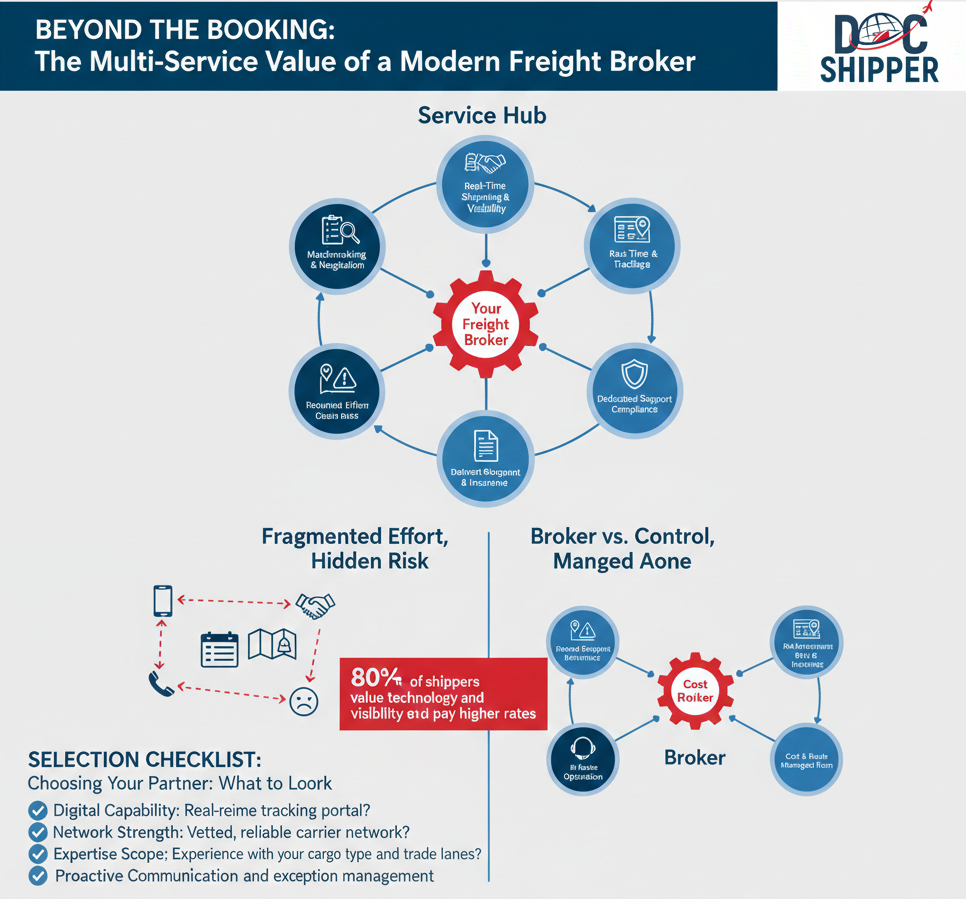
What a freight broker actually does for your loads (in plain English)
A freight broker sits in the middle of your shipment and makes the match between you, the shipper, and the carrier that will physically move the freight.
In day-to-day freight brokerage, you’re buying capacity, rate negotiation, and execution muscle, without running a carrier operation yourself.
You’ve probably been there, a carrier cancels last minute, spot rates spike, and suddenly your delivery window looks like a joke. A good broker exists for exactly that moment.
From experience at DocShipper, the best results come when you treat the broker like a third-party logistics partner for transportation, not a “phone number for trucks.”
DocShipper Info
DocShipper audits your flows, then designs the right freight brokerage mix so you buy capacity smartly, not blindly.
Core responsibilities between shipper and carrier
Last peak season, we saw a consumer goods shipper tender a full truckload on Friday afternoon, then get hit with a surprise “no truck available” call on Monday morning. The freight broker who saved the week wasn’t the cheapest, they were the fastest at finding a legal, insured backup and locking the lane.
At the core, freight broker services cover the parts that usually blow up when you’re busy running your business, not running logistics.
Here’s what you’re typically paying a freight shipping broker to handle, end to end.
- Freight quote management, comparing contract pricing vs. spot rates for your lane
- Rate negotiation with carriers, including accessorial fees like liftgate, inside delivery, and appointment scheduling
- Carrier vetting, verifying operating authority, safety history, and FMCSA compliance under DOT regulations
- Load tender and dispatch, confirming pickup details with shipper and instructions for the driver
- Shipment tracking and exception management, including reschedules and breakdown recovery
- Paperwork help, especially the bill of lading, POD, and document cleanup when the consignee refuses to sign
- Freight invoice checks, freight audit support, and dispute handling for detention charges
- Freight claim support when goods are lost or damaged, including timelines and evidence collection
To make this practical, use this quick checklist when you’re evaluating whether a broker is actually protecting you.
- They explain their brokerage license status, their bond and insurance, and how they verify carriers
- They can show a carrier selection process, not just a load board screenshot
- They proactively warn you about detention charges and common accessorial fees on your lanes
- They offer consistent shipment tracking touchpoints and escalation rules
One detail you’ll notice fast, serious brokers talk about capacity planning, lane optimization, and backhaul opportunities, not only “we can cover it.”
Key differences vs. freight forwarders, carriers, and dispatchers

Tip: if you’re not sure who you need, start by asking one question, “Who is legally responsible for transporting the freight, and who physically touches it?” That single line usually clears the fog around freight broker vs. freight forwarding vs. carrier roles.
A broker generally arranges domestic transport with authorized carriers, while freight forwarding often bundles international movement, consolidation, and sometimes customs clearance via agents.
The cleanest way to compare is side by side.
| Role | What they do | What you should watch |
| Freight broker | Arranges transport between shipper and carrier, manages tender, tracking, billing support | Margin transparency, carrier vetting, freight broker insurance expectations vs. carrier cargo insurance |
| Carrier | Physically moves the freight with its assets and drivers | Insurance limits, service area, claims process, detention rules |
| Dispatcher | Finds loads for a carrier or owner-operator, manages driver schedules | They work for the truck side, not for you, even if they’re friendly |
| Freight forwarder | Organizes international shipments, may consolidate cargo, coordinate intermodal transport and documents | Who holds contracts, Incoterms alignment, when customs clearance is included |
| 3PL | Can manage multiple logistics functions, transportation plus warehousing and value-added services | Scope creep, SLAs, and what sits inside the freight contract |
One more nuance, ocean freight brokers exist too, but the ocean world often behaves more like forwarding, with bookings, cutoffs, and sea carrier allocations.
If you’re shipping internationally, you’ll often combine models, a forwarder (or 3PL) for origin handling and compliance, and a broker for inland drayage or final-mile capacity.
For context, FIATA’s definitions and guidelines are often referenced in the forwarding world, which is why you’ll see different documentation habits compared to domestic brokerage.
DocShipper Advice
DocShipper helps you orchestrate forwarding, brokerage, and 3PL so each partner owns a clear, profitable piece of the chain.
DocShipper Info
DocShipper acts as your outsourced ops team, from quote to POD, aligning carriers, shipment tracking, and documentation in one playbook.
Step-by-step: how a freight broker manages a shipment from quote to delivery
A freight broker earns their keep in the small details, the ones that turn a clean plan into a late truck and a messy claim.
You’re not just buying phone calls, you’re buying a repeatable execution flow, usually powered by a transportation management system or TMS, plus carrier relationships that can absorb volatility.
We’ve seen shipments fail from something as simple as the wrong consignee hours being copied into the load tender. That’s why process matters.
Industry research bodies like the World Economic Forum regularly highlight resilience as a core supply chain advantage, and brokerage execution is a very practical version of that idea.
From order tender and load scheduling to loading and transit

Question: what actually happens between “send me a quote” and “the truck is on the way”? This is where most shippers underestimate the work a freight broker does.
Good freight broker services start before a truck is even booked, because the broker is already filtering risk, pricing, and timing.
Here’s the workflow you should expect to see, step by step.
Shipment workflow (broker-managed):
1) You share lane details, commodity, weight, dimensions, pickup and delivery windows, and any special handling.
2) The broker returns a freight quote, explaining assumptions, accessorials, and whether it’s contract pricing or spot rates.
3) You confirm and issue the load tender, with shipper, consignee, reference numbers, and requirements.
4) The broker books a carrier, confirms equipment type, and validates operating authority and insurance.
5) Dispatch goes out, driver details are shared, and pickup appointment gets locked.
6) Loading happens, the bill of lading is signed, and transit begins with shipment tracking updates.
Expect them to actively manage known friction points, like detention charges, “first come first served” docks, and last-minute pallet count changes that trigger accessorial fees.
If your freight is less-than-truckload, the broker should also brief you on terminal handling and the higher chance of claims. If it’s full truckload, they should focus on appointment discipline and on-time performance.
And if your move includes intermodal transport or drayage, the broker should talk cutoffs, chassis availability, and container returns, not vague promises.

Looking for a Reliable Shipping & Sourcing Partner?
Unloading, documents, billing, and claims support
Bold truth: delivery is not the finish line, paperwork is. A freight broker who disappears after “delivered” will cost you time and money.
This is the part where your consignee signs the POD, someone finds damage, and then everyone suddenly wants documentation you don’t have.
When the process is tight, you get clean billing, cleaner audits, and far fewer surprises tied to freight invoice corrections.
Here are the post-delivery services you should expect from a serious broker or freight shipping broker.
- Document control, POD collection, BOL cleanup, and exception notes when receivers add remarks
- Freight audit support, checking contracted accessorials vs. billed accessorials
- Dispute handling for detention charges, layover, and redelivery attempts
- Freight claim support, including timelines, photos, packaging evidence, and carrier notice requirements
- Shipment tracking history and milestone reporting, often pulled from a TMS
You’ll also want clarity on risk coverage, because this is where many shippers get confused about freight broker insurance.
Broker coverage is not the same as carrier cargo insurance, and it doesn’t automatically make you whole for every loss. You should confirm who carries what, and when you need shipper’s interest cargo insurance.
One insider note, if your broker offers a freight broker agent program, ask how they control agent quality and compliance. In brokerage, the agent model can be excellent, but only if the back office enforces carrier vetting and documentation discipline.
If you want a practical safety net, we can help you design the handoffs between brokerage, forwarding, and 3PL operations so your documents, claims, and compliance don’t fall through the cracks.
When you should use a freight broker (and when you shouldn’t)
You’ve probably been there, a freight broker jumps in after a carrier cancels at the last minute, and suddenly your shipment still moves on time. We’ve seen this exact scramble play out for an importer moving machinery from China to Europe, where the broker’s carrier network saved a week of production downtime.
Here’s the thing, brokers shine when flexibility beats rigid contracts, but they’re not magic. The World Trade Organization has often highlighted how fragmented transport markets reward intermediaries, yet that same setup can add cost if misused.
To help you decide fast, here’s a simple checklist we use with clients before recommending a broker.
- You benefit from a broker if you ship spot loads or face seasonal volume spikes.
- You gain speed if you lack direct carrier contracts or route specialists.
- You should avoid one if you run fixed high volumes with negotiated carrier rates.
- You’ll likely overpay if you expect guaranteed capacity without planning.
From experience, the sweet spot is clear, use a broker as a capacity buffer, not as a permanent crutch.
How to choose the right freight broker for your business
Here’s a direct tip, don’t start with rates, start with process when selecting a freight broker. We once worked with a retailer who chose the cheapest quote, only to discover delayed PODs and billing errors that killed their cash flow.
You’ll notice fast that strong brokers think like supply chain managers, not salespeople. The Freight Forwarders Association and FIATA both stress operational transparency as a key trust marker, and that applies to brokers too.
Use this comparison table to pressure-test your shortlist before committing.
| Criteria | Weak Broker | Reliable Broker |
| Carrier vetting | Unverified or outdated | Active compliance checks |
| Tracking visibility | Manual updates only | Real-time digital tracking |
| Claims handling | Deflects responsibility | Structured claims support |
At DocShipper, we review these points with you line by line, because choosing wrong once often costs more than switching later.
Conclusion
So, do you really need a freight broker, or just clearer logistics control? We’ve seen importers answer that question the hard way after missed deliveries, and others gain calm overnight with the right partner.
To lock everything in, here are the key takeaways you should remember before your next shipment.
- A freight broker adds value when speed and flexibility matter more than fixed pricing.
- The wrong broker increases costs through poor carrier control and weak follow-up.
- Clear selection criteria protect you more than chasing the lowest quote.
- Used strategically, brokers simplify shipping instead of complicating it.
If you’re unsure where you stand, we help you map that decision and avoid expensive trial and error.
FAQ | Freight broker guide: how middlemen cut your costs and simplify shipping
In simple terms, a freight broker is a licensed intermediary that arranges but does not perform transportation. Concretely, that means:
- They hold a brokerage authority (in the U.S., an FMCSA license) and a surety bond.
- They match your shipment with a carrier that has the right equipment, authority, and insurance.
- They negotiate the buy rate with the carrier and the sell rate with you, keeping the margin.
- They coordinate instructions, documents, and tracking, but the carrier’s name appears as the transporter.
When you sign a brokerage agreement, you’re not hiring a trucking company; you’re hiring a specialist to find and manage trucking companies on your behalf under specific terms and liability limits.
If you want to broker freight in the U.S., yes, you need a Motor Carrier (MC) number for brokerage authority. Basic compliance usually includes:
- Applying for broker authority (FMCSA Form OP-1 or its current equivalent) and receiving your MC number.
- Obtaining a freight broker surety bond (BMC-84) or trust fund (BMC-85), currently set at $75,000.
- Assigning a process agent in each state (Form BOC-3).
- Registering with the Unified Carrier Registration (UCR), where applicable.
- Maintaining records of loads, carriers used, and financial transactions.
On top of that, you should build internal procedures for:
- Carrier vetting (authority, insurance, safety scores).
- Written broker–carrier agreements.
- Clear terms and conditions with shippers.
Without proper authority and bonding, you’re effectively operating as an unlicensed middleman, which can expose you to penalties and unpaid-claim disputes.
You don’t need a huge team, but you do need a focused plan. The brokers who gain traction fast usually:
1) Specialize early
- Pick 1–2 industries or lanes you understand (e.g., building materials in the Midwest, reefer loads in specific corridors).
- Learn their peak seasons, common accessorials, and typical pain points.
2) Use targeted outreach
- Build a list of manufacturers, distributors, and importers in your niche (using trade shows, online directories, customs data providers, LinkedIn).
- Reach out with highly specific offers, for example: “We help XYZ companies cut missed appointment fees on Chicago–Dallas LTL.”
3) Leverage carrier relationships
- Talk to small carriers about their best lanes and underused capacity; then prospect shippers that fit those lanes.
- Ask carriers what shippers they’d like introductions to and offer joint solutions.
4) Prove value quickly
- Offer to start with problematic lanes or spot loads, not all the business at once.
- Provide post-move summaries (on-time %, issues caught, claim help) to build trust and referrals.
Consistency in a narrow segment beats generic “we move anything, anywhere” messaging for winning your first shipper accounts.
LTL pricing is detail-sensitive. To avoid re-bills and hidden charges, you need a disciplined quote process:
1) Collect precise shipment data
- Exact weight (with packaging) and number of handling units (pallets, crates, etc.).
- Dimensions of each pallet (L x W x H) and whether it’s stackable.
- Freight class (or the data needed to determine it: density, commodity, packaging).
2) Clarify service conditions
- Pickup and delivery types: business with dock, limited access, residential, construction site, etc.
- Required accessorials: liftgate, inside delivery, appointment, call-ahead, hazardous, trade-show delivery.
- Time constraints: guaranteed delivery, time-specific windows, or standard transit.
3) Standardize your quoting workflow
- Use the same information set every time you request an LTL quote from carriers or platforms.
- Ask carriers/brokerage partners to spell out accessorial assumptions in writing.
- Keep a log of frequent surprise charges (reclass, reweigh, limited access) and adjust your questions upstream.
4) Educate shippers you work with
- Explain why accurate dimensions and photos of pallets matter.
- Share a simple checklist they must fill before you quote.
The more disciplined your input, the fewer “unexpected” LTL adjustments you’ll see on the final freight invoice.
A broker’s role in insurance is often misunderstood. Typically:
- The carrier provides cargo insurance that covers losses up to a certain limit and under specific conditions.
- The broker verifies that the carrier has valid cargo insurance and acceptable limits before tendering your load.
- The broker’s own insurance (like contingent cargo) usually protects the broker, not automatically you.
If you’re the shipper, ask for clarity on:
- The carrier’s cargo liability limit (e.g., $100,000 per truckload, or a per‑pound limit in LTL).
- Exclusions (high-value goods, fragile items, temperature-sensitive cargo, improper packaging).
- Whether the broker can arrange shipper’s interest cargo insurance in your name for full-value coverage.
If your cargo is valuable, sensitive, or time-critical, don’t assume the broker’s or carrier’s default policy will make you whole after a loss—consider dedicated cargo insurance tailored to the shipment value.
Need Help with
Logistics or Sourcing ?
First, we secure the right products from the right suppliers at the right price by managing the sourcing process from start to finish. Then, we simplify your shipping experience - from pickup to final delivery - ensuring any product, anywhere, is delivered at highly competitive prices.
Fill the Form
Prefer email? Send us your inquiry, and we’ll get back to you as soon as possible.
Contact us