In short ⚡
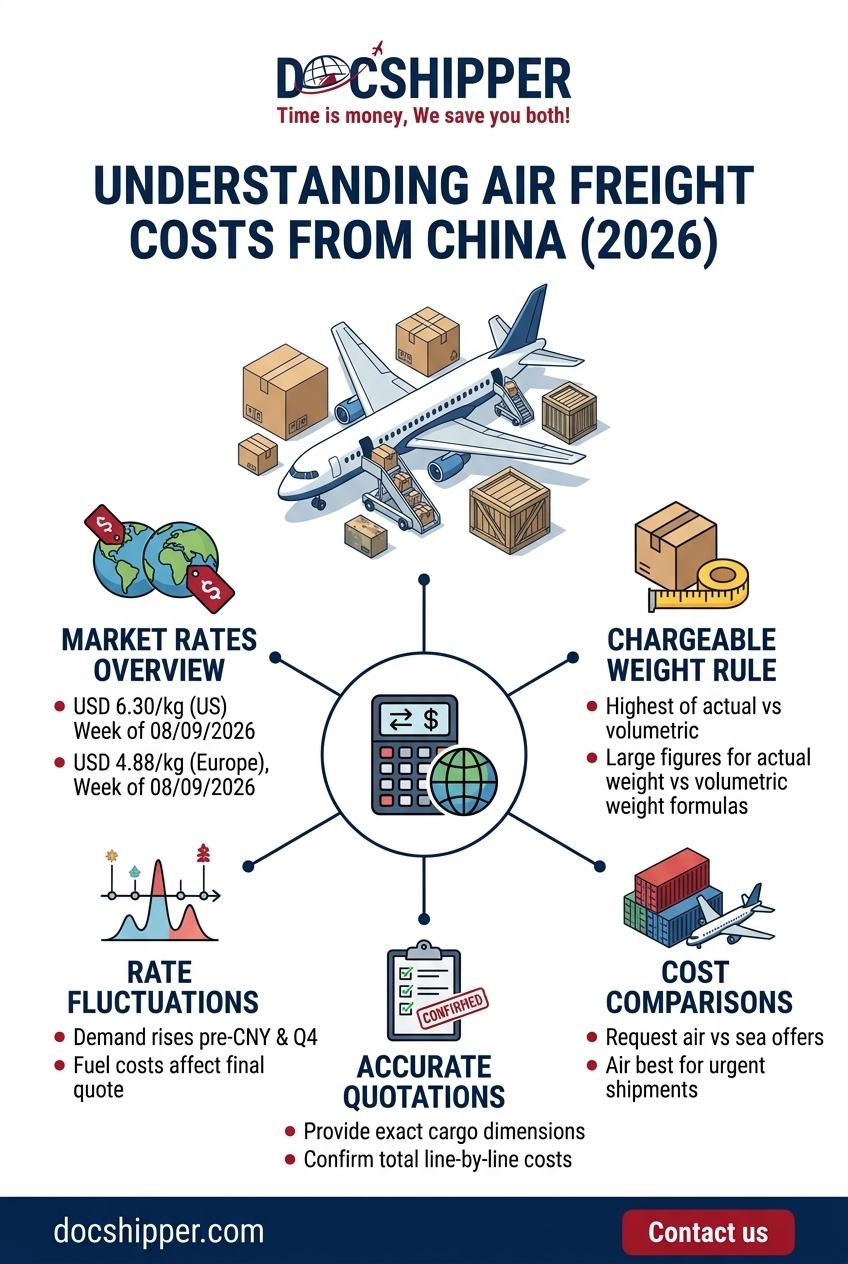
Air Freight Cost from China: Rates per Kg and What Affects Them depend on the route, shipment date, chargeable weight, service scope, surcharges, and market conditions. In September 2026, reference rates were USD 6.30/kg to North America and USD 4.88/kg to Northern Europe, excluding several additional charges. The key rates and cost drivers are:| Element | Key information |
|---|---|
| China to North America | USD 6.30/kg in the week of 8 September 2026 |
| China to Northern Europe | USD 4.88/kg in the week of 8 September 2026 |
| Chargeable weight | The higher of actual gross weight and volumetric weight; volumetric weight is calculated as length × width × height in centimetres ÷ 6,000 |
| Additional costs | Origin pickup, export handling, fuel and security surcharges, destination handling, customs clearance, duties, taxes, and final delivery |
| Factors affecting rates | Capacity, Chinese New Year and Q4 demand, fuel costs, sea disruptions, e-commerce volumes, shipment density, and service level |
| Most suitable shipments | Air freight generally suits urgent, high-value, light, or time-sensitive goods; LCL or FCL may be cheaper for larger, less urgent shipments |
You will find a breakdown of per-kilogram rates, chargeable-weight calculations, included and excluded costs, market factors, air-versus-sea options, and the information required for an accurate quote.
We hope you’ll find this article genuinely useful, but remember, if you ever feel lost at any step, whether it’s finding a supplier, validating quality, managing international shipping or customs, DocShipper can handle it all for you!
To estimate your air freight cost from China, start with a dated market rate, calculate the shipment’s chargeable weight, then add origin, destination, customs and delivery charges. In September 2026, the Freightos Air Index reported approximately USD 6.30 per kg from China to North America and USD 4.88 per kg from China to Northern Europe, before these additional costs.
This gives you an order of magnitude, not a complete door-to-door quote. The final price depends on your destination, dimensions, shipment size, service level, Incoterm, fuel surcharge and the way your forwarder calculates chargeable weight.
DocShipper Info
Request a lane-specific estimate with all surcharges included.
How much does air freight from China cost per kg in 2026?
In September 2026, air freight spot rates from China averaged about USD 6.30 per kg to North America and USD 4.88 per kg to Northern Europe, according to the Freightos Air Index. These are airport-to-airport index rates, so origin and destination charges, customs and delivery come on top.
China to the US
The Freightos Air Index showed a China-North America rate of USD 6.30/kg for the week of 8 September 2026. Use this figure as a market reference for the air transport segment, not as a guaranteed quotation for your shipment.
The North America rate was reported at USD 6.26 per kg after the 2025 peak season, on 31 December 2025. That comparison shows why an old price list can mislead you: capacity, demand and surcharges may have changed before your goods are ready to ship.
China to Europe
For China to Northern Europe, the Freightos Air Index reported USD 4.88 per kg on 8 September 2026. The same lane was reported at USD 3.52 per kg at the end of 2025, meaning the published rate increased by approximately 39% between those two dated observations.
The calculation is straightforward: USD 4.88 minus USD 3.52 equals USD 1.36 per kg; USD 1.36 divided by USD 3.52 equals approximately 38.6%. The practical lesson is simple: an undated air freight rate is not a reliable rate.
| Lane | Index rate | Date | Source | Excludes |
| China to North America | USD 6.30/kg | Week of 08/09/2026 | Freightos Air Index | Origin and destination charges, customs, duties, taxes and delivery |
| China to Northern Europe | USD 4.88/kg | Week of 08/09/2026 | Freightos Air Index | Origin and destination charges, customs, duties, taxes and delivery |
| China to North America | USD 6.26/kg | 31/12/2025 | Freightos Air Index data reported by STAT Times | Origin and destination charges, customs, duties, taxes and delivery |
| China to Northern Europe | USD 3.52/kg | 31/12/2025 | Freightos Air Index data reported by STAT Times | Origin and destination charges, customs, duties, taxes and delivery |
An index is a reference built from market data, whereas a quotation applies to a defined shipment and routing. Before comparing offers, confirm the validity period, airport pair, minimum charge, currency and whether the rate is for airport-to-airport or a broader service.
DocShipper Tips
Measure final cartons before comparing air freight offers.
Looking for a Reliable Shipping & Sourcing Partner?


How air freight cost is calculated: chargeable weight explained
Airlines generally charge the higher of the shipment’s gross weight and its volumetric weight. Volumetric weight converts space into a billable weight, commonly using this air cargo formula: length × width × height in centimetres ÷ 6,000.
For example, a light but bulky shipment can occupy as much aircraft capacity as a much heavier shipment. The carrier therefore compares the actual gross weight with the calculated volumetric weight and applies the higher figure.
Use this process before requesting quotations:
- Measure each carton in centimetres, including the final packaging.
- Multiply length by width by height for each carton.
- Divide the result by 6,000 to obtain the volumetric weight in kilograms.
- Add the volumetric weights of all cartons.
- Compare that total with the shipment’s actual gross weight.
- Use the higher figure as the estimated chargeable weight.
Air cargo and express courier services may use different rules. A divisor of 5,000 is often used by couriers, but you should verify the applicable divisor with the carrier before estimating a courier shipment.
Worked example: 20 cartons from China to Northern Europe
Assume you have 20 cartons. Each carton measures 60 × 40 × 40 cm and weighs 8 kg.
- Actual weight per carton: 8 kg.
- Total actual weight: 20 × 8 kg = 160 kg.
- Volume per carton: 60 × 40 × 40 cm = 96,000 cm³.
- Total volume: 20 × 96,000 cm³ = 1,920,000 cm³, or 1.92 m³.
- Volumetric weight: 1,920,000 ÷ 6,000 = 320 kg.
- Chargeable weight: the higher of 160 kg and 320 kg, therefore 320 kg.
- Illustrative air freight line: 320 kg × USD 4.88/kg = USD 1,561.60.
The USD 1,561.60 figure is an airport-to-airport illustration based on the September 2026 Northern Europe index rate. It does not include pickup, export handling, customs, destination handling, taxes or final delivery.
| Shipment | Actual weight | Volumetric weight | Chargeable weight |
| Dense shipment | 300 kg | 166.7 kg | 300 kg |
| 20 cartons in the example | 160 kg | 320 kg | 320 kg |
| Light shipment | 80 kg | 120 kg | 120 kg |
Packaging optimisation can reduce the bill when volumetric weight is higher. Ask your supplier whether cartons can be consolidated, redesigned or palletised without increasing damage risk, then request a quotation using the final packed dimensions rather than product dimensions.
DocShipper Info
Compare the full cost scope, from pickup through final delivery.
What is included in an air freight quote from China?
A door-to-door air freight quote combines pickup and export handling in China, the air freight rate and surcharges, destination handling, customs clearance with duties and taxes, and final delivery. Compare every line, because a lower per-kilogram rate may conceal higher fixed charges elsewhere.
An airport-to-airport index normally covers the air transport reference between specified airports. It does not normally cover the work required before cargo reaches the export airport or after it arrives at the destination airport.
| Cost item | What it covers | Included in the index rate? |
| Air freight | Transport between the agreed origin and destination airports | Yes, as the index reference |
| Fuel surcharge | Carrier adjustment linked to fuel and market conditions | Confirm separately |
| Security surcharge | Security and screening-related charges | Confirm separately |
| Origin pickup | Collection from the supplier or warehouse in China | No |
| Export clearance | Preparation and processing of export documents | No |
| Origin handling | Warehouse, terminal, documentation or consolidation charges | No |
| Destination handling | Airport terminal and handling charges after arrival | No |
| Customs clearance | Import declaration and broker processing | No |
| Duties and VAT | Taxes calculated according to the goods, value and destination rules | No |
| Final delivery | Transport from the destination airport to your address | No |
Your HS code matters because customs authorities use it to classify the goods and determine applicable duties or restrictions. The declared value, origin, destination and Incoterm also affect the final amount. For example, an airport-to-airport quotation and a door-to-door quotation do not have the same cost scope.
Ask whether the offer is based on Incoterms 2020, who is responsible for import clearance and whether duties and VAT are included or merely estimated. A quote marked “customs included” should still identify whether it includes brokerage only or also the actual duties and taxes.
For small shipments, fixed charges can represent a large share of the total. This is why two offers using the same air freight rate per kilogram can produce different totals once pickup, documentation, handling and delivery are added.
DocShipper Alert
Check validity dates and surcharges before booking.
Why Choose DocShipper
Lower risk, transparent pricing, and a single point of contact from pickup to delivery.
-
One single point of contactA dedicated consultant coordinating every step and keeping you informed.
-
9,200+ operations / 6,000+ clientsProven processes on China ↔ EU/US lanes (FCL, LCL, air, road, rail).
-
No hidden feesTransparent quotes and document guidance to avoid surprises.
What makes air freight rates go up or down?
Air freight prices move with available capacity, demand peaks, fuel costs, e-commerce volumes and disruptions that divert cargo from sea to air. Booking before peak periods and providing complete cargo information early can reduce avoidable cost, although no forwarder can guarantee a fixed market rate months in advance.
Demand often rises before Chinese New Year and during the fourth quarter, when retailers prepare for major sales periods and year-end consumption. During these periods, space may tighten and carriers may apply higher rates or stricter booking conditions.
| Factor | Possible effect | What you can do |
| Capacity | Limited aircraft space can push rates up | Book earlier and keep alternative departure dates |
| Chinese New Year | Pre-holiday demand can increase prices | Plan replenishment before the peak booking period |
| Q4 demand | Retail and e-commerce volumes can tighten capacity | Forecast stock and reserve space ahead of peak weeks |
| Fuel | Fuel surcharges can increase the total | Check whether the surcharge is included or variable |
| Sea disruption | Cargo may shift from ocean to air, increasing demand | Compare air, sea and hybrid options before an urgent shipment |
| Shipment density | Bulky goods generate more chargeable weight | Optimise packaging and use final packed dimensions |
IATA’s 2026 outlook, reported by STAT Times, projected air cargo demand growth of 2.6% in 2026 after 3.1% in 2025. Demand growth does not automatically determine your quotation, but it helps explain why capacity and pricing can remain sensitive.
In a 8 September 2026 Freightos update, Judah Levine, Head of Research at Freightos, wrote: “Climbing fuel costs are likely setting an elevated floor for container rates, but ocean prices are still largely being driven by demand trends and disruptions to capacity.” The comment concerns container rates, but it illustrates why fuel and capacity should be assessed separately rather than treated as one generic surcharge.
When requesting a rate, ask for its validity date, fuel and security surcharge basis, minimum charge, free storage period and any peak-season adjustment. Those details help you distinguish a genuinely competitive quote from a low headline rate with later additions.
DocShipper Tips
Compare total landed cost with the cost of waiting.
Air or sea freight from China: when is air worth it?
Air freight usually makes sense for urgent, high-value or light shipments, including samples, product launches and replenishment stock. Once volume and weight increase, LCL or FCL sea freight is generally cheaper per unit, so you should compare total landed cost with the financial cost of waiting.
For a 1 m³ shipment weighing 300 kg, the air chargeable weight is 300 kg because the actual weight is higher than the approximate volumetric weight of 166.7 kg. At the September 2026 Northern Europe index rate, the illustrative air freight line is 300 × USD 4.88 = USD 1,464, before other charges.
For context, the Drewry World Container Index reported a Shanghai-Rotterdam rate of USD 3,485 per 40-foot container on 24 September 2026. This is a full-container index figure, not an LCL price for 1 m³, so it cannot be divided directly to produce a valid LCL quotation.
| Option | Cost logic | Best suited to |
| Air freight | Charged mainly by chargeable weight plus handling and delivery | Urgent, valuable, light or time-sensitive goods |
| LCL sea freight | Shared-container pricing plus origin, destination and handling charges | Smaller, less urgent shipments that do not fill a container |
| FCL sea freight | Container-based pricing plus port and inland charges | Larger shipments with enough volume for a dedicated container |
| Sea-air | Combines a lower-cost ocean leg with a faster air leg | Shipments requiring a compromise between cost and speed |
Make the decision using three questions: how much does the shipment cost, how much margin or sales does faster delivery protect, and what is the cost of a stockout? For an urgent replenishment, the additional air freight may protect revenue. For planned stock with flexible delivery, sea freight may produce a better landed cost.
Above a few hundred kilograms, request both air and sea quotations using the same origin, destination, commodity, delivery address and customs assumptions. A proper comparison should include the total payable amount, not only the air rate per kilogram or the ocean rate per container.
How to get an accurate air freight quote
Give your forwarder the exact dimensions, gross weight, number of cartons, pickup address, destination, HS code, cargo value and Incoterm. With this information, the quotation can be checked line by line and the chargeable-weight calculation can be tested before booking.
- List every carton, pallet or package separately.
- Record the final packed length, width and height in centimetres.
- Record gross weight, number of pieces and total volume.
- Provide the supplier pickup address and the destination delivery address.
- State the product description, HS code if available and declared value.
- Specify whether you need airport-to-airport, airport-to-door or door-to-door service.
- Confirm the Incoterm and who will handle export and import customs.
- Ask for the validity period, transit option, surcharges and all fixed fees.
Use this request-for-quote template:
Subject: Air freight quote request from China to [destination]
Please quote air freight for the following shipment: pickup address [China address], delivery address [full destination address], product [description], HS code [code if available], declared value [currency and amount], Incoterm [term], number of cartons [quantity], dimensions [L × W × H cm per carton], gross weight [kg], total volume [m³], and ready date [date]. Please provide airport-to-airport and door-to-door options, chargeable weight, air freight, fuel and security surcharges, origin charges, destination charges, customs clearance, duties and taxes, final delivery, quote validity and payment terms.
When the quote arrives, check whether the chargeable weight matches your own calculation. Then compare the scope of service, not just the headline rate. We can prepare an air freight option from China with customs included and compare it with sea freight when the shipment profile makes that worthwhile.
DocShipper Info
Send final dimensions, weight and addresses for a door-to-door comparison.
Conclusion: key points on air freight costs from China
Use dated rates, calculate chargeable weight and compare complete quotations. The per-kilogram figure is only one part of your air freight cost from China, especially for light, bulky or small shipments.
- In September 2026, the Freightos Air Index reported about USD 4.88/kg from China to Northern Europe and USD 6.30/kg from China to North America.
- You pay on chargeable weight, meaning the higher of actual and volumetric weight.
- Air freight index rates generally exclude origin charges, destination handling, customs, duties, taxes and delivery.
- Rates can rise before Chinese New Year and during Q4 peak demand.
- For shipments above a few hundred kilograms, compare the full air option with LCL or FCL sea freight.
Need a real price for your shipment? Send us the dimensions, weight and destination, and we will quote air freight from China door-to-door with customs included, then compare it with sea freight if that makes commercial sense.
FAQ | Air Freight Cost from China: Rates per Kg and How to Estimate Your Shipment in 2026
Airlines and freight forwarders may apply a minimum chargeable weight or minimum freight charge. As a result, a shipment weighing only a few kilograms may cost more than its actual weight multiplied by the quoted rate. Ask the forwarder for the minimum charge, the applicable rate breakpoint and any fixed documentation or handling fees before comparing quotations.
The forwarder or airline may reweigh and remeasure the cargo at origin. If the revised chargeable weight is higher, the freight cost can be adjusted before departure or invoiced later. To reduce this risk, provide the final packed dimensions, include pallets or protective packaging, and keep photos or a packing specification from the supplier.
Yes, but they require additional checks and may be refused by certain airlines or routes. Lithium batteries, chemicals, aerosols and other regulated goods can require a safety data sheet, UN classification, compliant packaging, labels and a dangerous-goods declaration. Tell your forwarder about the product before booking; incorrectly describing it as general cargo can cause delays, penalties or shipment rejection.
Usually not. The carrier’s standard liability is generally limited and may not cover the full commercial value of goods lost or damaged in transit. If the shipment is valuable, fragile or difficult to replace, request separate cargo insurance and confirm its coverage, exclusions, deductible and claim procedure. Declared value is not the same as insured value unless the policy specifically says so.
Customs problems often arise when the documents do not match the physical cargo, declared value or product description. Prepare the commercial invoice, packing list and air waybill, plus any licences, certificates or product compliance documents required for the commodity and destination. Check the HS code, quantities, country of origin and importer details before pickup, because corrections can create storage, amendment or inspection charges.
Sometimes, but a lower airport-to-airport rate does not automatically mean a cheaper shipment. A less expensive gateway may involve longer pickup transport in China, additional handling, slower connections or more costly delivery at destination. Ask for comparable quotations using the same pickup and delivery addresses, then compare the full landed cost and transit time, not only the airline rate.
First confirm whether the delay concerns customs, missing documents, airline handling, unpaid charges or final delivery capacity. Ask the forwarder who currently controls the cargo, whether storage fees are accruing and what action is required to release it. Send corrected documents promptly and obtain written confirmation of the new delivery plan, especially if the goods are time-sensitive or subject to storage limits.
Need Help with
Logistics or Sourcing ?
First, we secure the right products from the right suppliers at the right price by managing the sourcing process from start to finish. Then, we simplify your shipping experience - from pickup to final delivery - ensuring any product, anywhere, is delivered at highly competitive prices.


Fill the Form
Prefer email? Send us your inquiry, and we’ll get back to you as soon as possible.
Contact us