In short ⚡
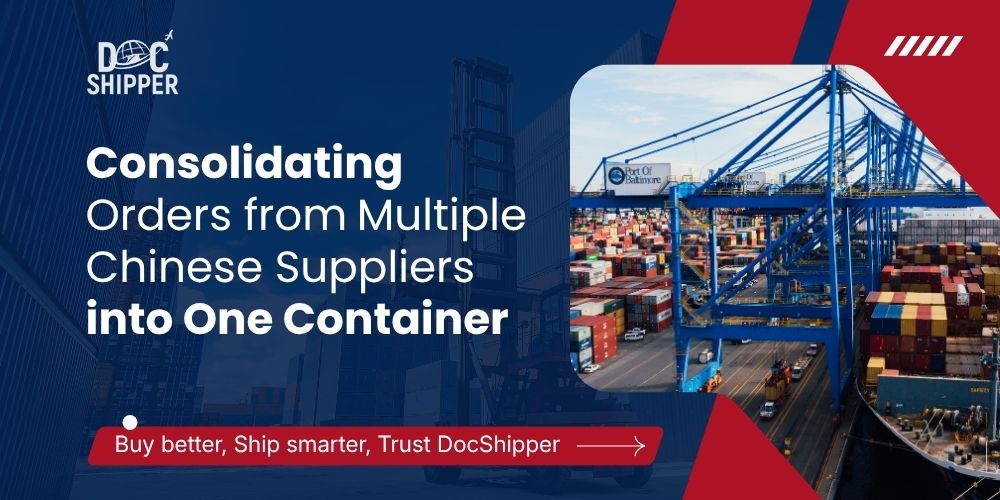
Consolidating Orders from Multiple Chinese Suppliers into One Container means sending goods from several factories to one China warehouse, combining and checking them, then shipping them as one LCL or FCL shipment. This can reduce repeated freight, handling and customs processes when suppliers meet a common readiness window.
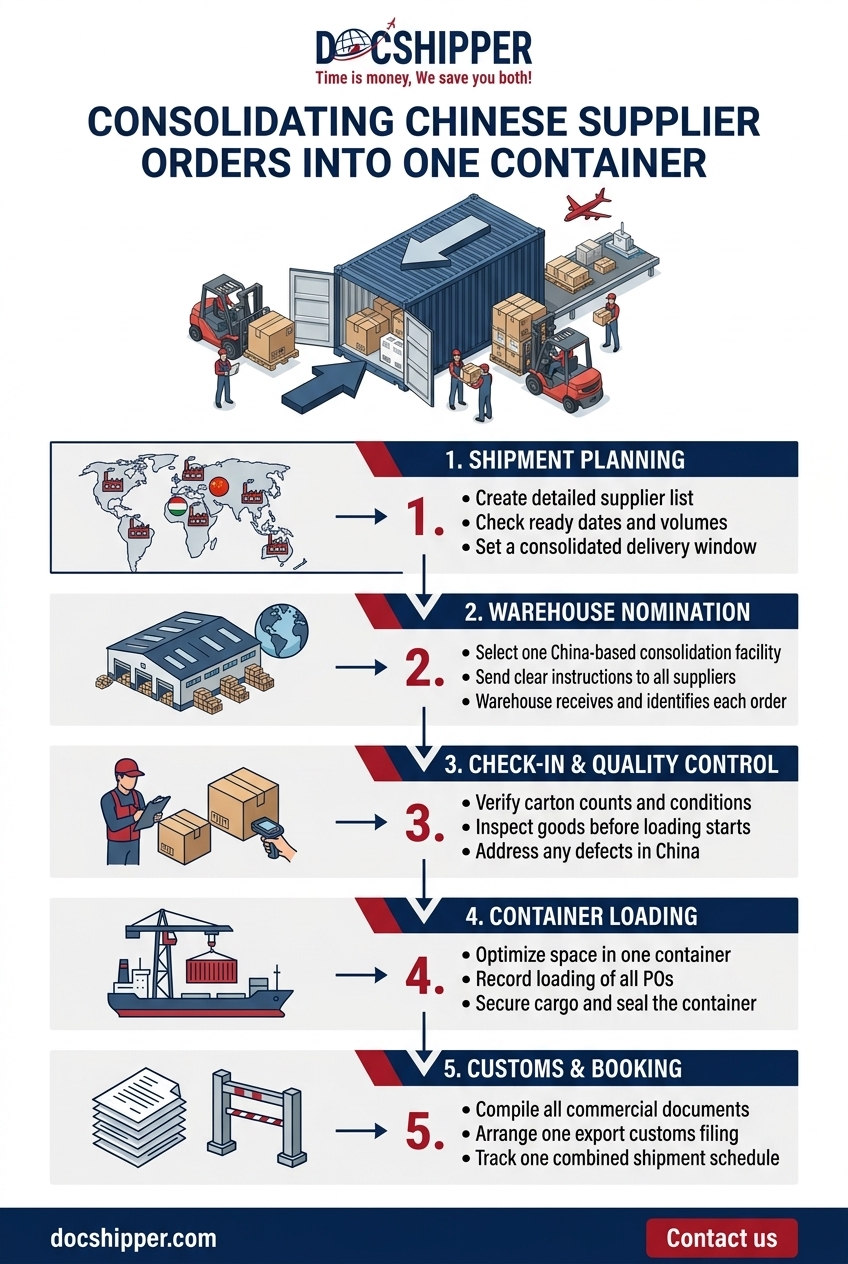
The process typically involves:
- List each supplier, PO, SKU, carton count, packed dimensions, weight and expected ready date.
- Nominate a China consolidation warehouse and give every supplier the address, receiving contact, PO references, carton labels and delivery window.
- Receive and identify each delivery, then verify carton counts, condition, labels, packing lists and quantities.
- Complete quality control, inspection, repacking or relabelling before the cargo is loaded and sealed.
- Compare separate LCL, consolidated LCL and consolidated FCL costs, including collection, storage, handling, inspection, documentation, ocean freight and customs charges.
- Confirm the final packing plan, load and seal the container, record the container and seal numbers, and coordinate export documents and customs clearance.
The guidance covers container capacity and cost comparisons, the warehouse-to-customs workflow, ready-date and quality risks, and when to choose consolidated FCL, consolidated LCL or separate shipments.
What consolidating orders from multiple suppliers actually means (and when it pays)
Consolidation, also called buyer’s consolidation, means sending goods from several Chinese suppliers to one warehouse in China, combining them there, and shipping them as one international shipment. The result can be lower freight per unit, fewer handling events and one customs entry instead of several.
Imagine three factories shipping roughly 4 to 6 CBM each. If every supplier ships separately, you may pay three LCL minimums, three sets of origin handling and three customs entries. With buyer’s consolidation, the goods move to a nominated warehouse, where they can be checked and loaded together into one FCL container or an optimised LCL shipment.
Buyer’s consolidation in plain terms
Buyer’s consolidation is controlled by the importer or its logistics partner. You decide which purchase orders belong in the same shipment, provide one warehouse address to each supplier and ask the warehouse to identify every delivery by PO, SKU or carton reference.
This is different from carrier consolidation. In carrier consolidation, a forwarder or carrier combines cargo from different unrelated customers into one container or LCL service. In buyer’s consolidation, the orders belong to you, even though they come from different factories.
The warehouse therefore becomes the meeting point for goods that were never designed to travel together. It receives the cartons, checks the quantities, holds the orders until the shipment plan is confirmed and prepares one loading operation.
The volume where it starts to make sense
Consolidation generally becomes more attractive when several LCL minimums stack up or when the combined cargo approaches the usable capacity of a container. A 20ft container holds roughly 28-33 CBM of usable volume, while a 40ft container holds roughly 58-68 CBM, depending on the equipment and loading conditions. These are reference capacities, not guaranteed quotable space. See the Maersk container equipment reference.
For example, three suppliers shipping 4 to 6 CBM each could produce a combined load of approximately 15 to 18 CBM. That may not fill a 20ft container, but combining the orders can still avoid repeated LCL minimums and duplicate origin handling. The correct comparison is not only the ocean freight rate. It is the complete cost of separate LCL shipments versus one warehouse consolidation and one export shipment.
Consolidation may be the wrong choice when one order is urgent, suppliers are ready weeks apart or the goods require incompatible handling. In those situations, waiting for the slowest supplier can create storage costs, missed sailings or a stock-out that costs more than the freight saving.
| Shipping approach | Freight events | Customs entries | Best fit |
| Separate supplier shipments | Several | Several | Small, urgent orders with very different ready dates |
| One combined LCL shipment | One consolidation plan, shared LCL movement | Usually one import entry, subject to destination requirements | Small combined volume with aligned timing |
| Buyer’s consolidated FCL | One warehouse loading and one container | One consolidated entry, subject to the destination customs regime | Combined volume approaching a container with coordinated suppliers |
The numbers: when consolidated FCL beats LCL and separate shipments
Consolidated FCL tends to beat separate LCL shipments when the cost of several LCL minimums, handling charges and customs processes exceeds the cost of one warehouse consolidation and one full-container booking. The crossover depends on live rates, volume, destination, supplier locations and timing, so container capacity alone cannot produce a universal threshold.
LCL pricing is commonly expressed per CBM, meaning cubic metre. FCL pricing is usually quoted as a container rate, so the effective cost per CBM falls as you use more of the available space. This is why combining several 4 to 6 CBM orders can change the economics even when the combined cargo is not yet a full 20ft container.
Per-CBM logic and container fill
Start by listing each supplier’s packed volume, number of pallets or cartons, gross weight and ready date. Then request two comparable scenarios: each order shipped separately by LCL, and all orders delivered to one consolidation warehouse for a combined LCL or FCL shipment.
Do not compare only the ocean line. Ask for the complete cost stack, including supplier collection, warehouse receiving, unloading, storage, inspection, repacking, export documentation, origin handling, ocean freight, destination charges and customs clearance.
Industry guidance places LCL sea freight in an indicative range of approximately US$40-180 per CBM in 2026, and suggests that consolidating small orders can reduce per-shipment freight by roughly 20-30% compared with shipping each supplier separately. This is a market indication, not a fixed saving. Confirm the actual result against a live quote for your route and cargo.
The hidden costs consolidation removes
Three separate shipments can create three minimum charges even when each order occupies only a small amount of space. They can also create repeated documentation, destination handling and broker coordination. A single consolidated shipment does not remove every charge, but it can reduce duplication.
Delay exposure also matters. One late shipment can be inconvenient; three separate shipments create three independent sailing and arrival schedules to monitor. At the same time, a consolidated container creates one important operational risk: if one supplier is late, the whole loading plan may be affected.
Container xChange reported average demurrage and detention charges of US$2,008 per container per day in 2023, down 25% from US$2,692 in 2022. This is not a fee that consolidation automatically eliminates. It shows why a delayed container, missing documents or poor readiness planning can quickly outweigh a freight saving. See the Container xChange benchmark.
Worked example without invented rates: Supplier A ships 4 CBM, Supplier B ships 5 CBM and Supplier C ships 6 CBM. Separately, the importer compares three LCL minimums, three origin handling flows and three customs processes. Under consolidation, the same 15 CBM moves to one warehouse, undergoes one receiving and loading plan, and is compared against one consolidated LCL quote or one 20ft FCL quote. The final decision requires live prices for both options, plus storage and inspection charges.
| Cost item | Three separate shipments | One consolidated shipment |
| Ocean freight | Three LCL calculations or minimums | One combined LCL or FCL calculation |
| Origin handling | Repeated for each shipment | One warehouse receiving and loading plan, plus applicable handling |
| Customs coordination | Several shipment files or entries | One consolidated file or entry where permitted |
| Warehouse work | Limited or handled separately | Receiving, identification, QC, storage and loading |
| Delay exposure | Several schedules to track | One container schedule, with greater dependence on supplier readiness |
DocShipper Advice
Request separate LCL, consolidated LCL and FCL quotes including warehouse, inspection and destination charges.
How consolidation works step by step, from PO to one container
The practical workflow is straightforward: nominate a China consolidation warehouse, give every supplier the delivery instructions and PO references, receive and check each shipment, complete quality control before loading, load one container and arrange one export and customs process.
The process works only when suppliers receive precise instructions. A warehouse address by itself is not enough. Each supplier should know the consignee or receiving name, PO number, carton markings, delivery appointment requirements, packing rules and latest acceptable arrival date.
Nominate a China warehouse and share it with suppliers
- 1. Build the shipment plan. List every supplier, PO, SKU, carton count, packed dimensions, weight, expected ready date and destination requirement.
- 2. Nominate the warehouse. Use a consolidation facility that can receive goods from different suppliers, identify them correctly and hold them until the loading plan is approved. DocShipper’s China warehousing service is the relevant operational reference.
- 3. Issue supplier instructions. Share the warehouse address, receiving contact, PO reference format, carton labels and delivery window with every factory.
- 4. Set the ready-date window. Agree that suppliers should deliver within a defined period, such as a 5 to 7 day window when the production schedules allow it. This is a planning template, not a universal requirement.
Inbound, check-in and quality control
When goods arrive, the warehouse should check the delivery against the supplier and PO reference before placing it into the consolidation stock. At minimum, confirm carton count, visible condition, labels and whether the delivery matches the expected packing list.
Quality control must take place before the container is sealed. Depending on the order, that may include quantity verification, product inspection, packaging checks, barcode or label checks, photographs, carton measurements and repacking or relabelling.
This checkpoint is important because a defect discovered after arrival is expensive to correct. A product can be inside a sealed container, mixed with other suppliers’ cargo and already committed to a sailing. DocShipper’s China inspection service explains how inspection can be structured before shipment.
Load one container and clear customs once
After all required deliveries have arrived and the QC results are accepted, the warehouse confirms the final packing plan. The loading team should record which PO and cartons enter the container, protect the cargo against movement and retain loading photographs and seal information.
The export documents must match the actual consolidated cargo. Commercial invoices, packing lists, HS classifications and shipping instructions should be checked before the container is released. The destination customs process may allow one consolidated entry, but the exact requirements depend on the importer, products and country.
- 5. Confirm readiness. Approve the received quantities, inspection results and final volumes.
- 6. Load and seal. Load the FCL, record the container and seal numbers, and retain the final loading report.
- 7. File the shipment. Coordinate export documents, ocean booking, customs clearance and destination delivery through one shipment file.
| Step | Primary owner | What to confirm |
| PO and shipment plan | Importer | Supplier list, volumes, SKUs, destination and required sailing |
| Warehouse nomination | Importer and logistics partner | Address, receiving rules, storage terms and reference format |
| Supplier delivery | Each supplier | Ready date, carton marks, packing list and delivery appointment |
| Check-in and QC | Warehouse and inspection team | Quantity, condition, packaging, labels and discrepancies |
| Container loading | Warehouse and forwarder | Final volume, loading record, container number and seal |
| Customs and shipment | Logistics partner | Commercial documents, export filing, booking and customs entry |
DocShipper Info
DocShipper can manage warehouse receiving, QC, loading, export documents and customs through one coordinated process.
Managing the risks: late suppliers, quality and coordination
The biggest consolidation risk is coordination. One supplier that is ready two weeks late can force you to choose between holding the other cargo, shipping without the late order or missing the planned sailing. A ready-date window, a defined buffer and QC before loading protect the freight saving from becoming an operational loss.
Aligning ready dates so one supplier does not hold the container
The slowest supplier sets the sailing unless you define a decision rule in advance. Before production starts, ask each factory for a realistic cargo-ready date, not only the production completion date. The goods still need packing, final inspection, domestic transport and warehouse check-in.
Use a readiness tracker with four dates: production complete, cargo ready, warehouse delivery and QC approval. Ask suppliers to report exceptions immediately. If one supplier slips, compare two options: hold the consolidated shipment and pay storage or risk missing the sailing, or ship the available cargo and handle the late order separately.
A buffer is justified because vessel schedules are not perfectly reliable. Sea-Intelligence reported global container schedule reliability of 64.1% in November 2025, meaning roughly one vessel in three was not on schedule. Use this figure as a planning warning, not as a promise about your route. See the Sea-Intelligence schedule reliability report.
Quality control before the box is sealed
QC at the consolidation warehouse should be linked to the shipment decision. If a supplier’s cartons fail inspection, the importer can hold, rework, relabel or remove them before the container is sealed. That is materially easier than discovering the issue after the cargo has crossed the sea.
For a multi-supplier load, match inspection results to the PO and carton references. Record accepted quantities, rejected quantities, photographs and corrective actions. Repacking and relabelling can also be completed while the cargo is in one location, provided the warehouse is equipped and the instructions are approved.
Consider a shipment with six suppliers where five are ready and one slips by two weeks. The decision is not simply “wait” or “ship”. Compare the storage and sailing impact of waiting with the cost and commercial impact of sending a slightly under-filled container now, then shipping the late supplier separately.
| Risk | What can happen | Mitigation |
| Late supplier | The container waits, incurs storage or misses the sailing | Set a ready-date window, track exceptions and define a partial-ship decision point |
| Defective goods | Defects travel inside a sealed container and are found at destination | Inspect at the warehouse before loading and approve corrective action |
| Mis-picked order | Goods from different POs or SKUs are mixed | Use PO references, carton marks, check-in records and loading photographs |
| Incorrect volume | The planned container or booking no longer fits the cargo | Re-measure received cargo and confirm final CBM before booking or loading |
| Document discrepancy | Customs clearance is delayed or the entry requires correction | Reconcile invoices, packing lists, HS codes and quantities before export |
Consolidate, ship separately or use LCL: choosing for your situation
Choose separate shipping for small orders with very different timelines, LCL for small combined volume that can move together without needing a full container, and consolidated FCL when the combined volume approaches container capacity and suppliers can meet a common readiness window.
Decision by volume and supplier count
Start with three questions: how much cargo will be ready together, how many suppliers are involved and how far apart are their ready dates? A single supplier with 15 CBM may be simpler than six suppliers with 15 CBM if the six factories are spread across different regions and cannot meet the same delivery window.
As a planning rule of thumb, less than 10 CBM spread over several months may favour separate shipments or ordinary LCL. Around 10 to 25 CBM arriving within one practical window may justify a consolidated 20ft comparison. At 25 CBM and above, compare a consolidated FCL carefully, while checking the remaining space, weight limits and loading constraints.
These ranges are decision prompts, not fixed market thresholds. A live quote should include collection from each factory, warehouse receiving, storage, inspection, export handling, ocean freight and destination charges. For a broader comparison of equipment and pricing logic, consult DocShipper’s FCL versus LCL cost guide.
When not to consolidate
Do not consolidate solely because one container appears cheaper on paper. If one order is urgent, one supplier is repeatedly late, or the ready dates are separated by weeks, the warehouse and delay costs may erase the saving.
Separate shipping can also be preferable when the orders have different destinations, different importers, incompatible cargo requirements or different customs treatment. In those cases, forcing the orders into one container can complicate documentation and delivery.
| Situation | Recommended method | Why | Relevant DocShipper support |
| Less than 10 CBM, suppliers ready months apart | Separate shipments or LCL | Avoid waiting for the slowest order | Sea freight |
| Small combined volume, one delivery window | Consolidated LCL | Combine cargo without paying for a largely empty FCL | Warehousing and consolidation |
| Approximately 10-25 CBM, several aligned suppliers | Compare consolidated LCL with 20ft FCL | Several LCL minimums may make one container competitive | FCL/LCL cost comparison |
| Near 20ft capacity, suppliers ready together | Consolidated 20ft FCL | One container and one loading plan can lower the effective cost per CBM | FCL booking and warehouse loading |
| 25 CBM or more with coordinated suppliers | Compare 20ft and 40ft FCL | Container fill becomes the main cost variable | FCL planning and customs clearance |
| Urgent order or widely different timelines | Ship separately | Protect availability and avoid waiting or storage | Sea freight and customs clearance |
DocShipper Advice
Compare consolidation with separate shipping when orders have different destinations, importers or customs requirements.
Key takeaways and how to set up consolidation from China
Consolidation lowers per-unit freight and customs work when combined volume approaches a container and suppliers can deliver within a controlled window. However, the freight calculation is only the starting point. Ready-date alignment and QC before loading determine whether the saving survives.
- Consolidation combines several Chinese suppliers’ orders into one container, reducing repeated freight events and potentially creating one customs entry.
- It becomes more attractive as volume approaches a 20ft container of roughly 28-33 CBM or a 40ft container of roughly 58-68 CBM, subject to equipment and loading conditions.
- Compare the full cost stack, including LCL minimums, warehouse handling, storage, inspection, customs, destination charges and delay exposure.
- Set a common ready-date window and a buffer so one late supplier does not automatically hold the entire shipment.
- Inspect and reconcile the goods at the consolidation warehouse before the container is sealed, not after arrival.
Buying from several Chinese suppliers at once? Tell DocShipper your suppliers, volumes and destination, and our China team can receive every order at one warehouse, quality-check it, load a single container and coordinate customs from origin.
DocShipper Info
Share your suppliers, volumes and destination with DocShipper for a tailored warehouse, QC, loading and customs plan.
FAQ | Consolidating Orders from Multiple Chinese Suppliers into One Container
Not automatically. Dangerous goods may require separate declarations, UN packaging, safety data sheets and carrier approval. Batteries, chemicals, aerosols and liquids can also have specific segregation or labelling requirements. Before production, provide the forwarder with the product composition, UN number if applicable, battery details and safety data sheet. The cargo should only be consolidated after the carrier confirms that all products can legally travel together.
Yes, but the commercial responsibilities must be clarified first. For example, one supplier shipping EXW may require collection from the factory, while another shipping FOB may deliver to a nominated port or warehouse. Ask your logistics partner to confirm who pays for inland transport, export clearance, warehouse delivery and origin charges for each order. Otherwise, apparently comparable supplier prices may hide duplicated or unexpected costs.
Usually, yes, provided the goods can be documented and cleared under the destination country’s rules. Each product line should remain traceable to its supplier, purchase order, commercial invoice and packing list. Do not combine cargo if one product requires a separate import licence, certification, quota or special customs procedure unless your broker confirms that the shipment can be handled correctly.
The warehouse should place the delivery on hold instead of mixing it with the other cargo. Request the supplier’s packing list, confirm the carton count and identify the goods through labels, photographs or an approved inspection. Correct the markings before loading and record the discrepancy. Loading unidentified cartons creates a preventable risk of missing goods, incorrect customs documents or shipment to the wrong customer.
Responsibility depends on the warehouse agreement, shipping terms and insurance coverage. Confirm in writing when the warehouse accepts custody, which handling activities are included, how damage is reported and whether liability is limited by weight or shipment value. Photograph cartons at arrival and keep inspection, receiving and loading records. Separate cargo insurance may be advisable because warehouse liability does not always cover the full commercial value.
There is no universal free-storage period. The warehouse may charge storage by carton, pallet, CBM or day, sometimes after a short grace period. Ask for the tariff before suppliers dispatch their orders and set a maximum holding date. If one factory is significantly late, compare the accumulated storage cost and next sailing with shipping the ready cargo separately rather than allowing the warehouse to hold everything indefinitely.
Need Help with
Logistics or Sourcing ?
First, we secure the right products from the right suppliers at the right price by managing the sourcing process from start to finish. Then, we simplify your shipping experience - from pickup to final delivery - ensuring any product, anywhere, is delivered at highly competitive prices.


Fill the Form
Prefer email? Send us your inquiry, and we’ll get back to you as soon as possible.
Contact us