Types of transportation: how to choose the best mode for your cargo and routes

  • DocShipper Team 7 Min
  • Published on April 21, 2021 Updated on January 6, 2026
img

In short ⚡

Types of transportation in freight logistics are the main modes used to move cargo—road, rail, maritime (ocean), air, pipeline, and combined intermodal or multimodal services. Each mode differs in speed, cost, capacity, risk, and paperwork, and is chosen based on cargo characteristics, route, Incoterms, customs complexity, and required transit time.

We hope you’ll find this article genuinely useful, but remember, if you ever feel lost at any step, whether it’s finding a supplier, validating quality, managing international shipping or customs,  DocShipper can handle it all for you!

Free shipping quote 24h      I want to talk to a sourcing expert

What are the main types of transportation and how do they shape your supply chain?

Picking between the types of transportation is not a theoretical exercise, it rewires your logistics costs, transit time, inventory levels, and the way you handle customs clearance.

You’ll notice fast that the “right” mode of shipment depends as much on your product and Incoterms as on your destination, your distribution network, and how much risk you can tolerate.

From experience at DocShipper, most importers get stuck when they treat transport modes like a menu item, not a system.

One real case, you’re importing fragile electronics and your supplier books “cheap sea” without planning the inland leg, so your last-mile delivery becomes a bottleneck and you pay peak road haulage rates anyway. That’s how a “low-cost” choice quietly inflates your landed cost.

To keep your decision grounded, we like the framing promoted by UNCTAD, because it ties transport choices directly to trade flows, port performance, and supply chain resilience.

DocShipper Info

Every shipment choice rewires your supply chain, but you do not need to guess alone.
Let DocShipper audit your flows and design a tailored transport mix that cuts costs while protecting transit time and customs compliance.

Core freight modes: road, rail, ocean, air, pipeline, and combined services

We once handled a shipment where the buyer insisted on air cargo “to be safe”, then realized the cargo sat two days waiting for customs brokerage and a slot at the airport warehouse. The mode was fast, the process wasn’t.

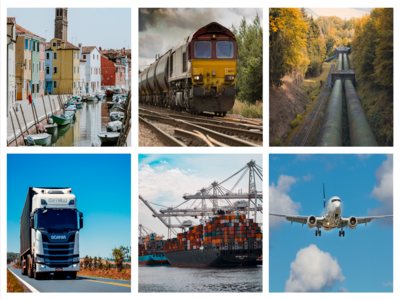
In freight transport, your modes of transport usually fall into five core buckets, plus combined services that stitch them together.

Here’s a practical breakdown of the main methods of transportation, including how they map to your daily operations like cargo handling, load planning, and carrier selection.

  • Road haulage: best for flexibility, regional moves, door-to-door service, and last-mile delivery.
  • Rail freight: strong for heavy volumes on long corridors, often paired with trucks for pickup and delivery.
  • Maritime transport (ocean freight): your go-to for global shipping, containers, and large types of freight.
  • Air cargo: built for speed, high value goods, and urgent replenishment.
  • Pipeline transport: limited to liquids and gases, but extremely efficient where available.
  • Intermodal transport and multimodal transport: combined services that connect two or more modes under a defined liability structure and operating plan.

And yes, people often talk about “5 transportation modes”, but in real supply chains you’ll almost always add a combined leg, especially for international import export.

Just to avoid confusion, public transport and private transport matter more in passenger transport, while in freight forwarding you care about freight networks, carriers, and service levels.

Key factors that differentiate transportation methods (speed, cost, capacity, risk)
Tip: before you compare the types of transportation modes, lock your objective, do you need the fastest transit time, the lowest freight rates, or the most predictable ETA?

Even “simple” choices like ocean vs air change your cash cycle, because your inventory sits in motion longer, and your tariffs and VAT timing can shift based on arrival and regulatory compliance steps.

To make your decision operational, use this quick checklist before you start booking shipment options.

  • Speed: required transit time and buffer for disruption.
  • Total landed cost: freight rates, local charges, handling, warehousing, and insurance.
  • Capacity: volume, weight, and peak season constraints.
  • Risk profile: damage, theft, temperature exposure, and delay sensitivity.
  • Paperwork: bill of lading needs, export docs, and customs clearance complexity.
  • Incoterms: who controls the main carriage, who pays, and who carries which risks.
  • Sustainability: emissions targets and sustainable transport requirements from your customers.

Once you’ve answered these, you can set up a transportation management system ruleset, or at least a playbook, that standardizes decisions instead of reinventing them shipment by shipment.

How each transportation mode works: pros, cons, and best-use scenarios

When you compare types of transportation, you’re really comparing operating models, schedules, handling intensity, and where delays typically happen in the chain.

You’ve probably dealt with that classic headache: the carrier is “on time”, but congestion, missed cut-offs, or a documentation error pushes the delivery out anyway.

We’ve seen it in a simple import: ocean arrived as scheduled, then one mismatch between the commercial invoice and the packing list slowed customs clearance and the container burned demurrage at the terminal. Painful, and avoidable.

One useful reference point is IATA standards for air cargo processes, because they remind you that speed only works when documentation and handling discipline are tight.

DocShipper Advice

Each freight mode hides different cut-offs, bottlenecks and costs, especially at handoffs.
Ask DocShipper to map your full route, from booking to clearance, and turn these weak points into a predictable, trackable transport plan.

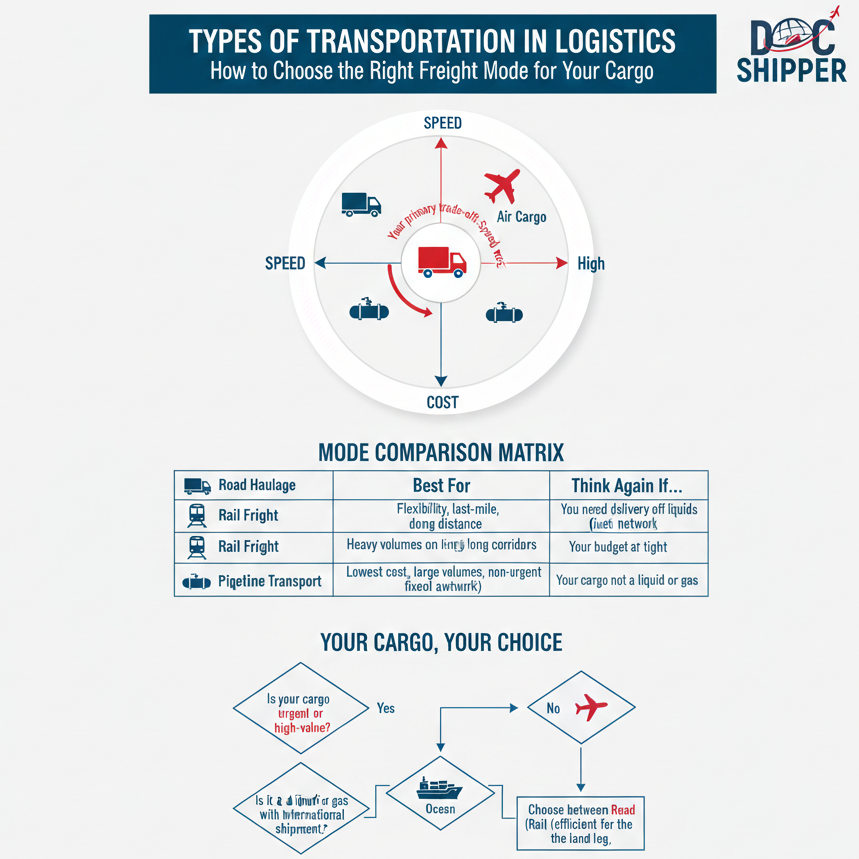
Road, rail, ocean, air, and pipeline compared by transit time, price, and reliability

Is there a single “best” option among the main modes of transport, or does it always depend on your cargo and route?

It depends, but you can still compare the core transportation methods side by side and make a clean first decision.

Use this table as a fast filter before you go deeper into routing, fleet management, and warehousing strategy.

Mode Typical strengths Main drawbacks Best-use scenarios
Road haulage Flexible routing, strong for last-mile delivery, easy door-to-door Costly long distance, driver and fuel volatility, border delays Regional distribution, cross-border short to mid range, time-sensitive domestic legs
Rail freight High capacity, stable for long corridors, good sustainable transport option Fixed networks, terminal handling, requires drayage trucks Heavy freight inland, long distance bulk, port-to-hub moves
Maritime transport Lowest unit cost, huge capacity, ideal for containers and many types of freight Long transit time, port congestion, schedule variability International shipping of non-urgent goods, high volume replenishment
Air cargo Fastest, high reliability on core lanes, lower in-transit inventory Highest cost, dimensional constraints, strict packaging and screening Urgent spares, high value goods, launch deadlines
Pipeline transport Continuous flow, very low loss rate, predictable economics Limited to specific commodities and routes, heavy regulation Oil, gas, chemicals where infrastructure exists

Inside these big categories, you’ll also choose service levels, like LTL vs FTL on road, block train vs single wagons on rail, and FCL vs LCL in ocean.

That’s where a solid freight forwarding partner earns their keep, because the “mode” is only half the story, the service design is the other half.

Looking for a Reliable Shipping & Sourcing Partner?

We handle the entire sourcing process, supplier research, negotiation, production, and inspections, so you can focus on what matters most: growing your business.

When to use intermodal and multimodal transport to optimize complex shipments

Intermodal and multimodal transport are not exotic options, they’re how you make international shipping actually work when no single carrier can cover the whole route efficiently.

Here’s the thing, most delays don’t happen on the ocean or in the air, they happen at the handoffs, terminal transfers, port gates, inland depots, and paperwork checkpoints.

To keep those handoffs under control, use this simple workflow to design a combined route and avoid the usual surprises in carriage of goods.

Step-by-step workflow:

  • Step 1: Define your shipment profile, HS codes, cargo value, packing constraints, and any dangerous goods rules.
  • Step 2: Confirm your Incoterms and who controls each leg, pickup, main carriage, and on-carriage.
  • Step 3: Choose the trunk leg first (ocean, air, rail), then design pre-carriage and on-carriage around it.
  • Step 4: Map handoff points, port, rail terminal, airport, inland depot, and assign responsibility for cargo handling.
  • Step 5: Align documents, bill of lading or airwaybill, commercial docs, and customs brokerage plan.
  • Step 6: Add protection, transit insurance, packaging specs, and exception management rules.
  • Step 7: Execute with tracking and alerts in your transportation management system, then review performance and adjust.

In practice, the most common combinations for international shipping look like ocean + road (port drayage and delivery), air + road (airport pickup and final delivery), and in some corridors rail + road for inland continuity.

If you want a true door-to-door service with fewer gray zones, we can structure multimodal shipments where liability and milestones stay clear, even across borders, tariffs, and compliance checks.

Freight transportation modes in detail: road, rail, ocean, air, and pipeline

Last year, you might remember a shipment stuck between Ningbo and Rotterdam for weeks, and that moment usually pushes you to rethink types of transportation at a deeper level. We’ve lived that exact scenario with a client whose ocean container missed a transshipment window, and suddenly road and rail became part of the rescue plan.

Here’s the thing, once you break freight down by road, rail, ocean, air, and pipeline, you’ll notice fast how each mode behaves differently in your supply chain, from transit time to risk exposure, as tracked by bodies like the International Maritime Organization.

Before diving into details, this comparison will help you visualize how each freight mode actually performs in real operations.

Mode How it works Main advantages Key limitations
Road Door-to-door via trucks Flexible routes, fast setup Capacity limits, fuel cost volatility
Rail Scheduled trains over fixed lines Stable pricing, heavy cargo Terminal dependency
Ocean Container or bulk vessels Lowest cost per unit Long transit, port congestion
Air Cargo aircraft and belly freight Fastest global reach High price, volume limits
Pipeline Fixed infrastructure flow Continuous, low-loss transport Only for liquids and gas

How to choose the right transportation type for your cargo, budget, and timelines

Here’s a direct tip from our side, if you don’t align cargo value and urgency with the right types of transportation, you’ll overpay or miss delivery windows. We’ve seen importers book air freight for products that could easily tolerate ocean transit, simply because no one challenged the default choice.

From experience, the smartest decisions come from a short evaluation routine that reflects Incoterms and risk transfer logic defined by the ICC.

Use this quick checklist we rely on internally when advising you on freight mode selection.

  • Cargo value and sensitivity, fragile or high value goods lean toward air or rail.
  • Transit time tolerance, fixed launch dates rarely survive ocean delays.
  • Budget ceiling, always calculate landed cost, not freight alone.
  • Routing complexity, multiple handovers often justify intermodal solutions.
  • Customs and compliance risk, some borders favor rail over road.

We recently helped a buyer shipping electronics from Shenzhen to Paris, combining ocean and rail saved 18 percent while keeping deadlines intact.

DocShipper Alert

Choosing a mode without aligning it to cargo, budget and deadlines can quietly destroy your margins.
DocShipper builds scenario comparisons so you see transit time, landed cost and risk before you book the shipment.

Conclusion

So which types of transportation should you actually trust for your next shipment? You’ve probably noticed by now that there’s no universal answer, only trade-offs that depend on your cargo, cash flow, and deadlines.

At DocShipper, we’ve learned that the best outcomes come when you treat transport as a strategy, not a line item, and that’s where real savings and reliability show up.

  • Road and rail give you regional flexibility and predictable volumes.
  • Ocean freight stays unbeatable on cost for large international flows.
  • Air freight protects urgency and high-value goods.
  • Intermodal combinations often deliver the best balance for global shipping.

FAQ | Types of transportation: how to choose the best mode for your cargo and routes

“Safest” depends on what risk you’re trying to minimize (accident, theft, damage, leakage). Broadly:

  • Pipeline
  • Extremely low loss and incident rate for liquids/gases once built.
  • Highly controlled, but only for specific commodities and routes.
  • Rail
  • Very good safety record for heavy and bulk cargo.
  • Fewer accidents per ton‑kilometer than road, but depends on infrastructure quality.
  • Air
  • Strong security and handling standards; tight procedures.
  • Good for high‑value, fragile, or urgent cargo if correctly packed.
  • Ocean
  • Overall safe for containers and bulk, but exposed to weather and port risks.
  • Mis-declared or poorly stowed cargo is the main issue, not the mode itself.
  • Road
  • Most exposed to theft, accidents, and handling shocks, especially on long distances.
  • Safety varies a lot by country and operator.

If you want to maximize safety in practice:

  • Choose rail or pipeline where possible for bulk commodities.
  • Use air for high‑value and time‑critical goods, with proper packaging and insurance.
  • Combine modes smartly (e.g. rail + road instead of very long all‑road legs).
  • Work with vetted carriers, use good packaging, seals, and cargo insurance regardless of mode.

Ask us anything!

Need Help with
Logistics or Sourcing ?

First, we secure the right products from the right suppliers at the right price by managing the sourcing process from start to finish. Then, we simplify your shipping experience - from pickup to final delivery - ensuring any product, anywhere, is delivered at highly competitive prices.

Component-15.png

Live Chat

Get instant assistance from our team—just click and start chatting!

Live Chat Now
image

Fill the Form

Prefer email? Send us your inquiry, and we’ll get back to you as soon as possible.

Contact us
image
Component-15.png

Call us

Reach out to us on WhatsApp for quick, convenient, and personal support.

Call us
image
Component-15.png