Fiber optic manufacturers: how to choose the best partner for your network projects

  • DocShipper Team 24 Min
  • Published on October 6, 2022 Updated on December 17, 2025
img

In short ⚡

Fiber optic manufacturers are not just cable producers; they act as strategic supply chain partners that shape your logistics, freight forwarding choices, lead times, shipping costs, and customs clearance risk. The best manufacturers help optimize containerization, palletization, cargo consolidation, and delivery terms across telecom, data center, and industrial projects to keep network rollouts on schedule and under control.

We hope you’ll find this article genuinely useful, but remember, if you ever feel lost at any step, whether it’s finding a supplier, validating quality, managing international shipping or customs,  DocShipper can handle it all for you!

Free shipping quote 24h      I want to talk to a sourcing expert

What you must know about fiber optic manufacturers before you start sourcing

Before you start talking to fiber optic manufacturers, you need to understand how they fit into your broader logistics, supply chain, and procurement strategy. You are not just buying cables, you are locking yourself into a partner who will impact your freight forwarding choices, shipping costs, lead time, and even your customs clearance risk for years.


We see too many buyers obsess on price per meter and forget about freight rate, Incoterms, transit time, and how the factory manages cargo, containerization, and warehousing before dispatch. That is usually when projects start to slip and your inventory management gets messy with delays, partial shipments, and damaged reels.


From DocShipper’s experience, once you treat the manufacturer as a core part of your distribution center and order fulfillment chain, your decisions about who to work with, how to negotiate, and how to plan capacity become much clearer. You will see why this matters in the next sections.


DocShipper Info

Choosing the right manufacturer is only half the game, structuring a resilient logistics setup around them is what keeps your projects on schedule. DocShipper connects your sourcing decisions with concrete freight forwarding, customs and warehousing solutions, so your reels, hardware and accessories move as planned. From Incoterms negotiation and tariff classification to door to door delivery, our team coordinates every stakeholder so you avoid delays, hidden costs and operational chaos.

Key roles fiber manufacturers play in telecom, data center, and industrial projects

We once supported a telecom operator who picked a cheap supplier without checking how they handled cargo flows and shipment tracking. The fiber optic manufacturer delivered the right spec on paper, but poor load planning, sloppy palletization, and no traceability caused weeks of delay on site. The issue was not the cable, it was the transportation ecosystem around it.


In telecom, data center, and industrial environments, a good fiber optic partner is not just a factory. They act as a key node in your supply chain, impacting how you manage reverse logistics for returns, how fast you can respond to project changes, and how reliable your multimodal transport plan is from factory gate to last splice.


Here is how a strong manufacturer typically supports your projects and your logistics operations at the same time:


  • Telecom projects: design of outside-plant cables, advising on drum lengths to optimize containerization and reduce waste in the field.
  • Data centers: high-density patch cords and MPO trunks, with tight tolerances and strict warehousing rules to avoid microbends and damage.
  • Industrial networks: armored and metal-intensive products that require careful palletization, bonded warehouse storage, and robust carrier contracts.
  • Project coordination: aligning production slots with your freight forwarder, freight tendering cycles, and route optimization choices.

If your fiber optic manufacturers are not used to coordinating with third-party logistics providers and supporting complex order fulfillment schedules, you will feel it the first time you run a multi-site rollout with tight delivery terms.


Main product categories you will see in manufacturer catalogs

When you open a catalog from serious fiber optic manufacturers, you might feel overwhelmed: dozens of cable types, hundreds of accessories, and each one with different implications for shipping, freight rate, and import duties. So let us start with a simple tip, always link each product family to its impact on your logistics and capacity planning.


Every product category has its own footprint in a container, its own sensitivity to damage, and its own effect on customs brokerage steps like tariff classification. A wrong HS code for a splice closure can block your whole cargo in customs, even if the cables were perfectly declared.


To help you map products to supply chain decisions, here is a short comparison table of typical categories and what they mean for your freight forwarding strategy:


Product category Key examples Logistics impact
Bulk fiber cables ADSS, duct, direct-buried, indoor/outdoor Heavy reels, critical for containerization, affect freight rate and load planning.
Patch cords & assemblies LC/SC patch cords, MPO/MTP trunks High value, low volume, ideal for cargo consolidation and fast air freight.
Passive hardware ODFs, splice closures, distribution boxes Bulky, need careful palletization and warehousing to avoid damage.
Metal accessories Brackets, poles parts, racks Can dominate weight in a container, important for freight tendering and route optimization.

Each of these families will also have different effects on your bill of lading descriptions, Incoterms choices, and risk levels during customs clearance. When you map products to these factors early, negotiation and supplier selection becomes much more strategic.


How global demand and 5G rollouts reshape the fiber manufacturing landscape

Why are fiber optic manufacturers sometimes suddenly “out of capacity” or pushing you to accept longer lead time? The short answer is 5G and global FTTH expansion. Every new rollout shifts their capacity planning, their carrier contracts, and even their agreements with freight brokers for outbound shipping.


When global demand peaks, factories increase batch sizes on their most profitable SKUs and deprioritize smaller, customized orders. If you do not anticipate this, your whole supply chain and order fulfillment schedule, including cargo consolidation windows and cross-docking at your distribution center, will start to slide.


From our side at DocShipper, we have seen project owners lose months because they treated fiber like a commodity with fixed transit time, when in reality production slots, multimodal transport capacity, and freight rate all spike and fluctuate. If you align your forecasts, procurement cycles, and freight forwarding bookings with your manufacturer’s real constraints, you protect your margins and your deadlines.


So when you discuss with suppliers, always connect the dots between future 5G or FTTH projects in their main markets, their current shipment tracking performance, and how flexible they are on delivery terms during peak seasons.


Compare major fiber optic manufacturing regions and what each does best

Once you understand the role of fiber optic manufacturers in your end-to-end supply chain, the next question is where to source from: China, US, Europe, or other APAC hubs. Your choice will change not only your cable quality, but also how you handle logistics, freight forwarding, customs brokerage, and total landed cost.


We see many importers comparing unit prices without considering freight rate, import duties, and regional strengths like lead time stability or available bonded warehouse options. That is usually when tariff classification mistakes, unexpected export compliance issues, or broken delivery terms destroy the initial savings.


To help you step back, let us quickly compare how the main regions perform on a few critical dimensions that impact your cargo flow and transportation strategy:


Region Typical strengths Typical trade-offs
China Very competitive pricing, huge capacity, strong export logistics ecosystem. Quality variance, need strong freight forwarding and trade compliance control.
US & Europe High quality, strong certifications, shorter transit time for local projects. Higher unit cost, sometimes rigid MOQs and less flexible cargo consolidation.
Other APAC (e.g. Vietnam, India) Improving capacity, interesting freight rate and duty positions. Less mature export logistics, more work on export compliance.

If you align your region choice with your project profile, procurement strategy, and multimodal transport needs, you will avoid many painful surprises later when your containers are on the water or stuck at customs.


DocShipper Advice

Comparing sourcing regions is tricky if you only look at ex‑works pricing. You also need to simulate different freight routes, duties and service levels before you commit. DocShipper can build side by side landed cost scenarios, including customs, local charges and realistic transit times, so you see the full picture. With our neutral comparison of routes and suppliers, you pick the region that fits your budget, deadlines and risk profile.

Strengths and risks of sourcing from China

A few years ago, we helped a client who had switched to a very cheap Chinese fiber optic manufacturer based on a trading company’s recommendation. The price looked great, but no one had checked the factory’s experience with containerization, freight invoice accuracy, or correct bill of lading details. One missing digit in the HS code caused a long customs clearance delay and huge storage fees at the port.


China remains the most powerful sourcing base for fiber, with strong clusters, aggressive pricing, and an advanced freight forwarding ecosystem, especially from ports like Ningbo, Shanghai, and Shenzhen. You can leverage competitive freight rate, fast cargo consolidation, and flexible carrier contracts if you know how to select and manage the right partner.


Here is a concise checklist you can use before you confirm any order with a Chinese supplier, focusing on both manufacturing and logistics aspects:


  • Verify export experience, check their typical Incoterms and main destination markets.
  • Ask who prepares tariff classification and how they handle export compliance paperwork.
  • Confirm how they pack reels and accessories, and whether they optimize for containerization.
  • Clarify cooperation with your freight forwarder on shipment tracking and load planning.
  • Review sample freight invoices, bill of lading drafts, and labeling to avoid customs issues.

If you control these points, sourcing in China can give you strong leverage on price and capacity planning without unacceptable risk to your transportation flows and order fulfillment.


How US, Europe, and APAC manufacturers differ on price, quality, and lead times

When you compare fiber optic manufacturers across US, Europe, and other APAC countries, you might ask: how do I balance price, transit time, and reliability of logistics? The answer depends on how sensitive your project is to lead time versus budget and how complex your shipping pattern is.


Manufacturers in the US and Europe tend to offer very consistent quality, strong documentation, and stable delivery terms inside their regions. You usually benefit from lower import duties if you are local, shorter transportation legs, and easier reverse logistics for returns or repairs, although unit prices and labor costs are higher.


Other APAC countries like Vietnam or India are emerging as alternatives that combine competitive pricing with interesting trade positions for some markets. However, you often need more support on customs brokerage, export compliance, and coordinating multimodal transport legs due to less mature warehousing and distribution center infrastructure.


From our experience at DocShipper, when your project requires very tight deadlines and predictable shipment tracking, paying more for a closer supplier can make sense. If you have more flexibility on lead time, you can unlock major savings by working with APAC plants that fit well into your cargo consolidation and freight tendering strategy.


Looking for a Reliable Shipping & Sourcing Partner?

We handle the entire sourcing process, supplier research, negotiation, production, and inspections, so you can focus on what matters most: growing your business.

When it pays to work with regional specialists instead of global giants

Global fiber optic manufacturers are not always your best choice. That might sound surprising, but for many mid-size projects, a strong regional player with tight control over logistics, warehousing, and order fulfillment can outperform a famous brand that treats you as a tiny account.


Regional specialists usually understand local customs clearance practices, realistic transit time, and specific import duties better than large global groups. They are often more flexible on Incoterms, delivery terms, and can support tailored cross-docking or last-mile delivery arrangements that fit your network build.


Here is a simple workflow to decide if a regional specialist or a global giant is better for your fiber optic manufacturer strategy:


  • Step 1: List your top 3 constraints, for example budget, lead time, certification, or multimodal transport simplicity.
  • Step 2: Check whether global giants can meet your MOQ, freight rate expectations, and capacity planning needs.
  • Step 3: Evaluate regional specialists on flexibility for cargo consolidation, bonded warehouse storage, and reverse logistics.
  • Step 4: Compare total landed cost including freight forwarding, customs brokerage, and typical freight invoices.
  • Step 5: Choose the profile that offers the best balance between technical fit and supply chain resilience.

When you run this comparison seriously, you will often find that regional specialists give you better real-world performance, especially if you coordinate them with a strong partner like DocShipper to manage the shipping, cargo flow, and end-to-end trade compliance.


Inside China’s fiber optic hubs: where different manufacturers have an edge

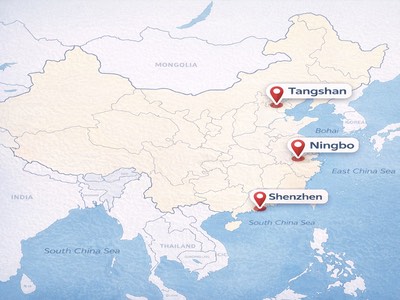
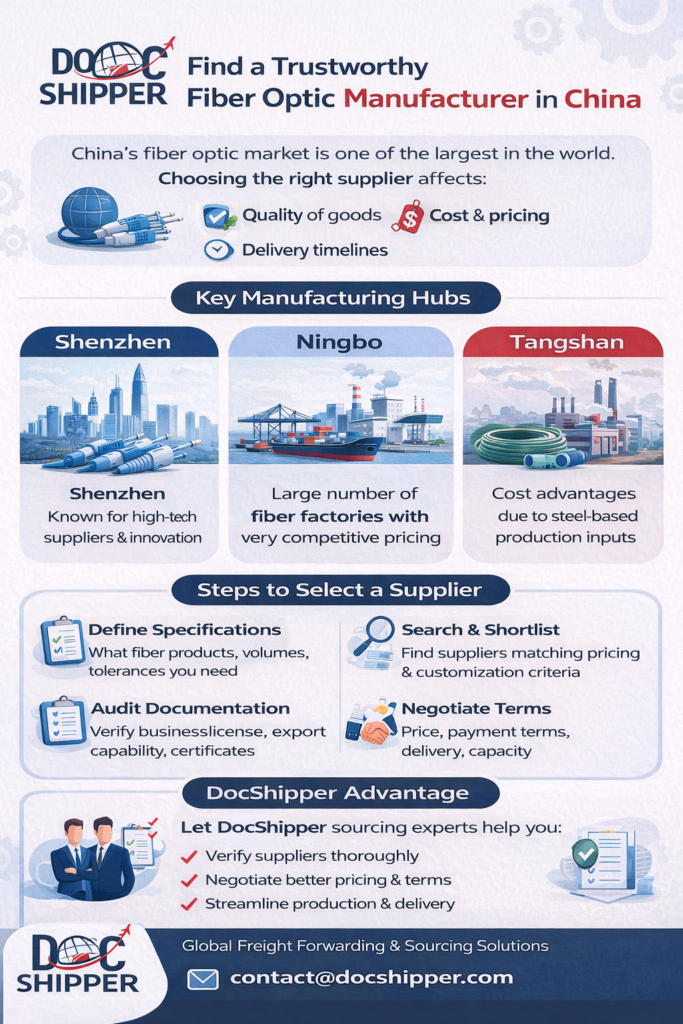
If you decide to work with Chinese fiber optic manufacturers, your next step is choosing the right city or hub. Each region has its own industrial strengths, pricing logic, and surrounding logistics ecosystem, from freight forwarding capacity and containerization efficiency to local bonded warehouse options and average transit time.


We have seen buyers source the wrong product category from the wrong city, then pay more in transportation, order fulfillment delays, and damaged goods than they saved on unit price. If you match your product mix with the right hub and a good cargo and shipping plan, your whole supply chain will feel smoother.


Before we look at Shenzhen, Ningbo, Tangshan, and other hubs, keep one thing in mind. The decision is not just about factories. It is about the surrounding distribution centers, local freight brokers, and how easy it is to manage customs clearance and export compliance for your specific destination markets.


DocShipper Alert

Once you decide to source in China, picking the wrong hub or leaving logistics to chance can wipe out your price advantage with port charges, damage or customs delays. That is exactly where DocShipper steps in. We assess the strengths of each production area, then design your end to end flow, from factory gate to destination. Our team manages cargo consolidation, export paperwork and carrier selection so your orders leave on time and arrive intact.

Shenzhen: high‑tech components, brand suppliers, and premium projects

We once coordinated a complex data center deployment for a client who needed high-density MPO assemblies and premium patch cords. The right move was to work with a Shenzhen-based fiber optic manufacturer that specialized in high-tech components and had strong ties with local third-party logistics providers for fast air freight and reliable shipment tracking.


Shenzhen is ideal when you need advanced components, brand-level performance, and tight integration with electronics suppliers. The city is deeply connected to global freight forwarding networks, offers efficient cargo consolidation, and supports flexible multimodal transport through Hong Kong, Yantian, or other nearby ports.


If you are targeting premium equipment, you should expect higher unit prices but also better control on lead time, more accurate freight invoices, and smoother customs brokerage due to mature documentation practices.


Ningbo and the Yangtze Delta: cost‑driven factories and export logistics

You have probably heard people say “go to Ningbo if you want aggressive pricing from fiber optic manufacturers”. That advice is not wrong, but you need a clear strategy for logistics, containerization, and freight tendering if you want the savings to be real.


The Yangtze Delta, especially around Ningbo and Shanghai, is packed with cost-driven factories and very strong export shipping capacity. You can benefit from sharp freight rates, efficient cargo consolidation, and competitive carrier contracts. However, quality ranges widely and some suppliers cut corners on packing, which can impact load planning and damage rates during transportation.


Before you confirm large orders in this region, you should align your supplier choice with a clear supply chain plan, including bonded warehouse use, cross-docking at origin, and realistic transit time expectations to your distribution centers.


To avoid common mistakes, here is a quick checklist for Ningbo / Yangtze Delta sourcing, with a focus on fiber optic projects and their freight forwarding dimension:


  • Confirm how the supplier optimizes drum sizes for containerization and load planning.
  • Check if they can coordinate directly with your freight broker on schedule and route optimization.
  • Verify packing standards to ensure safe palletization and reduced damage in multimodal transport.
  • Assess their experience with customs clearance documents and accurate tariff classification.
  • Discuss options for cargo consolidation with other components sourced in the Yangtze Delta.

Tangshan and Hebei: metal‑intensive accessories and hardware

If your fiber optic projects involve a lot of steel and metal hardware, Tangshan and the Hebei region can be goldmines. We have seen clients significantly cut costs on poles, brackets, and metal enclosures by pairing cable suppliers from one area with hardware manufacturers from Hebei, then managing smart cargo consolidation and containerization.


This region is known for metal-intensive production, which makes it ideal for heavy accessories that would be expensive from other hubs. However, because these products are weight intensive, they dramatically affect your freight rate, load planning, and even your choice of carrier contracts for ocean shipping.


When you plan sourcing here, you need a strong handle on shipment tracking, robust palletization standards, and clear agreements on delivery terms and Incoterms so that extra port charges or import duties do not erode your savings. The right fiber optic manufacturers in Hebei will already have experience working with international freight forwarding partners.


Other emerging cities you should not ignore

Recently, we have helped several clients work with lesser-known hubs where fiber optic manufacturers are growing fast but are not yet on every importer’s radar. Cities in inland provinces or secondary coastal ports can offer interesting pricing and more flexible capacity planning, especially when main hubs are overloaded.


The main trade-off is that logistics infrastructure and warehousing options can be less mature. You may need extra coordination on domestic transportation to the export port, more attention to bill of lading accuracy, and closer control of shipment tracking during inland multimodal transport legs.


When you consider these emerging cities, make sure you involve a strong freight forwarder early to design your cargo flow, optimize route planning, and secure reliable cross-docking or distribution center solutions. With the right setup, you can tap into new capacity without sacrificing order fulfillment reliability or trade compliance.


FAQ | Fiber optic manufacturers: how to choose the best partner for your network projects

Main red flags include: very aggressive prices compared to market averages without a clear explanation; reluctance to share certifications, test reports, or past client references; vague answers about production capacity, lead time, or how they manage demand peaks; no clear packing standards (drum protection, palletization, labeling) and no experience optimizing container loads; weak export documentation skills (they “will see later” for HS codes, declarations, or country‑specific requirements); and pressure to work only under Incoterms where they control the freight without transparency (e.g., CIF with no clear breakdown). If several of these appear together, you should either audit the factory, reduce order size, or walk away.

Ask us anything!

Need Help with
Logistics or Sourcing ?

First, we secure the right products from the right suppliers at the right price by managing the sourcing process from start to finish. Then, we simplify your shipping experience - from pickup to final delivery - ensuring any product, anywhere, is delivered at highly competitive prices.

Component-15.png

Live Chat

Get instant assistance from our team—just click and start chatting!

Live Chat Now
image

Fill the Form

Prefer email? Send us your inquiry, and we’ll get back to you as soon as possible.

Contact us
image
Component-15.png

Call us

Reach out to us on WhatsApp for quick, convenient, and personal support.

Call us
image
Component-15.png