In short ⚡
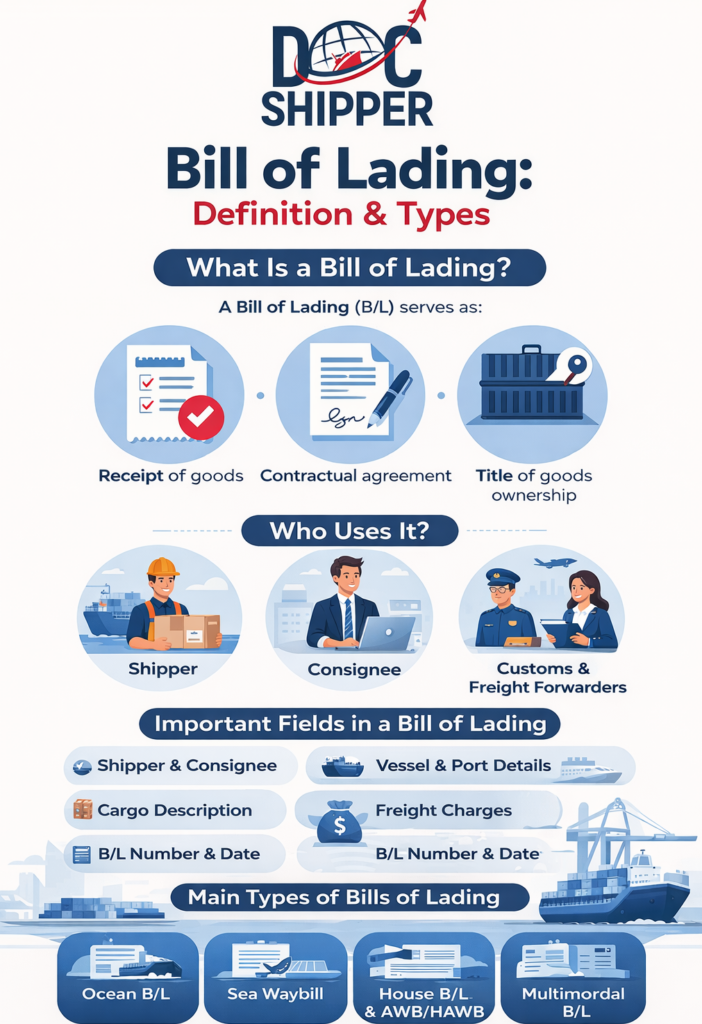
Bill of lading is a transport document issued by a carrier to confirm that goods have been received in good condition and are ready for shipment. It serves as a receipt, a contract of carriage between shipper, carrier, and consignee, and a document of title that can control ownership transfer and payment before cargo release.Don’t worry if, during your first transaction, the term “Bill of Lading” looks foreign to you. We’ll clarify the characteristics of this renowned document. The Bill of Lading (or B/L) is one of the key commercial documents used for transactions requiring transportation by land, air, or rail. A carrier will give a shipper a bill of lading to affirm that the goods have been received in good order and are prepared for shipping. These things will then be delivered to the recipient by the carrier. The Bill of Lading ultimately acts as a transportation agreement (usually for maritime transit) between the shipper, recipient, and carrier. This article will serve as an introduction to the document, enabling you to understand its purpose and how to approach it successfully.
What is a Bill of Lading?
The bill of lading is a document that a carrier gives to a shipper to affirm that the items have been received in excellent shape and are prepared for shipping. The transporter will next deliver these things to a recipient. In the end, the Bill of Lading acts as a contract of carriage, stipulating the terms of the transportation between the shipper, recipient, and carrier.
What are the Bill of Lading’s roles?
Receipt confirmation
A Bill of Lading is necessary for the execution of shipments. For commodities to move from point A (such as the country of origin) to point B, B/Ls must be issued (e.g., the destination country). It is a document used for maritime shipping in which the carrier or its representative acknowledges receiving the listed items.
Property title
The Bill of Lading acts as the commodities’ title of ownership after they arrive at their destination. To ensure that the shipment is released by the carrier and to establish ownership, the designated recipient must show the bill of Lading. In this sense, it serves as proof of delivery confirmation.
Payment guarantee
The original Bill of Lading could occasionally be kept by the shipper until payment is made. In this case, the products won’t be available to the recipient until payment has been received and the Bill of Lading has been released.
Who emits the Bill of Lading?
The only organization permitted to issue the Bill of Lading is the “carrier.” Although not all freight forwarders are NVOCCs, the term “carrier” in the context of maritime freight transportation can refer to either an ocean carrier (Vessel Operating Common Carrier) or a Non-Vessel Operating Common Carrier (NVOCC), also known as a freight forwarder (such as DocShipper). Both domestic and foreign deliveries may need a bill of lading.
What information do you have to find in a bill of lading?
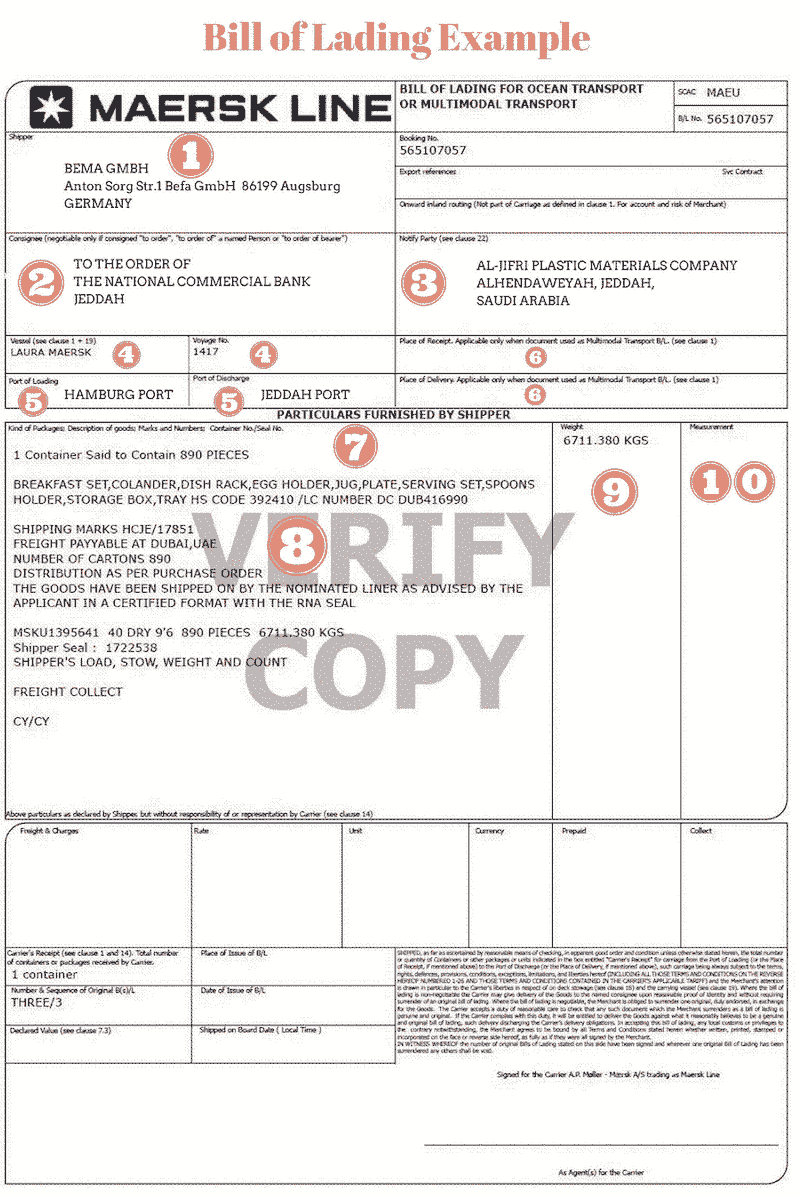
- the names of the shipper and the consignee
- the names of the ports of departure and destination
- the name of the shipping line
- the dates of departure and arrival
- a detailed list of goods transported with the number of packages and the type of packaging
- marks and numbers on the packages
- weight and/or volume of the cargo
- tariff and amount of freight.
The consequences of a lack of precision in the bill of lading
Mistakes in the preparation of bills of lading have resulted in disastrous consequences for certain transportation companies. For instance, in 2019, a court in New South Wales ruled that a freight forwarder must pay damages exceeding $800,000 for engaging in “misleading conduct.” This verdict stemmed from the bills of lading giving the false impression that they originated from maritime carriers when, in fact, they did not.
Another case serves as an example:
A Turkish trader, conducting business in Syria, procures steel from Ukraine through an intermediary. The transaction is financed via a documentary credit opened with a French bank, naming the appointed agent as the beneficiary. A Turkish bank confirms the credit, the necessary documents, including the charter-party bill of lading, are dispatched, and the documentary credit is activated.
However, two months later, the same party files a complaint in Turkish courts, alleging money laundering, fraud, and forgery/counterfeiting. They notify the beneficiary that any payment is contingent upon the outcome of the criminal proceedings. Consequently, the principal refuses to release the documents, contesting the settlement of the documentary credit.
Specifically, the issuing bank, having fulfilled its commitment, concludes that execution is unnecessary due to the fraud perpetrated to its detriment. The court of appeal grants a stay while awaiting the resolution of the criminal proceedings in Turkey, relying on Article 4 of the Criminal Procedure Code and the principle that “criminal matters take precedence over civil matters.” The ruling emphasizes that the principal’s refusal to release the documents was not solely due to document irregularities, but rather to suspicions surrounding the legality of the transaction.
These suspicions arise from indications that the seller is an empty entity, the purportedly loaded vessel does not exist, and the bill of lading is fraudulent. As a result, the autonomy of the documentary credit must yield to suspicion of fraud. The mere initiation of fraudulent activities is enough to impede the independent and irrevocable commitment made under the documentary credit.
Who is the bill of lading for?
Bills of lading serve various purposes for different parties involved in the shipping process:
Shipper
The shipper, who is usually the seller or shipping company, relies on the bill of lading as both evidence of shipment and a contractual agreement with the carrier. It includes comprehensive details about the shipment, such as the nature of the goods, quantities, packaging requirements, and delivery instructions. The shipper uses the bill of lading to ensure that the goods are transported in compliance with the agreed-upon terms.
Customs broker or freight forwarder
These professionals play a crucial role in facilitating customs clearance at international borders. They use the bill of lading to verify essential information about the goods, including product specifications, customs codes, serial numbers, and more. This enables them to prepare the necessary documentation for smooth import or export processes and ensures compliance with customs regulations.
Consignee
The consignee, who is the buyer or recipient of the goods, relies on the bill of lading as proof of ownership and entitlement to receive the goods. It contains vital delivery information, such as the consignee’s name, delivery address, and payment terms. The consignee utilizes the bill of lading to claim the goods upon arrival and to address any potential issues related to delivery or the condition of the goods.
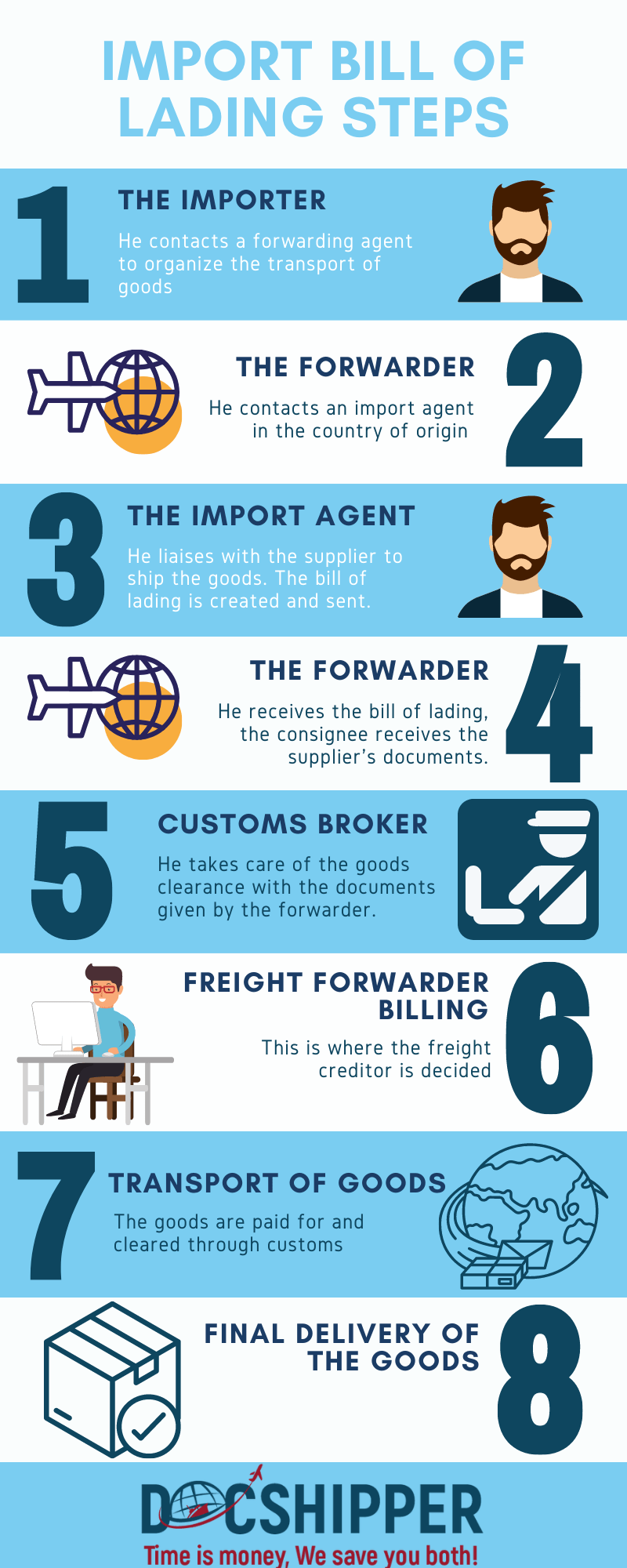
Import bill of lading steps
Example: If the goods are imported by a freight forwarder under Ex Works (EXW) conditions (refer to Incoterms), here is the journey of the bill of lading:
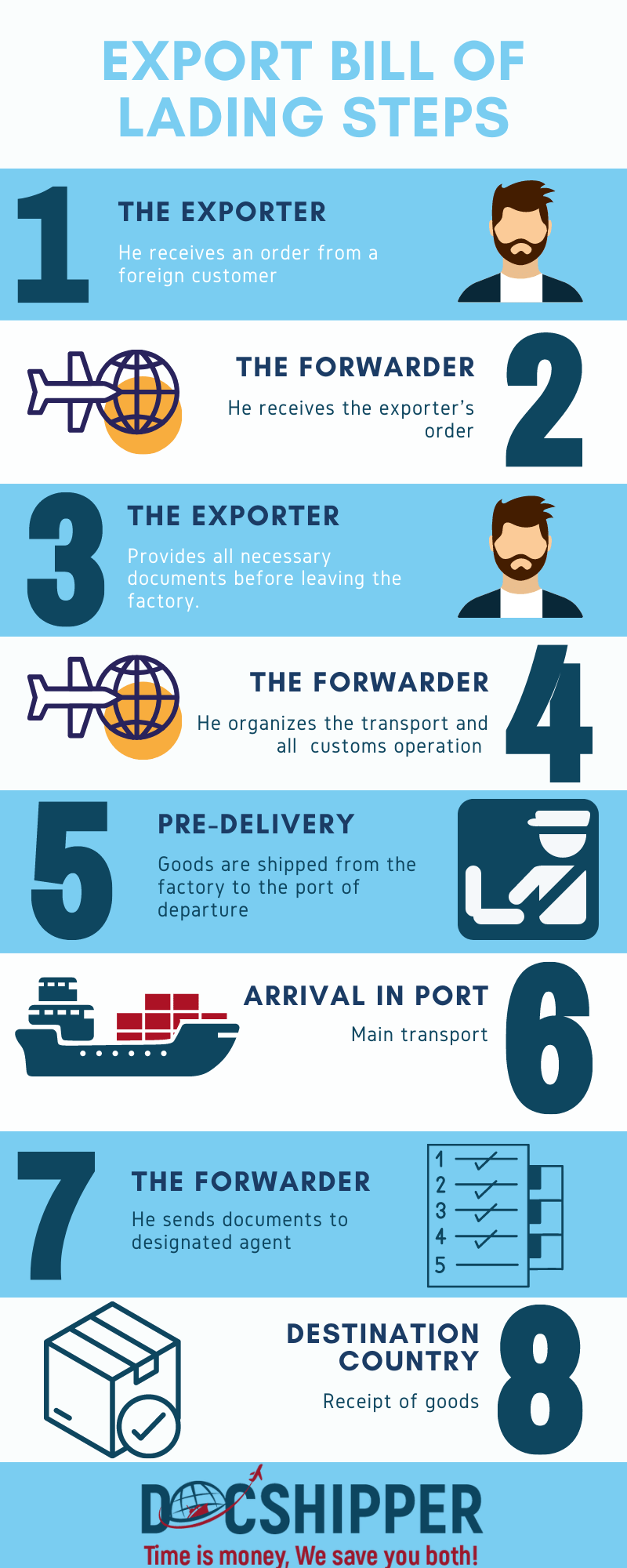
Export bill of lading steps
This is the process if the goods are exported:
DocShipper Advice
Is Your Bill of Lading Accurate?
Providing accurate information in your bills of lading is essential. That’s why you have to be extremely careful when providing these documents. You may call a freight forwarder to take care of this step and avoid a loss of time. Contact us for free.
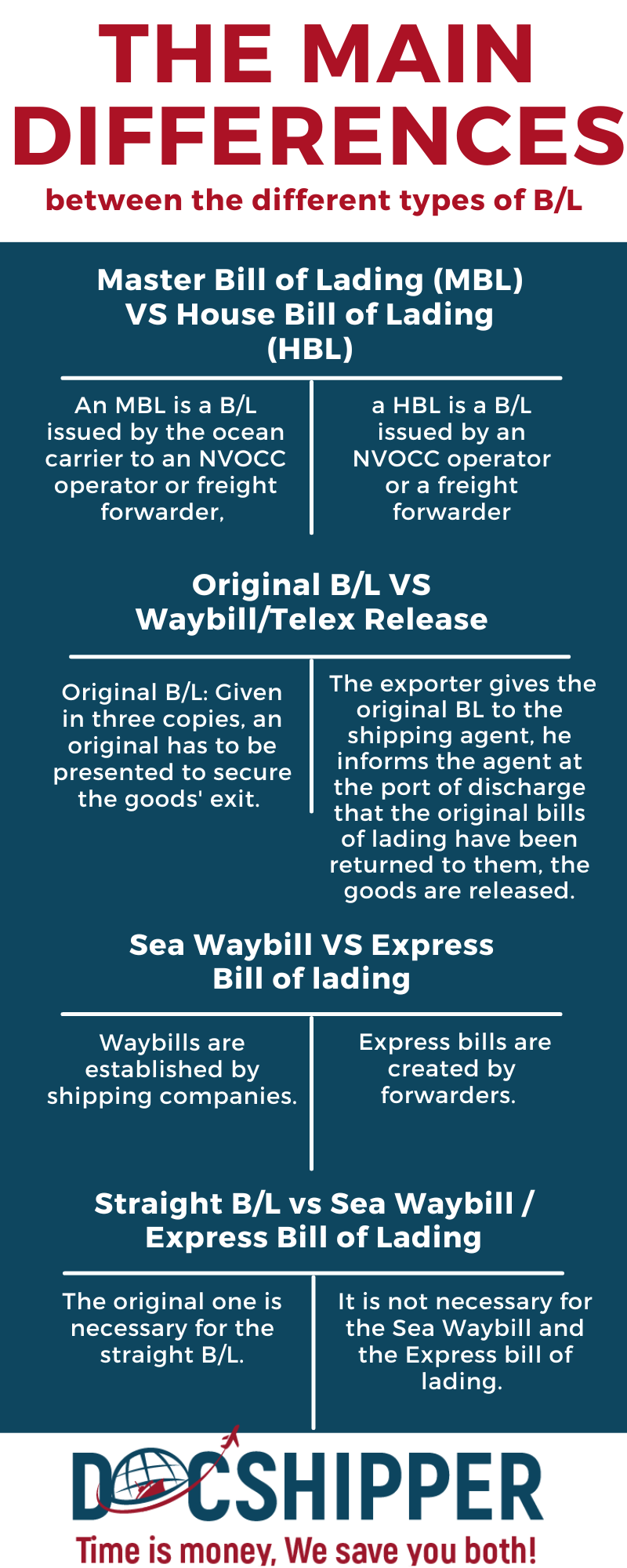
The different kinds of B/L
There are several distinct kinds of bills of lading. They differ depending on the issuer, function, transmission mechanism, buyer-seller connection, and degree of buyer protection, among other things.
The ocean bill of lading, Sea Waybill, House Waybill, Master Air Waybill, House Air Waybill, and occasionally the Switch Bill of Lading are the primary bills of lading used in international transportation.
Each of them will be discussed below. Bills of lading can be divided into two primary categories: those that are negotiable and those that are not.
Negotiable and non-negotiable bills of ladings
First, you should note that these two conditions only apply to sea freight; for air freight, the terms are Master Air Waybill and House Air Waybill.
A negotiable bill of lading is the original one; it’s negotiable and legal because it represents the title to the property of the goods.
A non-negotiable bill of lading is a copy of the originals and doesn’t represent any title to the property. Original bills of lading (negotiable) transferred to a third party, such as a freight forwarder, must have the consignee’s endorsement, much like a check. The freight forwarder is in charge of making sure that the cargo is delivered to a qualified authority when it is in a negotiable position. Before releasing the consignee or their representative while using the NVOCC services of the freight forwarder, the freight forwarder must make sure that they receive the original (negotiable) bill of lading. An error in this process could make the forwarder responsible for the value of the goods in the event that the shipper and consignee’s agreement is not upheld.
Contrary to sea freight, in air freight, documents are classified as non-negotiable sets of documents, except if the intermediary is a bank. Moreover, the AirWaybill can replace the non-negotiable B/L.
Ocean bill of lading
They are often used when the shipper wants to maintain control over the payment by the consignee (buyer) for the goods and are produced by maritime carriers, who act as the carrier in the case of containerized shipments by sea. To make sure that payment has been made before the items are released to the consignee, the original bill of lading will be needed.
Depending on the options the carrier provides, the document can be processed in a number of ways once payment has been received. The carrier will accept the original bill of lading in exchange for a telex release, which is a digital counterpart of the B/L. The consignee receives the original bill of lading by courier to deliver to the carrier for the goods’ release.
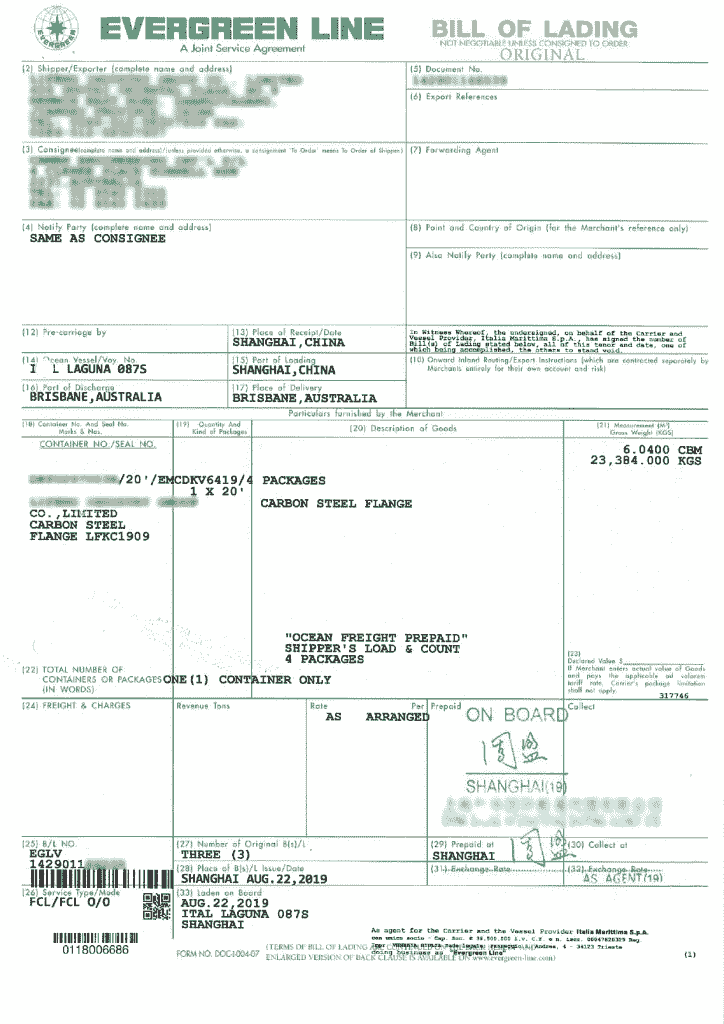
Sea Waybill of Lading
It’s a non-negotiable document that can replace the bill of lading, and thanks to this, it’s not necessary for the shipper to control the release of the goods.
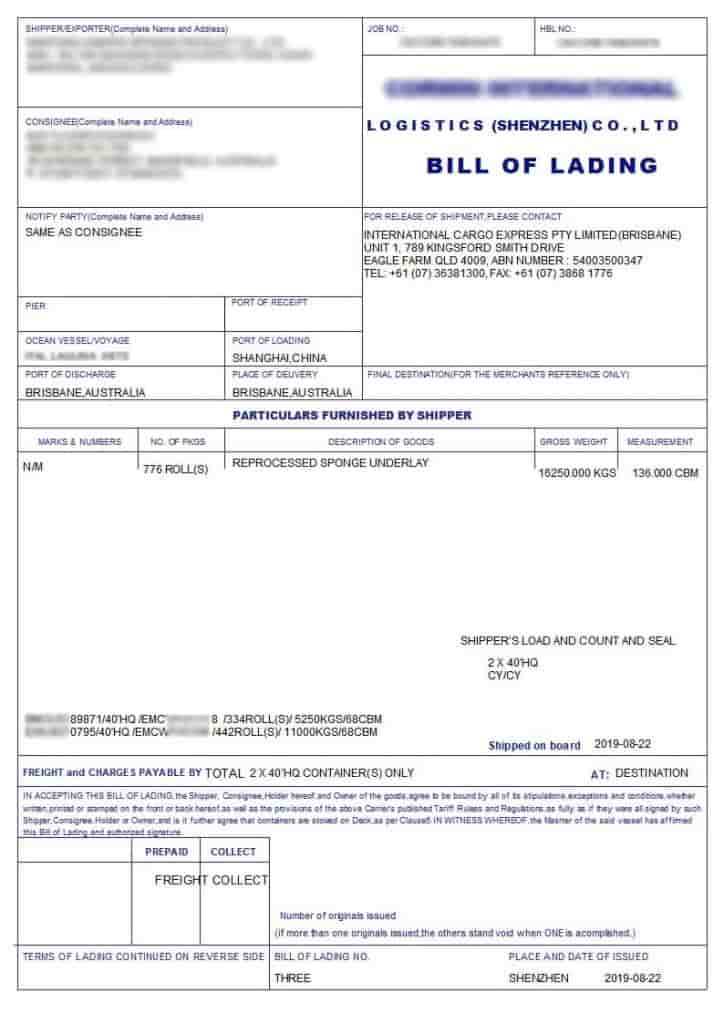
House Bill of Lading (Hbol)
A transport document used for domestic or inland goods is the home bill of lading. The items, parties involved and transportation circumstances are all given in great detail.
When transferring products within the same nation, the House Bill of Lading is a crucial component in maintaining accountability and traceability. An internal bill of lading is created when the freight is organized through an NVOCC / freight forwarder for maritime transport. Based on the needs of the shipper, this can be handled as a negotiable or non-negotiable option. The term “express bill of lading” may occasionally be used to describe a non-negotiable option.
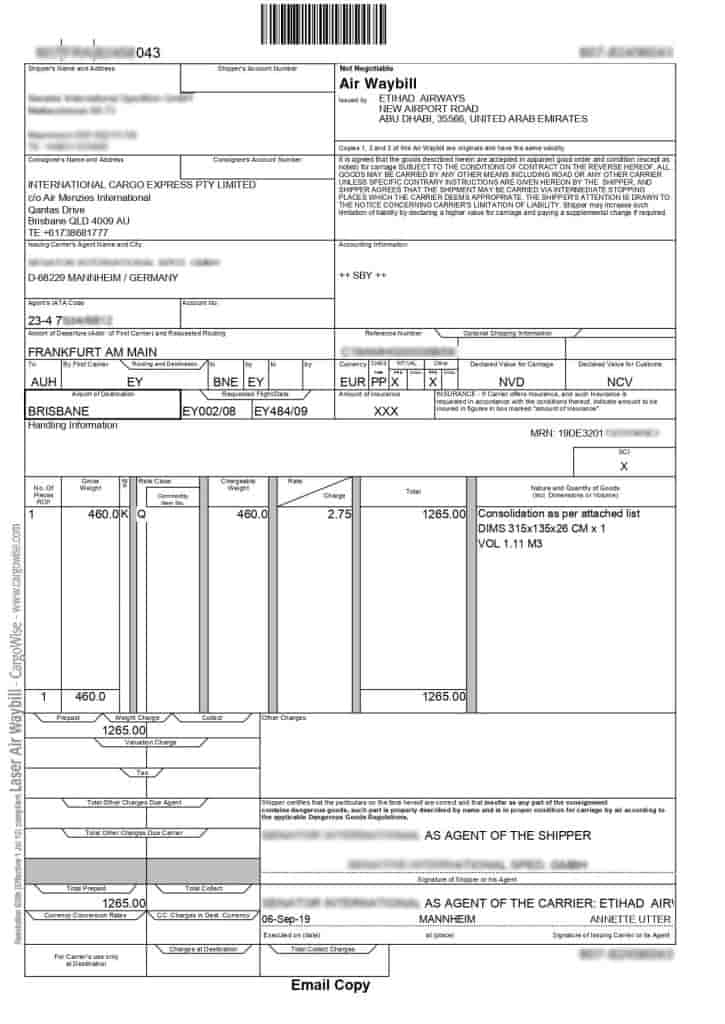
Master Airway Bill of Lading (MAWB)
Airline transport documents known as Master Air Way Bills (MAWBs) are utilized for air freight shipments. Except for when the goods are sent “on consignment,” these documents are non-negotiable.
This usually indicates that the cargo was arranged through a bank, in which case a bank endorsement is required before the carrier releases the freight. Usually, a House Air Way Bill is created from the shipper to the consignee, and it is arranged from one freight forwarder to another.
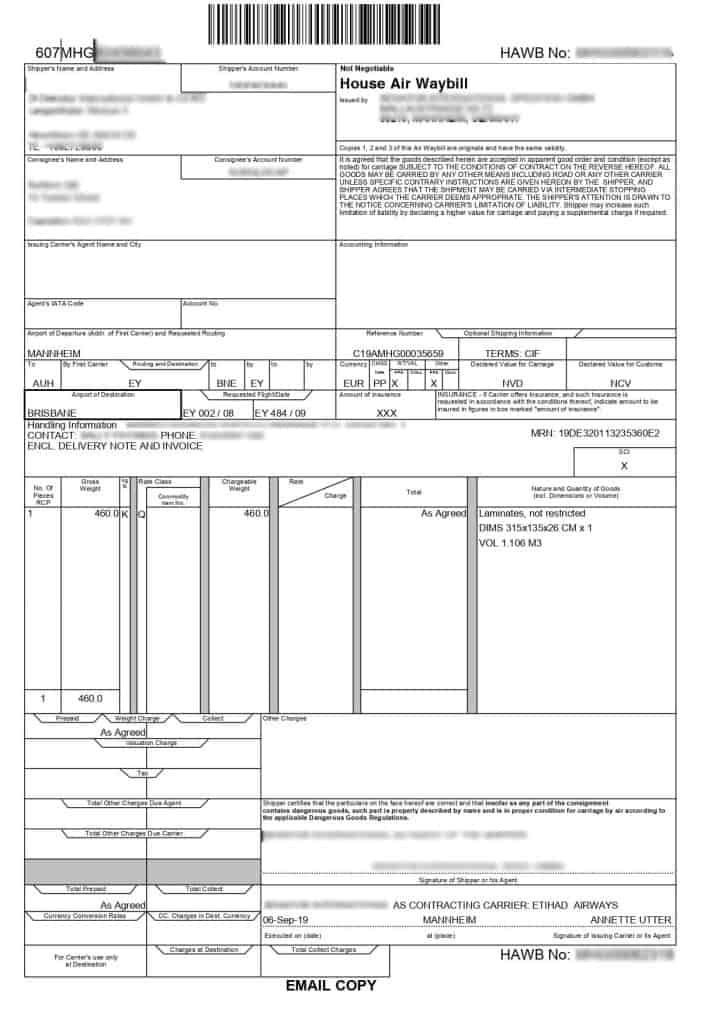
House Airway Bill Of Lading
This is the House Air Way Bill (HAWB) for combined air freight shipments that were issued by a freight forwarder. As long as they state that the issuer accepts responsibility as a carrier or serves as an agent of a designated carrier, HAWBs are processed in the same manner as MAWBs.
Multi-modal bill of lading
This kind of bill of lading is the one that you may use when your goods are transported with different kinds of freight.
Bill of lading
These bills of lading cover items that are primarily transported by water, followed by land or rail to their destination. Take care to avoid combining them with multimodal bills of lading.
Switch Bill of lading
This kind of bill of lading is used when the supplier’s information has to stay secret. As an example, when a buyer sells to a third party in a Triangle shipment, a second Bill of Lading is generated by substituting the first one with the new information.
Dirty Bill of Lading
This is the opposite of a “clean” bill of lading; it’s used when the goods are received with problems / in a bad state.
Straight Bill of Lading
This type of bill of lading is used when the goods have already been paid for and are delivered immediately to the recipient.
DocShipper Alert
Need Help Choosing a Bill?
If you feel confused and need help understanding all these terms, we are here to give you further information and take care of all the steps of your expedition. Contact us to get a free quote. If you don’t know which bill of lading is most suited to your situation, call us.
DocShipper Platform
One platform. Your entire supply chain
Sourcing, freight, customs & documents — all centralised, all visible, 24/7.
Online Bill of Lading: Telex version and Express version
Instead of several kinds of bills of lading, Telex release and Express release are ways to release the bill of lading.
Telex version
The carrier or agent at the loading port will send an EDI email or telex message to inform their agent at the discharge port that the shipper has given over some or all of the original bills of lading that were issued to them. As a result, the items can be transferred to the designated consignee indicated on the bill of lading at the discharge port without the need to present the original bill of lading.
Express Version
In that it can be electronic, the Express Release Bill and the Telex Release are comparable. The Express Release is different in that a paper copy of the bill of lading is not provided. The Express Release offers several benefits in the absence of manufacturing physical originals, but it should only be utilized in extremely narrow situations.
The indemnity letter
A claim for compensation in the event of damage, loss, or delay during the international shipment of goods is declared in a letter of indemnity. This letter is often sent to the responsible transportation firm or logistics company by the shipper or consignee of the items. The following details ought to be in the letter of indemnity:
- All the shippers’, consignees’, and transportation companies’ contact information.
- A thorough description of the damaged or lost goods that includes references, the amount, the worth, and any other pertinent details.
- Damage sustained, including its type (damage, loss, or delay), as well as when it happened.
- Supporting documentation for the compensation claim, such as purchase invoices, delivery receipts, inspection reports, photos, etc.
Depending on the terms and conditions outlined in the shipping contract or any relevant foreign rules, the terms and steps for indemnification may change.
DocShipper info
How Can DocShipper Simplify Trade?
By managing all phases of international transportation, including customs clearance, DocShipper assists small and medium-sized businesses (SMEs) and individuals with importing and exporting. Get a quote
FAQ | Bill of Lading: Definition, Template, Types
A complete bill of lading form must clearly identify all parties and shipment data. At minimum, verify: Shipper’s full legal name and contact details Consignee’s exact delivery address Carrier or shipping line name Port of loading and port of discharge Precise cargo description (quantity, packaging type, weight, volume, marks and numbers) Freight charges and tariff references Incoterm (FOB, CIF, EXW, etc.) Container or equipment numbers Issue date and authorized signature Before approving the draft, cross-check it against your commercial invoice and packing list. Even minor discrepancies can trigger customs holds or bank rejection under a letter of credit.
It depends on your booking structure. You may have: One B/L number covering multiple containers under a single shipment Separate B/Ls issued per container Multiple original bills of lading issued for the same cargo Your sales contract or letter of credit should specify: Number of originals required Whether the original bill of lading must be negotiable Whether issuance applies per shipment or per container Always confirm this before cargo departure. Amendments after issuance usually involve fees and delays.
The OB/L number is assigned by the ocean carrier. If you book directly with a shipping line, they generate it. If you work with a freight forwarder or NVOCC: The carrier issues the Master Bill of Lading (MBL) The forwarder may issue a House Bill of Lading (HBL) Even when a House B/L is used, the master number always originates from the carrier.
Endorsing a negotiable original bill of lading transfers ownership. To do it correctly: Confirm the B/L is negotiable (not marked “non-negotiable” or “express”) Write the new beneficiary’s name on the back (or endorse in blank if contractually agreed) Sign and stamp using an authorized company signature Physically transfer the original document Without proper endorsement of the original bill of lading, the carrier will not release the cargo. Always verify destination-country practices.
Fraud still occurs in international trade. Protect your transaction by: Checking the B/L number directly on the carrier’s official tracking website Confirming vessel name and voyage against real sailing schedules Verifying the carrier’s official domain and contact details Requesting written confirmation from the carrier or NVOCC Matching all shipment data with your commercial invoice and packing list Red flags include unknown carriers, fake vessels, inconsistent ports, and spelling errors. If a documentary credit is involved, validate everything before authorizing payment.
In U.S. trade operations, the most common formats include: Ocean Bill of Lading (negotiable or non-negotiable) Straight Bill of Lading Sea Waybill House Bill of Lading (HBL) Master Bill of Lading (MBL) Switch Bill of Lading Multi-modal Bill of Lading Choosing the wrong type can affect payment security, cargo release timing, and bank compliance. Align the format with your Incoterm and payment structure.
In the United States, bills of lading are mainly governed by: U.S. Carriage of Goods by Sea Act (COGSA) Uniform Commercial Code (UCC), especially Article 7 (Documents of Title) Applicable international conventions depending on routing For high-value or sensitive shipments: Consult a maritime attorney Confirm documentary requirements with your bank Coordinate compliance procedures with your freight forwarder Legal validation is strongly recommended when payment risk is significant.
These documents serve very different purposes. Bill of lading meaning in practice: Transport contract between shipper and carrier Receipt confirming goods were received May function as a document of title Required for cargo release Packing slip: Warehouse-level operational document Lists box-by-box contents Used for customs inspection and physical checks Does not transfer ownership In short, bill of lading vs packing slip is a legal control document versus a logistical inventory document.
Yes — but only as a preparation tool. A bill of lading template helps you organize shipment data before submitting shipping instructions. Important limitations: Only a carrier or NVOCC can issue an official bill of lading form Templates cannot replace an original bill of lading for cargo release All details must match the commercial invoice exactly It must reflect agreed Incoterms and payment terms Use templates to reduce drafting errors — never treat them as legally valid transport documents.
These documents operate in completely separate legal environments. Bill of Lading: Used in transportation and international trade Acts as receipt, contract of carriage, and possibly document of title Bill of particulars example: Used in court proceedings Clarifies legal claims or criminal charges Has no role in shipping or cargo control If you are moving goods internationally, you need a bill of lading form — not a bill of particulars.
Errors on an original bill of lading can create serious financial exposure, especially under letters of credit. Possible consequences include: Bank refusal of documents Customs clearance delays Cargo release blockage Ownership disputes Correction options may involve: Amending the B/L before surrender Issuing a switch bill of lading Providing a letter of indemnity (subject to carrier approval) Always review the draft carefully before final issuance. Minor inconsistencies can become major commercial risks.
In a waybill vs bill of lading comparison, the key issue is ownership control. Bill of Lading (negotiable): Can function as a document of title Requires presentation of the original bill of lading for cargo release Suitable when payment leverage is needed Waybill (Sea Waybill or Air Waybill): Non-negotiable Does not transfer ownership Cargo can be released to the named consignee without original presentation Often faster and paperless If you do not need title control or payment security through documents, a waybill reduces administrative complexity.
A switch bill of lading is typically used in triangle shipments when the intermediary wants to keep the original supplier confidential. It may be appropriate when: A trader buys from supplier A and resells to buyer B The buyer must not see the original supplier’s identity The cargo is already in transit Operational precautions: The first set of originals must be surrendered before issuing the switched set All data must remain consistent (cargo description, quantities, dates) Carrier approval is mandatory Improper use can create fraud exposure or invalidate a letter of credit.
A dirty bill of lading (also called a “claused” B/L) indicates that the goods were received in damaged or irregular condition. Common clauses may mention: Damaged packaging Wet cargo Short shipment Visible defects Commercial consequences: Banks often reject dirty bills under letters of credit Insurance claims become more complex Buyers may refuse payment If cargo condition is disputed, address it immediately before document issuance. Once issued, correction is difficult.
A straight bill of lading names a specific consignee and is typically non-negotiable. Straight B/L: Used when goods are already paid Cargo is released to the named consignee Does not function as a transferable title document Negotiable original bill of lading: Can be endorsed and transferred Controls ownership Commonly used under documentary credit transactions Choosing the wrong format can eliminate your payment leverage before goods arrive.
A bill of lading is issued after the carrier has physically received the goods and verified the shipping instructions. In practice: For ocean freight, it is usually issued after cargo is loaded on board (on-board B/L) For air freight, the Air Waybill is issued once cargo is accepted by the airline Drafts are typically reviewed before final issuance Never assume issuance equals loading unless the B/L clearly states “on board” with a dated notation. That date can directly impact letter of credit compliance.
You don’t technically “create” the official document — only the carrier or NVOCC can issue it. But you prepare the shipping instructions. Here’s a practical workflow: Gather commercial invoice and packing list data Confirm Incoterm and payment structure Validate consignee legal name and address Define cargo description exactly as invoiced Submit shipping instructions to the carrier or forwarder Review the draft bill of lading carefully Approve only after cross-checking all data Using a bill of lading template can help structure your information, but the legally valid bill of lading form must come from the carrier.