

In short ⚡
Full inspection China is a 100% product inspection where every unit is checked against an agreed inspection checklist for function, appearance, labeling, packaging, and compliance before shipment or balance payment. It’s used when defects are costly or risky, often as pre shipment quality control or end-of-line inspection, and generates an inspection report as traceable proof.
We hope you’ll find this article genuinely useful, but remember, if you ever feel lost at any step, whether it’s finding a supplier, validating quality, managing international shipping or customs, DocShipper can handle it all for you!
What a full inspection in China really is (and when you actually need it)
Full inspection China usually means a 100% product inspection, every unit gets checked against an inspection checklist before you pay the balance or ship. It’s the opposite of “we checked a few cartons and it looked fine”.
Here’s the thing, a china quality inspection is not only about cosmetics. It’s also about defect classification (critical, major, minor), compliance inspection, labeling, cartons, and even HS code classification or trade compliance China triggers when your product is regulated.
In practice, a full check often happens as pre shipment quality control, but you can also run it as an end of line inspection while production is still active. If you’ve ever received 2% defective pieces and still had to refund 30% of orders, you already know why this matters.
One realistic scenario we see a lot: you approve a golden sample, the factory swaps a sub-supplier for screws or fabric mid-run, and your random sampling inspection misses it. A full inspection in China catches that switch fast because inconsistency shows up across units, not just in one carton.
And yes, you can still ask for an inspection certificate or formal conformity assessment evidence for your files, especially if your buyer, marketplace, or insurer asks questions later. The inspection report becomes your paper trail.
DocShipper Info
DocShipper coordinates on-site checks, reporting, and follow up so you ship with confidence.
Full inspection vs standard sampling: key differences for importers
We’ve seen this play out on the warehouse floor: 1,000 units lined up, the supplier says “AQL is enough”, then you spot a pattern defect every 20 pieces. That’s exactly where full inspection China changes the outcome.
To make the decision clearer, here’s a quick comparison between AQL sampling and a 100% china quality check.
| Method | What happens | Best for | Main drawback |
| AQL sampling (random sampling inspection) | Inspector checks a statistically selected sample, then applies defect classification and acceptance rules | Stable suppliers, low-to-mid risk items, repeat orders | Systemic defects can slip through if they don’t appear in the sample |
| Full inspection China (100% check) | Every unit gets verified for function, appearance, labeling, packaging, and agreed specs | High risk launches, strict buyers, tight returns policies | Costs more and can slow dispatch if you didn’t plan rework capacity |
| Factory inspection China (process-focused) | Checks how the factory makes and controls the product, not only the finished goods | New supplier onboarding, ongoing quality assurance | Doesn’t guarantee your specific batch is perfect |
AQL is not “bad”. It’s a tool, but it assumes your process is under control, and you’ll notice fast many factories run mixed lines and mixed operators.
When you combine third party inspection China with clear tolerances and photos, you get fewer arguments later. That’s especially true if you’re using an inspection agent service China to keep everyone aligned.
Looking for a Reliable Shipping & Sourcing Partner?
Situations where a 100% quality check in China is worth the cost

Direct tip: if the money you risk on returns, chargebacks, or brand damage is higher than the inspection and rework bill, you’re already in full inspection China territory.
From experience, the “worth it” moment often hits on first shipments. You’re under time pressure, your supplier promises the world, and your customer expects Amazon-level perfection.
Use this quick checklist to decide whether a china quality inspection should be 100% instead of AQL.
- New supplier with limited due diligence China or no solid vendor verification history
- New product or first mass production after prototypes
- Regulated product where import regulations China and destination rules matter, think CCC certification scope or electrical safety labeling
- High customer sensitivity, cosmetics, baby items, food-contact, safety-related parts
- Known variability in materials, color, sizing, or assembly torque, the classic “looks fine, fails later” problem
- Marketplace exposure where reviews and returns can kill your listing in days
Also, don’t forget the operational side. If you don’t plan the rework path, a full check can just identify defects and still ship late.
That’s why we often pair inspection with freight inspection and rework planning, so goods verification and sorting can happen without breaking your export logistics China booking.
DocShipper Alert
DocShipper helps you plan full inspections, rework flows, and freight coordination so issues are fixed in China, not at your customer’s door.
The 4 critical quality checkpoints in China you must map before ordering
Full inspection China only works when it fits into a broader quality control China map. If you wait until everything is packed, you’re paying to discover problems when fixes are slowest.
We’ve watched importers lose a full week because cartons were already sealed and palletized, making a simple label correction a nightmare. A smarter plan spreads controls across production, loading, and arrival.
The World Trade Organization often highlights how friction and uncertainty increase trade costs, and quality failures are a very real form of that friction. You reduce uncertainty by choosing your checkpoints on purpose.
Here are the four checkpoints you should map before you even place the PO, so your product inspection China plan supports cashflow, not chaos.
- Supplier audit and factory inspection China before mass production
- Pre-production approval and first-article checks (materials, specs, golden sample alignment)
- In process inspection during manufacturing (early catch of systemic defects)
- Pre shipment inspection plus loading supervision China, then post-arrival verification when needed
DocShipper Advice
DocShipper builds your quality control China roadmap, from audits to pre shipment checks, fully aligned with your lead times.
Pre-production and during-production checks that prevent systemic defects
Ever seen a supplier swear they use “Grade A” material, then you find out the real batch came from a different trader? That’s the moment a supplier audit China and an early full inspection China strategy saves you.
Before production, you’re doing risk assessment China, not policing. You confirm equipment, QC records, traceability, and real capacity, that’s supply chain audit thinking.
Then, you lock what “good” means with an inspection checklist, signed spec sheet, labeling rules, and pack-out requirements. It’s boring paperwork, but it stops 80% of disputes.
To keep execution practical, here’s a simple workflow we use for pre-production and in process inspection planning.
Step 1: Run vendor verification and confirm factory address, legal entity, and scope of work.
Step 2: Do a factory inspection China focusing on process controls, gauges, test equipment, and corrective action habits.
Step 3: Approve pre-production samples, then freeze the BOM, colors, tolerances, and packaging.
Step 4: Start production monitoring with an onsite inspection at 10% to 20% completion to catch drift early.
Step 5: Repeat an in process inspection when the highest-risk operation happens, coating, molding, soldering, stitching, depending on your product.
When you do this right, your final china quality check becomes a confirmation, not a surprise.
DocShipper Info
DocShipper structures your inspection checklist, audits suppliers, and monitors high risk operations so systemic defects never reach final packing.
Final, loading, and post-arrival controls that protect your brand and cashflow
What happens when your goods pass inspection, but the wrong cartons get loaded? It happens more than suppliers admit, especially during peak season when trucks queue outside factories.
Your end-of-line pre shipment inspection focuses on finished units, packaging, labeling, and carton drop tests if relevant. If you need a full inspection China, this is often the checkpoint where you do the 100% sorting.
Then comes logistics, and this is where importers get stuck. Without loading supervision China and a container loading check, you can’t be sure the inspected batch is the shipped batch, which kills your shipment verification.
Use this short checklist to make loading and release decisions simple and defensible.
- Match PO, cartons, and pallet marks to the inspection report batch identifiers
- Verify quantity and carton condition before sealing, including photos of seal number
- Confirm shipping marks, destination labels, and any compliance labels required by your market
- Check documents readiness, invoice, packing list, and any CIQ inspection or origin paperwork triggers
- Record container floor condition and loading pattern to reduce damage claims
If you’re coordinating freight forwarding China, this checkpoint also protects your timeline for customs clearance China. One missing label can turn into a costly hold when trade compliance China questions pop up.
When importers ask us for “asia inspection china support”, this is usually what they mean. They need the inspection to connect cleanly with shipping, not sit in a PDF nobody enforces.
DocShipper Alert
DocShipper combines loading supervision China, shipment verification, and documentation checks so what you approved is exactly what arrives.
How to plan a full inspection in China step by step with your supplier and agent
You’ve probably seen this happen, a full inspection China plan agreed on email, then the factory ships before anyone checks a single carton. From experience, this usually happens when roles are vague and timing is guessed instead of mapped.
We’ve handled cases where a supplier insisted everything was ready, but a 100 percent check revealed mixed components across pallets, a classic issue during peak season. That’s why we always align inspections with internationally recognized quality logic, the same principles found in ISO quality management frameworks.
Before getting operational, here’s the exact workflow you should follow to lock responsibilities and timing.
- Define the inspection scope, SKUs, cartons, functionality, labeling, and tolerance limits, not just “QC ok”.
- Confirm production status in writing, the full inspection only starts when 100 percent of goods are finished and packed.
- Book inspectors early with your agent or partner, capacity disappears fast during Q3 and Q4.
- Block shipment at supplier level until you receive the inspection report and corrective actions, if any.
- Release shipping only after approval, and yes, this step saves you real cash.
When you coordinate this properly, you’ll notice fast how full inspection China turns from a cost into a control tool. And when something fails, you have proof to renegotiate, remake, or stop shipment before it touches your balance sheet.
DocShipper Advice
DocShipper coordinates suppliers, inspectors, and forwarders so your QC decisions are enforced, not ignored.
Choosing a China inspection partner: costs, integrity, and regional coverage
Here’s a direct tip, stop choosing an inspection partner in China based on the lowest daily rate, especially if your shipment value is high. A cheap full inspection China with weak integrity usually costs you more later.
We once took over a case where an inspector was paid by the factory itself, reports were clean, goods were not. Situations like this are why global trade bodies like the ICC Incoterms Committee constantly stress independence and clear contractual roles.
To help you compare options without getting lost, here’s a simple comparison that reflects what you’ll actually experience on the ground.
| Criteria | Local freelance inspector | Structured inspection partner |
| Cost per man-day | Low upfront | Moderate and predictable |
| Independence | Often unclear | Contractually ensured |
| Regional coverage | Limited to one area | Multi-province, adaptable |
| Report reliability | Inconsistent | Standardized with evidence |
If you’re sourcing across multiple provinces, Guangdong, Zhejiang, Jiangsu, you’ll feel the difference immediately. At DocShipper, we’ve built networks that stay independent from factories, because trust is the real asset here.
DocShipper Alert
DocShipper offers independent, standardized inspections across China, protecting each shipment and your long term brand.
Conclusion
So, is a full inspection China always necessary, or only when things go wrong? The honest answer is that it’s a strategic choice, and when used correctly, it protects both your brand and your cashflow.
To wrap things up, here are the key points you should walk away with.
- Full inspections make sense when defects are costly, hard to detect, or legally sensitive.
- Timing matters, inspections only work if production is truly finished and shipping is blocked.
- Independence beats price, your inspection partner should never depend on the factory.
- Clear workflows turn quality control into a negotiation and risk management tool.
If you apply these principles consistently, you’ll stop reacting to quality problems and start controlling them. That’s exactly where experienced importers want to be.
FAQ | Full inspection in China: how to secure your shipments and avoid costly quality failures
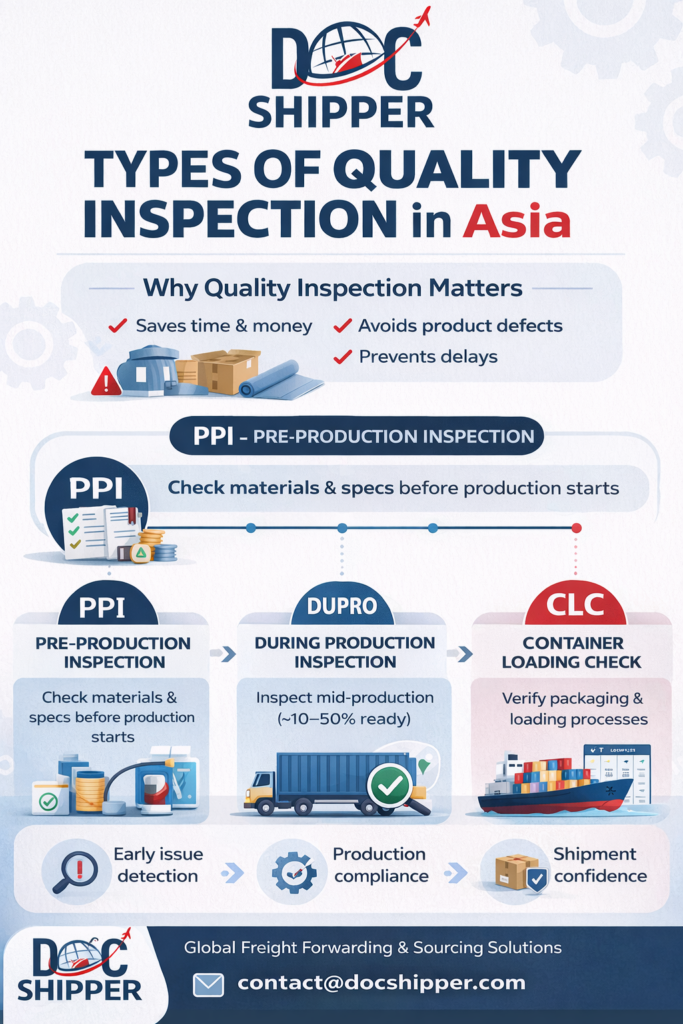
If you zoom out beyond the factory floor, you can think of inspections in 6 practical categories:
1. Supplier-level inspections
- Factory audit / supplier audit
- Ethical or social compliance audits
2. Pre-production inspections
- Material verification, color/finish checks, tooling or mold approval
3. In-process inspections
- DUPRO, inline checks at critical operations (soldering, molding, stitching…)
4. Pre-shipment inspections
- Random sampling or full inspection on finished, packed goods
5. Logistics-related inspections
- Container loading check, pallet/packaging robustness checks
- Destination warehouse arrival checks on first shipments
6. Compliance & lab testing
- Electrical safety, chemical content, mechanical tests, performance tests
You don’t need all of them for every order, but mapping which 2–4 you’ll always use (by product risk level) helps you standardize and budget your QC process.
Most third-party inspections in China are billed per “man-day”:
- Typical range:
- USD 180–350 per man-day for mainstream inspection companies
- Below USD 150 is often freelance-level, with more variability in quality and integrity
Main cost drivers are:
- Location:
- Remote provinces (inland China) = higher travel costs than coastal hubs (Guangdong, Zhejiang, Jiangsu).
- Scope and depth:
- Simple visual/quantity checks are faster and cheaper than 100% function testing or complex measurements.
- Volume and SKUs:
- Many SKUs or complex product lines often require extra man-days.
- Type of inspection:
- CLC is usually cheaper and shorter.
- Full inspection of 100% of units is the most time-consuming and expensive.
- Add-ons:
- Lab tests, sample pick-up and courier, rush bookings, or weekend/holiday work all add cost.
To budget:
- Small–medium shipment: 1 man-day is often enough.
- Large or 100% checks: plan 2–3 man-days or more, depending on quantity and test complexity.
Use AQL sampling when:
- You have:
- A stable, proven supplier and repeat orders.
- Low-to-medium product risk (non-safety-critical, not heavily regulated).
- You can tolerate:
- A small percentage of minor defects.
- You mainly need:
- A statistical assurance that the batch is “good enough” on average.
Consider 100% full inspection when:
- Product risk is high:
- Baby products, electrical items, safety or structural parts, food-contact items.
- Your cost of failure is high:
- Strict retailer or marketplace penalties, expensive returns, or brand damage.
- You’re in a “first time” situation:
- First order with a new factory or first mass run of a new product.
- You’ve already seen pattern defects:
- Same defect repeats often but doesn’t always show in random samples.
A useful rule: if one serious failure could cost you more than the full inspection bill (including rework), lean toward 100%.
You can keep your risk under control and still optimize costs by:
- Standardizing your QC plan
- Use a fixed sequence by risk level (e.g., low-risk: PSI only; medium-risk: DUPRO + PSI; high-risk: PPI + DUPRO + PSI + CLC).
- This avoids “over-inspecting” low-value, low-risk items.
- Grouping inspections
- Combine multiple POs or SKUs from the same factory into one visit when timelines allow.
- Sharpening your inspection checklist
- Clear, prioritized checkpoints = faster inspections and fewer back-and-forth clarifications.
- Focus on defects that really matter to your customers.
- Improving supplier selection
- Better factories = fewer severe defects, so you can rely more on sampling and fewer emergency reinspections.
- Planning dates early
- Last-minute or weekend inspections often require surcharges.
Think in terms of “cost per shipment saved” instead of cost per man-day: one well-planned inspection schedule can prevent multiple expensive failures.
Several recurring mistakes create both quality and cost problems:
- Vague requirements
- Telling the factory “do QC” without a written spec sheet, tolerances, and visual references.
- Late booking
- Requesting inspection the day before shipment, leaving no time for corrective actions.
- No shipment hold
- Not specifying in the PO that shipment is blocked until the inspection report is approved.
- Wrong timing
- Inspecting too early (production not finished) or too late (already loaded or on the way).
- Ignoring communication gaps
- Not aligning all three parties (you, supplier, inspection agent) on quantities, SKUs, and test methods.
- Choosing inspectors only on price
- Lowest fee with weak independence can lead to “clean reports, dirty goods.”
Avoiding these issues is mostly about process: written instructions, clear timing, and a contractual link between passing inspection and releasing payment/shipment.
For first-time importers, a simple, robust baseline strategy is:
- Before order:
- Run at least a basic supplier audit (documentation check + factory visit or video walk-through).
- Before mass production:
- Approve a “golden sample” and lock specs in writing.
- During production:
- Arrange 1 DUPRO at 20–40% completion to catch major issues early.
- Before shipment:
- Conduct a pre-shipment inspection using AQL sampling.
- Add a container loading check if shipment value is high or if you don’t fully trust the factory.
Once you have 2–3 successful shipments with clean reports and low returns, you can gradually reduce frequency or depth of inspections for that specific supplier and product line.
Read more
Looking for more? Check out these articles.
Need Help with
Logistics or Sourcing ?
First, we secure the right products from the right suppliers at the right price by managing the sourcing process from start to finish. Then, we simplify your shipping experience - from pickup to final delivery - ensuring any product, anywhere, is delivered at highly competitive prices.
Fill the Form
Prefer email? Send us your inquiry, and we’ll get back to you as soon as possible.
Contact us