

In short ⚡
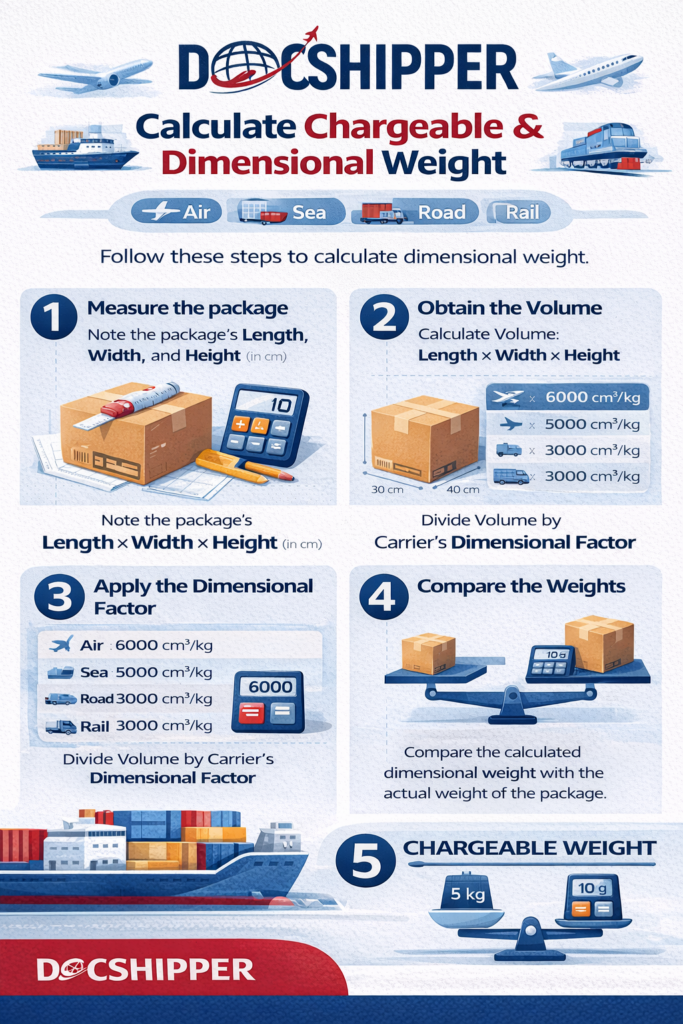
How to calculate dimensional weight: use the package’s dimensions and divide its volume by the carrier’s dimensional factor. This method converts the space a shipment occupies into an equivalent weight, commonly used in air, sea, road, and rail freight to reflect space utilization. Follow these steps:- Measure the package’s length, width, and height (in cm).
- Multiply: Length × Width × Height to obtain the volume (cm³).
- Divide the volume by the carrier’s dimensional factor (e.g., 6000 cm³/kg for air, 5000 for sea, 3000 for rail).
- The result is the dimensional weight in kilograms.
- Compare it with the actual weight; the higher value is used as the chargeable weight.
Calculating taxable weight and volumetric weight is essential for transporting goods by different modes of transport such as air, sea, road and rail. This introduction highlights the importance of accurate weight calculation for cost optimisation and resource utilisation. It also opens the way to exploring calculation methods and the differences between billable weight and dimensional weight in the different modes of transport.
DocShipper Advice
How Can Docshipper Cut Shipping Costs?
Optimise your shipping costs with Docshipper. We calculate precise billable and volumetric weights, in compliance with International Maritime Organisation (IMO) regulations. Take advantage of our customised solutions to control your transport costs and maximise the efficiency of your resources. Entrust us with your maritime shipments for optimum management of your transport costs.
Chargeable Weight Calculation


Chargeable weight in air transportation is normally established by comparing the actual weight and the dimensional weight. The greater of the two is regarded as the charged weight. The formula is as follows:
Chargeable weight = The maximum between the gross weight of the goods in tonnes and the volume in m3 divided by 6.
For sea, road, and rail transportation, chargeable weight is often based solely on the actual weight of the goods. In these modes, the dimensional weight is not typically taken into consideration unless specified by specific carriers or regulations.
A simple method for calculating your taxable weight is as follows:
– Divide your volume in m3 by 6
– If the result is greater than the gross weight in tonnes, the taxable weight will be this result
– Otherwise, the taxable weight will be your gross weight.

Factors Influencing Calculation
Several factors influence the calculation of chargeable weight:
- Weight-based charges: The pricing structure of the transportation service may be primarily based on the actual weight of the goods. Heavier shipments will incur higher charges.
- Space-based charges: Some transportation modes may also consider the occupied space in addition to weight. If the dimensions of the package result in significant space utilization, it can impact the chargeable weight calculation.
Example
Your goods have a volume of 18m3 and weigh 2 tonnes.
– Divide the volume by 6: 18 / 6 = 3
– The result, 3, is greater than the gross weight in tonnes (2), so the taxable weight of your goods is 3 tonnes.
If your goods weigh 3 tonnes, rather than 2, then the taxable weight will be 3 tonnes.
So don’t be surprised if the weight shown on your quotations or invoices does not correspond to the weight of your goods. It’s probably a question of taxable weight.
DocShipper Alert
How Can Docshipper Cut Freight Costs?
Optimise your air freight costs with Docshipper, the specialist in precise calculation of billable and volumetric weight. Following the standards of the International Air Transport Association (IATA), our experienced team offers you reliable expertise and personalised advice. Discover the most advantageous weight calculation solution for your air shipments thanks to Docshipper, your trusted partner.
Dimensional Weight Calculation


The dimensional weight calculation formula varies depending on the mode of transportation and the individual dimensional weight calculation method employed by carriers. The general formula is as follows:
Dimensional weight = (Length x Width x Height) / Dimensional factor
The dimensional factor is a constant determined by the carrier and is used to convert the dimensions into an equivalent weight.
Factors Influencing Calculation
Several factors influence the calculation of dimensional weight:
Package dimensions: The length, breadth, and height of the package have a direct bearing on the dimensional weight computation. A higher dimensional weight results from larger dimensions.
Conversion factors: Carriers use dimensional factors or volumetric conversion factors to convert the dimensions of the package into an equivalent weight. The specific conversion factor can vary among carriers and transportation modes.
Examples
Air Transportation
Package 1: Length = 50 cm, Width = 40 cm, Height = 30 cm, Dimensional factor = 6000 (cm³/kg)
Dimensional weight = (50 cm x 40 cm x 30 cm) / 6000 = 10 kg
Package 2: Length = 60 cm, Width = 50 cm, Height = 40 cm, Dimensional factor = 6000 (cm³/kg)
Dimensional weight = (60 cm x 50 cm x 40 cm) / 6000 = 20 kg
Sea Transportation
Package 1: Length = 80 cm, Width = 60 cm, Height = 50 cm, Dimensional factor = 5000 (cm³/kg)
Dimensional weight = (80 cm x 60 cm x 50 cm) / 5000 = 48 kg
Package 2: Length = 70 cm, Width = 50 cm, Height = 40 cm, Dimensional factor = 5000 (cm³/kg)
Dimensional weight = (70 cm x 50 cm x 40 cm) / 5000 = 28 kg
These examples show how to calculate dimensional weight using the provided dimensions and dimensional factors. Dimensional parameters and calculation methodologies may differ between carriers and types of transportation.
DocShipper Advice
How Can Docshipper Cut Transport Costs?
Optimise your road transport costs with Docshipper. We calculate the precise billable and volumetric weight for each shipment, in compliance with specific road transport regulations. Rely on our expertise to choose the most advantageous weight, save on your transport costs and simplify your weight calculations.
Comparison and Selection of Chargeable Weight vs. Dimensional Weight
Differences and Importance of Choosing the Higher Weight
Understanding the differences and picking the higher weight is critical for proper billing and cost optimization.
Chargeable weight is determined by the actual weight of the items or the dimensional weight, whichever is greater. This weight calculation takes into account the shipment’s physical mass. Choosing the heavier weight ensures that transportation costs appropriately represent the resources used and are consistent with weight-based pricing models.
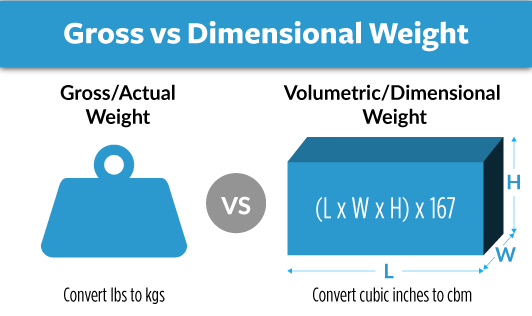
Dimensional weight takes into consideration the size and volume of the package to account for the space it takes up during transportation. The dimensional weight is utilized for cost computation if the package’s dimensions result in a higher weight than its actual mass. Choosing the larger dimensional weight enables fair pricing when the product takes up more space, even if it is not heavy.
Choosing the heavier weight, whether chargeable weight or dimensional weight, is critical because it guarantees that transportation expenses appropriately reflect the resources utilized. This strategy supports billing fairness and transparency, preventing expense underestimation and significant revenue losses for carriers.

Favorable Scenarios for Each Weight Type


- Favorable in scenarios where the actual weight of the goods is higher than their dimensional weight. This often occurs with dense and heavy items.
- Suitable for goods that do not occupy excessive space in relation to their weight.
- Preferred when weight-based charges are the primary pricing criterion.
Dimensional Weight:
- Favorable when the package’s dimensions result in a higher weight compared to its actual mass. This is common with lightweight, bulky items or packages with a lot of empty space.
- Ideal for optimizing cargo space utilization, especially when the transport mode has limitations on volume.
- Applicable when space-based charges are significant or when carriers prioritize space optimization.
The choice between chargeable weight and dimensional weight is determined by the shipment’s features, the pricing structure of the transportation service, and the specific requirements of the mode of transport. Businesses can make informed selections about which weight type to use for accurate cost computation and resource optimization by considering the variables listed above.

DocShipper Advice
How Can Docshipper Reduce Rail Costs?
Optimise your rail transport costs with Docshipper. We offer you tailor-made solutions for the precise calculation of billable and volumetric weight, adapted to the specificities of rail transport. Take advantage of our expertise to minimise your transport costs and optimise your resources. Simplify your rail logistics with Docshipper, your trusted partner for weight calculation in rail transport.
Chargeable and Dimensional Weight Calculation in Air, Sea, Road, Rail
Specifics and Industry Standards
The calculation of chargeable and dimensional weight varies across different modes of transportation. Here are the specifics and industry standards for each mode:
Air Transportation
Industry Standards: The International Air Transport Association (IATA) provides guidelines for calculating chargeable and dimensional weight in air freight.
Specifics: Air carriers typically use a dimensional factor (e.g., 166 cubic inches per pound or 6000 cubic centimeters per kilogram) to convert package dimensions into dimensional weight. The chargeable weight is determined by comparing the actual weight and dimensional weight, with the higher weight being selected.
Air freight: a density ratio of 1:6
The formula: ((L x W x H, in centimetres) / 6,000) x number of packages.
Examples
Dimensions: Length = 90 cm, Width = 60 cm, Height = 40 cm Actual Weight: 15 kg Dimensional Factor: 6000 (cm³/kg)
- Calculate the dimensional weight: Dimensional Weight = (Length x Width x Height) / Dimensional Factor = (90 cm x 60 cm x 40 cm) / 6000 cm³/kg = 216,000 cm³ / 6000 cm³/kg = 36 kg
- Compare the actual weight and dimensional weight: Actual Weight: 15 kg Dimensional Weight: 36 kg
In this example, the dimensional weight (36 kg) is higher than the actual weight (15 kg).
- Determine the chargeable weight: Chargeable Weight = Max(Actual Weight, Dimensional Weight) = Max(15 kg, 36 kg) = 36 kg
Therefore, with a dimensional factor of 6000 (cm³/kg), the chargeable weight for the package would be 36 kg. This weight would be used for determining the shipping cost of air freight.
Sea Transportation
Industry Standards: The International Maritime Organization (IMO) sets regulations for calculating chargeable and dimensional weight in sea freight.
Specifics: Sea carriers generally consider only the actual weight of the goods when determining the chargeable weight. Dimensional weight is typically not a factor unless specified by specific carriers or regulations.
Sea freight: a density ratio of 1:1
The formula: ((L x W x H, in centimeters) / 1,000) x number of packages.
This applies to part-load shipments (LCL); for full-container-load shipments (FCL), a charge per container replaces the volume-based charge.
Example
Dimensions: Length = 120 cm, Width = 80 cm, Height = 60 cm
Actual Weight: 50 kg
Dimensional Factor: 1000 (cm³/kg)
- Calculate the dimensional weight:
Dimensional Weight = (Length x Width x Height) / Dimensional Factor
= (120 cm x 80 cm x 60 cm) / 1000 cm³/kg
= 576,000 cm³ / 1000 cm³/kg
= 576 kg - Compare the actual weight and dimensional weight:
Actual Weight: 50 kg
Dimensional Weight: 576 kg
In this example, the dimensional weight (576 kg) is higher than the actual weight (50 kg).
- Determine the chargeable weight:
Chargeable Weight = Max(Actual Weight, Dimensional Weight)
= Max(50 kg, 576 kg)
= 576 kg
Therefore, with a dimensional factor of 1000 (cm³/kg), the chargeable weight for the package would be 576 kg. This weight would be used for determining the shipping cost of sea freight.
Road Transportation
Industry Standards: There are no specific industry-wide standards for chargeable and dimensional weight calculation in road freight.
Specifics: Similar to sea transportation, road carriers primarily consider the actual weight of the goods when determining the chargeable weight. Dimensional weight is generally not a consideration unless explicitly stated.
Rail freight: a density ratio of 1:3
The formula: ((L x W x H, in centimetres) / 3,000) x number of packages.
Example
Dimensions: Length = 150 cm, Width = 100 cm, Height = 80 cm Actual Weight: 30 kg Dimensional Factor: 3000 (cm³/kg)
- Calculate the dimensional weight: Dimensional Weight = (Length x Width x Height) / Dimensional Factor = (150 cm x 100 cm x 80 cm) / 3000 cm³/kg = 1,200,000 cm³ / 3000 cm³/kg = 400 kg
- Compare the actual weight and dimensional weight: Actual Weight: 30 kg Dimensional Weight: 400 kg
In this example, the dimensional weight (400 kg) is higher than the actual weight (30 kg).
Determine the chargeable weight: Chargeable Weight = Max(Actual Weight, Dimensional Weight) = Max(30 kg, 400 kg) = 400 kg
Therefore, in road freight, the chargeable weight for the package would be 400 kg.

Rail Transportation
Industry Standards: Rail freight associations and individual carriers may have their own standards and guidelines for chargeable and dimensional weight calculation in rail transportation.
Specifics: Rail carriers often follow a similar approach to road transportation, where the chargeable weight is predominantly based on the actual weight of the goods. Dimensional weight is typically not a primary consideration.
Road freight: a case-by-case scenario
Density ratios vary according to location and carrier, so check with your scheduled carriers for complete information.

Case Studies and Examples


Examples of case studies and specific scenarios in each transportation mode can be examined to illustrate the differences and similarities in chargeable and dimensional weight calculation. These examples may include various package dimensions, weights, dimensional factors, and the resulting chargeable and dimensional weights.

How can Docshipper help you?
Docshipper offers comprehensive solutions to help individuals and businesses calculate and ship parcels efficiently. Accurate calculation of billable and volumetric weight is crucial to determining transport costs and optimising the use of available space. Docshipper takes into account the regulations and tariff structures specific to each mode of transport, whether air, sea, road or rail. By offering reliable expertise and personalised advice, Docshipper enables you to maximise the efficiency of your resources, optimise your transport costs and guarantee accurate pricing. Entrust your shipments to Docshipper for optimum management of your transport costs.
FAQ | Calculate Chargeable and Dimensional Weight [Air, Sea, Road, Rail]
Weight calculation is becoming more automated and data-driven across all transport modes. Here’s what you can expect: Advanced 3D scanning systems to capture exact dimensions instantly in warehouses and terminals. Standardized volumetric weight factors across carriers to reduce pricing discrepancies. Real-time calculation of chargeable weight through integrated TMS and ERP systems. API-based air freight dim weight calculators connected directly to carrier rate engines. Greater transparency for shippers, with automated dimensional weight calculator kg tools embedded in booking platforms.
Yes, and they vary by mode: Air freight follows IATA guidelines, including the IATA volumetric weight formula air freight 6000 cm³ per kg (standard density ratio 1:6). Sea freight is influenced by IMO regulations, especially for LCL shipments where volumetric weight calculation for sea freight may apply. Road and rail freight typically follow carrier-specific rules rather than strict global standards. Always verify the dimensional factor written in your carrier’s tariff or quotation before confirming the shipment.
Because carriers charge based on the space and weight your cargo consumes. Choosing the higher value: Prevents underbilling and unexpected invoice adjustments. Reflects true cargo density. Ensures fair pricing when shipping bulky but lightweight goods. Improves load planning and aircraft/container space optimization. This principle is the foundation of proper calculation of chargeable weight.
The most frequent errors include: Using the wrong dimensional factor (for example, confusing 5000 with 6000 cm³/kg). Forgetting to include pallets, outer packaging, or protective materials in measurements. Rounding dimensions down instead of up (carriers often round up). Mixing units (cm vs meters, kg vs tonnes). Not using an updated dimensional weight calculator kg aligned with your carrier’s policy.
Follow these exact steps: Measure length × width × height in centimeters. Multiply the three dimensions to get volume in cm³. Divide by the carrier’s dimensional factor (e.g., 6000 for air freight). The result is your volumetric weight in kg. Example: 100 × 50 × 40 cm = 200,000 cm³ 200,000 ÷ 6000 = 33.33 kg Always round up according to carrier rules.
Air freight uses the standard IATA volumetric weight formula air freight 6000 cm³ per kg. Formula: (L × W × H in cm) ÷ 6000 If you have multiple packages, multiply by the number of cartons. Then compare the result with the gross weight. The higher value becomes the chargeable weight. Pro tip: Many professionals use an air freight dim weight calculator to avoid manual errors.
Road freight is often case-by-case. Here’s how to approach it: Ask your carrier for their volumetric conversion ratio (commonly 3000–5000 cm³/kg depending on region). Apply the formula: (L × W × H) ÷ carrier factor. Compare with gross weight if volumetric pricing applies. If no volumetric rule is stated, pricing is usually based purely on actual weight or pallet space. Never assume the air freight factor applies to trucking.
No, dimensions alone only give you volumetric weight. Gross weight includes: Net weight of the goods. Inner packaging. Outer cartons or crates. Pallet weight (if applicable). To estimate gross weight, you must physically weigh the shipment. Dimensions help calculate volumetric weight, but they do not replace scale measurement.
For your business interest, you may like the following useful articles :