
Freight from China to Australia | Rates, Transit Times, Duties & Taxes
The biggest mistake on this route is underestimating how fast costs and timelines can shift when you ship from China to Australia.
You’ll notice it quickly when a rate expires, a port gets congested, or customs asks for one missing detail.
If you’re researching shipping from China to Australia, you’re probably trying to lock a budget, a timeline, or a reliable process that won’t surprise you later.
That’s exactly what this guide gives you, concrete decision points on transport modes, transit times, duties, and customs, based on how this route actually works.
From experience, once you understand where things usually go wrong, choosing the right setup becomes much easier.
And if you want a second opinion, we’re always here to sanity-check your plan or handle the shipment end to end.
Which are the different modes of transportation between China and Australia?
Imagine trying to send a package from Beijing to Sydney, a journey crossing over 5,500 miles. It’s like choosing a path on a massive board game, with sea, air, road, and rail serving as potential routes. The winner is the method that provides the perfect balance of cost, time, reliability, and cargo type.
Ocean and air freight become our chess pieces in this game due to long distances and international borders. Getting a handle on these options helps you strategize your shipping game between these two far-flung locations. Choose wisely: your business win depends on it.
Docshipper Note:
Need assistance with your shipment? Dont hesitate to contact us even for a simple question. Choose the option that suits you
Live chat with an expert Chat us on WhatsApp Fill the formHow can DocShipper help?
Looking to ship goods from China to Australia? At DocShipper, our expert team can simplify the process for you, ensuring seamless customs clearance and timely delivery. From organizing transportation to handling administrative matters, we’ve got you covered. Got any questions? Our consultants are just a call away. Contact us today for a quick, free estimate in under 24 hours.
Sea freight from China to Australia
If you’re shipping volume-heavy or non-urgent cargo between China and Australia, sea freight usually makes sense. It’s the backbone of this international ocean freight route, especially for container shipping China Australia flows like consumer goods, machinery, and industrial inputs. The trade-off is simple. You save on cost, but you pay with time and paperwork.
Here’s the thing most importers underestimate. This lane looks straightforward on paper, but timing, Incoterm choice, and port selection can quietly add days and costs. We’ve seen first-time importers assume door-to-port is automatic, or that any Chinese port works the same. It doesn’t. The wrong assumption early usually shows up as demurrage or unexpected destination charges later.
If you need speed, air freight is the answer. If you need cost control and can plan ahead, maritime transport China to Australia is still the most efficient option. The goal here is to help you decide if sea freight fits your case, and if it does, how to avoid the classic mistakes on this route.
DocShipper Tip:
Sea freight might be the best solution for you if:
- You are shipping large volumes or bulky items, as sea freight offers the most space at a cost-effective rate.
- Your cargo doesn't have an urgent deadline, as sea freight typically has longer transit times compared to air or rail.
- Your shipping routes are between major ports, allowing you to leverage the extensive global network of sea shipping lanes.
Which Incoterms should you use?
On China–Australia ocean shipping, FOB and CIF dominate, but that doesn’t mean they’re always the right choice. In practice, Incoterms define who controls the booking, the paperwork, and the risk when things slow down.
FOB gives you control over the main carriage. We generally recommend it if you already work with a freight forwarder, because you decide the carrier, the sailing, and you see the real ocean freight pricing. CIF often looks easier, but many importers discover too late that destination charges in Australia are outside the seller’s scope, and they add up fast.
EXW is where first-time importers get burned. You’re responsible from the factory gate, including export clearance in China. DAP can work if you want simplicity, but you must be clear on what’s included. Incoterms for sea freight aren’t about definitions, they’re about who stays in control when the shipment hits friction.
Main ports to know in China and Australia
In China, port choice follows your supplier location.
- Shanghai and Ningbo, ideal for East China factories, reliable sailings and strong FCL availability.
- Shenzhen and Guangzhou, best for South China, electronics, and LCL consolidation warehouses.
- Qingdao and Tianjin, used when sourcing from North China, but often with longer inland trucking.
In Australia, the port affects your inland cost more than the ocean leg.
- Sydney and Melbourne, the main ports of discharge, but also the most exposed to congestion and storage pressure.
- Brisbane, a solid alternative for Queensland-bound cargo.
- Fremantle, relevant for Western Australia, but longer sailing times from China.
Your port of loading and port of discharge choice directly impacts trucking distance, terminal fees, and how fast you can clear customs. This is where planning pays off.
Should I choose FCL or LCL when shipping between China and Australia?
When shipping between China and Australia, you’re faced with a strategic decision: FCL (Full Container Load) or LCL (Less than Container Load). This isn’t just about saving cents on the dollar – it’s a decision that shapes the efficiency of your entire freight journey.
Get ready to dive into the specifics of these two sea freight options and understand how they can adapt to your unique shipping requirements, influencing key factors like cost, delivery time, and overall success. This guide aims to equip you with the necessary insights so you can make the most pragmatic choice for your business.
LCL: Less than Container Load
Definition: LCL (Less-than-Container-Load) shipment is a mode of ocean freight where several shipments from different shippers are consolidated into one container.
When to Use: LCL proves to be the more cost-effective and flexible solution when the volume of your cargo is low. When your cargo is less than approximately 13 to 15 CBM (cubic meters), specifically, LCL becomes a preferable option.
Example: For instance, let’s say a Perth-based furniture manufacturing business wishes to import a small quantity of specialty wood from China. Since the order volume is quite small, employing a full container load (FCL) would result in needless expense and waste of space. In this scenario, the business could opt for an LCL shipment to minimize costs and improve efficiency.
Cost Implications: LCL freight may bear additional costs such as consolidation and deconsolidation fees. But remember, these are usually less than the price of renting an entire container that isn’t fully utilized. Therefore, for shipments smaller than about 15 CBM, you can save money with an LCL option.
FCL: Full Container Load
Definition: FCL (Full Container Load) shipping is a type of freight transport where a goods consignment from one shipper fills up an entire FCL container, typically 20’ft or 40’ft in size.
When to Use: This alternative is primarily suitable when your cargo exceeds 13 to 15 CBM (cubic meters). FCL shipping is favorable for larger shipments due to lower costs per unit and heightened security, as the container is sealed at origin and remains unopened until it reaches its destination.
Example: Let’s say you’re shipping furniture from Shanghai to Sydney. Your inventory fills up more than half of a 40’ft container. By opting for FCL, you can ensure that your goods remain unhandled, minimizing the risk of damage in transit.
Cost Implications: With FCL shipping, you pay for the entire container’s use, hence your cost will be fixed regardless of the cargo volume. On receiving an FCL shipping quote, you might find it significantly cheaper per unit for high-volume shipments compared to the LCL option. However, low-volume shippers may find FCL less competitive because unused space within the container also incurs charges.
Unlock hassle-free shipping
If you’re hesitating between LCL consolidation and full container load shipping, that’s normal. The answer depends on your CBM, your deadlines, and how much handling risk you’re willing to accept. This is exactly where we step in. We look at your volume, your Incoterm, and your destination behavior before recommending FCL or LCL. Reach out to us and we’ll walk you through the logic, no pressure.
Transit times: how long does it take to ship from China to Australia?
Sea transit time China Australia varies by port pair and service type. Below is a realistic planning overview for container shipping.
| Port of loading | Port of discharge | Estimated sea transit time |
|---|---|---|
| Shanghai | Sydney | 18–22 days (FCL) |
| Ningbo | Melbourne | 20–24 days (FCL) |
| Shenzhen | Brisbane | 18–23 days (FCL) |
| Qingdao | Fremantle | 22–26 days (FCL) |
| Multiple origins | Major AU ports | 22–37 days (LCL) |
These are sailing estimates, not guarantees. Port congestion in Australia, transshipment, and LCL consolidation are the main variables. Peak periods like Chinese New Year or pre-Christmas rush can easily stretch lead times. If you need predictability, build buffer days into your plan.
Shipping rates: how much does a sea freight shipment cost from China to Australia?
| Shipment type | Typical planning range |
|---|---|
| LCL (1–5 CBM) | USD 80–150 per CBM |
| 20ft container (FCL) | USD 1,200–2,500 |
| 40ft container (FCL) | USD 2,000–4,500 |
The first thing we always tell people is this. The ocean freight rate is never the final cost. On this lane, pricing is driven by equipment availability, port pair, seasonality, and destination charges in Australia. That’s why two quotes with the same base rate can land very differently.
Special sea freight solutions
Some cargo simply doesn’t fit standard container rules. On China–Australia routes, we regularly handle OOG containers, breakbulk, Ro-Ro, and reefer shipments. These solutions require early planning, precise dimensions, and coordination with terminals on both sides.
If you’re moving oversized machinery, vehicles, or temperature-sensitive goods, the key is feasibility before pricing. One wrong assumption here can block loading entirely. We assess lifting points, port restrictions, and sailing options before confirming anything.
Air freight from China to Australia
Air freight from China to Australia makes sense when time matters more than cost. If you’re shipping high‑value goods, urgent replenishment, samples, or anything tied to a launch or deadline, air is the right tool. But if you’re moving bulky or low‑density cargo, or if timing is flexible, this route gets expensive fast.
Here’s the thing most guides don’t tell you. Air isn’t “always 3 days”, pricing isn’t driven by gross weight alone, and poor prep is what really blows budgets. We see the same mistakes on this international air shipping route, underestimating chargeable weight, cartons rejected at cargo acceptance and screening, incomplete docs delaying the AWB. Air is fast, but it’s unforgiving.
DocShipper Tip:
Air freight might be the best solution for you if:
- You are in a hurry or have a strict deadline requirement, as air freight offers the fastest transit times.
- Your cargo is less than 2 CBM (Cubic Meter), making it more suitable for smaller shipments.
- Your shipment needs to reach a destination that is not easily accessible by sea or rail, allowing you to tap into the extensive network of global airports.
Air Cargo vs Express Air Freight: How should I ship?
On the China–Australia lane, the real question isn’t speed versus price. It’s control versus simplicity. Air cargo gives you flexibility and cost logic. Express gives you speed and fewer touchpoints. Both work, if you pick them for the right reason.
Should you choose air cargo from China to Australia?
Air cargo China Australia usually becomes relevant from 1 CBM or 100/150 kg (220/330 lbs) and up. It’s the standard air freight solution when you ship B2B, need airport‑to‑airport shipping, or want control over costs and delivery legs.
This option works well if you have your basics ready. Exact dimensions, real weight, Incoterm, origin airport, ready date, and cargo type. Miss one, and you’ll feel it at cut‑off or during export handling at origin airport.
Where people get stuck is assuming air cargo is door‑to‑door by default. It’s not. Add screening, minimum charges, handling, and import handling at destination airport. When we manage it end‑to‑end, these steps are predictable. When they’re ignored, costs spike.
Should you choose express air freight from China to Australia?
Express air delivery option makes sense for urgent shipment by air, small parcels, or when you don’t have a logistics team. It’s fast, usually door‑to‑door, and removes a lot of coordination.
The trade‑off is control. Express air freight vs air cargo isn’t about speed alone. Re‑weighs, volumetric pricing, unclear Incoterms, and destination charges surprise a lot of first‑time importers. Express is great if you need simplicity now. It’s risky if margins are tight and density is low.
Main cargo airports in China
- Shanghai Pudong (PVG). Best overall connectivity. High flight frequency to Australia, good for consolidation vs direct flight.
- Shenzhen (SZX). Close to manufacturing hubs. Ideal for electronics and high‑value goods air shipping.
- Guangzhou (CAN). Strong freighter capacity and stable export handling.
- Beijing (PEK). Useful for northern suppliers, but trucking often adds cost.
Airport choice impacts inland trucking, cut‑off pressure, and real lead time more than most importers expect.
Main cargo airports in Australia
- Sydney (SYD). Highest frequency. Fast customs, but congestion at peak seasons.
- Melbourne (MEL). 24/7 operations. Good balance of cost and reliability.
- Brisbane (BNE). Efficient for perishables and temperature‑controlled air cargo.
- Perth (PER). Shorter flight time from South China, useful for Western Australia.
Your destination airport affects last‑mile cost and clearance speed more than flight time alone.
Transit times: how long does air freight take from China to Australia?
| Service | Typical lead time |
|---|---|
| Standard air cargo | 3–7 days |
| Express air freight | 2–5 days |
These are door‑to‑door estimates, not flight time. The air leg is under 12 hours. The rest is docs, screening, handling, and clearance.
Delays usually come from missed cut‑off, incomplete air freight documentation flow, or seasonal congestion like Chinese New Year.
Shipping rates: how much does air freight cost from China to Australia?
| Service | Indicative range |
|---|---|
| Standard air cargo | USD 4–7 per kg |
| Express air freight | USD 6–9 per kg |
Rates depend on chargeable weight, not assumptions. Density, dimensions, season, and airport choice drive the final number. That’s why air freight quote estimation always starts with measurements.
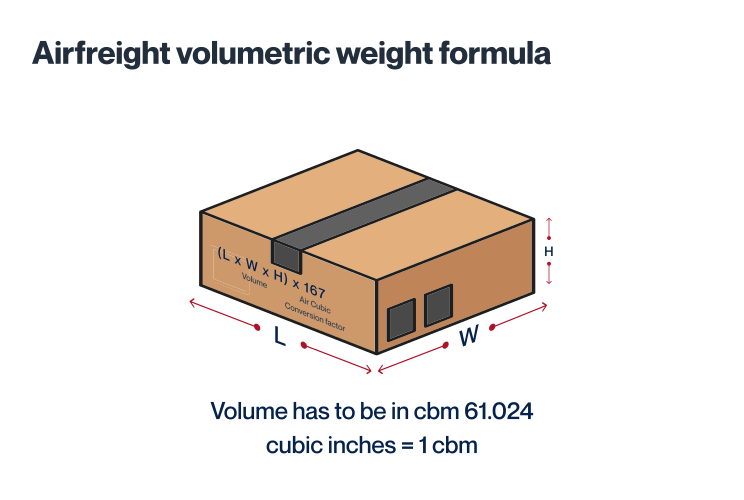
What is the difference between volumetric and gross weight?
This is the most expensive misunderstanding in air freight. Airlines charge based on the higher of gross weight vs volumetric weight, also called dimensional weight pricing.
- Gross weight. What the shipment actually weighs.
- Volumetric weight. The space it occupies.
How to calculate.
Length × Width × Height (cm) ÷ divisor.
Example: 40 × 30 × 20 cm = 24,000 cm³.
Air cargo: 24,000 ÷ 6,000 = 4 kg.
Express: 24,000 ÷ 5,000 = 4.8 kg.
| Service | Standard divisor |
|---|---|
| Air cargo | 1 m³ = 167 kg |
| Express | 1 m³ = 200 kg |
Common mistakes. Guessing carton sizes, poor packaging, or assuming gross weight wins. On this route, low density costs more than distance.
Door to door between China and Australia
Venturing into international shipping? Door to Door services might be your ticket to stress-free transportation of goods from China to Australia. Put simply, it’s an all-inclusive service, covering pick-up, transport, customs, and delivery. This method saves time, simplifies logistics, and often proves cost-effective. Intrigued? Let’s dive into the specifics of Door to Door shipping between these bustling trade hubs.
Overview – Door to Door
Wrestling with the intricacies of international shipping? Door to Door shipping between China and Australia offers a stress-free solution. Its popularity stems from its convenience, bridging the gap between sender and receiver seamlessly no matter the distance or complexity. Despite higher costs, businesses cherish this tailor-made, all-inclusive approach.
It eliminates potential pitfalls along the way – from customs clearance headaches to unexpected delays. A standout service, it’s hand-picked by our DocShipper clients seeking streamlined shipping experiences. Dive deep with us into this logistics life-saver, comparing pros, cons, and addressing potential concerns to help decode your best shipping strategy.
Why should I use a Door to Door service between China and Australia?
Pandas shipping seaweed? Maybe not, but choosing Door to Door service from China to Australia can feel just as exotic and effortless! Let me give you five good reasons why:
1. Stress-Free Logistics: Just sit back and relax. Door to Door service takes care of all logistically intimidating aspects, starting from goods pick up at the source to delivery at the destination.
2. Time-Saver for Urgent Shipments: If your shipment is time-sensitive, this service is a lifesaver. It ensures a streamlined process and timely delivery, keeping those strict deadline nightmares at bay.
3. Specialized Care for Complex Cargo: Got something tricky to ship? Fret not. Door to Door service has you covered, providing specialized handling for complex cargo – your valuable goods are in safe and knowledgeable hands.
4. Complete Trucking Solution: Wave goodbye to additional headaches! This service takes care of all the trucking needs till the very end, ensuring your cargo reaches even the remotest business location.
5. Utmost Convenience: Lastly, it’s all about convenience. Door to Door service simplifies international shipping intensely, leaving you with extra time to focus on core business tasks.
In a nutshell, Door to Door service trades the hassle of complex shipping procedures for comfort, efficiency, and peace-of-mind. Save time, effort, and likely, a few grey hairs too!
DocShipper – Door to Door specialist between China and Australia
Experience stress-free door-to-door shipping from China to Australia with DocShipper. From packaging to transport, customs clearance to delivery, we handle all aspects of your freight needs. No jargon, no complications, just smooth international shipping managed by our proficient team.
Plus, with a dedicated Account Executive assigned to you, 24/7 support is just a call away. Want an estimate? Get in touch for a free consultation and quote within 24 hours. Trust DocShipper with your transportation requirements – We make shipping simple.
DocShipper Tip:
- You value convenience and want a seamless shipping process, as door-to-door takes care of every step from pickup to delivery.
- You prefer a single point of contact, as door-to-door services typically provide a dedicated agent to handle all aspects of the shipment.
- You want to minimize the handling of your goods, reducing the risk of damage or loss, as door-to-door minimizes transitions between different modes of transport.
Customs clearance in Australia for goods imported from China
Customs clearance in Australia directly affects your total landed cost, your cargo release timing, and who is legally on the hook as Importer of Record. On China to Australia flows, clearance decisions ripple fast into storage fees, delivery rebooking, and cash flow. We coordinate the import clearance workflow with licensed partners, so you’re not managing the customs declaration process alone.
Most problems don’t happen at the border itself. They come from assumptions upstream. Common mistakes we see on this route include the wrong Incoterm logic, weak HS code classification, undervaluation that ignores freight or insurance, and documents that don’t line up at filing time. Below, we walk you through the customs process China to Australia, and a practical method for duties and taxes calculation so you can estimate
Step-by-step: how customs clearance usually works on this route
If you’re importing goods from China, this is how the import clearance workflow usually plays out in real life. The sequence changes a bit by port or airport, Incoterm, and whether you ship express or freight, but the pressure points are consistent.
- We receive the pre-alert and documents from origin. This is where commercial invoice review and packing list verification already catch issues.
- We confirm the Importer of Record, HS code, and customs value. A mismatch here is a top cause of clearance delays.
- The customs declaration process is filed with Australian authorities using the bill of lading for customs or air waybill for customs.
- Customs may ask questions or select the cargo for the customs inspection process, often triggered by product description or value.
- Duties and GST are assessed. Payment or guarantee timing matters for release.
- Cargo release procedure is issued once everything checks out.
- Delivery is booked. Missed warehouse appointments can still add costs.
- Post-clearance follow-up happens if customs rechecks classification or value.
landed cost before you ship.
How to calculate duties & taxes when importing from China to Australia?
If you want a reliable landed cost estimation, you need a few inputs that actually matter: country of origin identification, product HS code classification, customs value determination, and the applicable import tariff assessment. Miss one, and the numbers fall apart.
Why estimates change at assessment time is usually about classification or valuation questions, not math. Cheap quotes often ignore the full tax base, especially freight, insurance, or additional measures. The steps below show you the logic we use so you can budget realistically.
Step 0 – Quick checks before you calculate
- Who is the Importer of Record? This party is legally responsible for duties, GST, and compliance.
- Which Incoterm applies? It decides who controls clearance and what costs belong in the customs value.
- Is a low-value or simplified path possible? Check Australian Border Force thresholds and your carrier’s rules before assuming anything.
Step 1 – Identify the Country of Origin
You’re importing from China, but origin is more than a label. It drives tariff eligibility, proof expectations, and risk of challenge if your documents don’t tell the same story.
Origin affects whether preferential rates apply, what proof customs expects, and how closely the file is reviewed. If the invoice, manufacturer details, and markings don’t align, customs will question it.
Preferential tariffs and trade defense measures can apply depending on HS code and origin. We’ll show you how to verify this in Step 4. A common mistake is confusing origin with shipping country or a vague “Made in” claim.
Step 2 – Find the HS Code of your product
HS code classification decides duty rate, controls, and how smooth your customs broker coordination will be. Get it wrong, and you’re looking at reclassification, back-payments, or holds.
Your supplier’s code is a starting point, not a guarantee. Validate it using Australia’s tariff classification tools and build a light support file, product function, materials, photos, datasheets, SKUs.
Use the official Australian tariff resources to cross-check your code. One reliable starting point is the Australian Customs Tariff.
Operational warning: wrong HS codes trigger customs questions, inspections, and extra storage while it’s fixed. On China to Australia flows, generic product descriptions are a frequent cause.
Here’s an infographic showing you how to read an HS code.
Step 3 – Calculate the Customs Value
Australia generally uses the transaction value when applicable. In practice, this means the price you paid, plus elements that must be added depending on the Incoterm.
What changes the taxable base is usually freight and insurance, and sometimes packing, assists, or commissions. If you’re on CIF, these are already included. On EXW or FOB, they often get added.
Example: goods at 5,000, freight 1,000, insurance 300. Customs value becomes 6,300. This is the base customs looks at, not just the invoice.
Step 4 – Figure out the applicable Import Tariff in Australia
An import tariff is the duty rate applied to your product when it enters Australia. Rates are organized by HS code and can change based on origin.
How to find the real rate:
- Open the official Australian tariff tool.
- Enter your HS code and select China as origin.
- Read the duty rate and any notes or additional measures.
- Check standard vs preferential rates, and proof requirements.
- Watch for additional measures tied to HS code and origin.
Formula: import duty = customs value × duty rate. If the rate shown is X% and the value is 1,000, duty equals 1,000 × X%.
Rates and measures change, and weak origin proof can cancel preferences. Save a screenshot of the tariff result for budgeting and for your broker. We can double-check the HS code and tariff logic with you before you ship if you share your product details, value, and Incoterm.
Step 5 – Consider other Import Duties and Taxes in Australia
GST is usually the biggest line after duty. In Australia, GST is generally calculated on the customs value plus duty and certain transport or insurance costs.
Mini example: customs value 6,300, duty 5% equals 315. GST base becomes 6,615. GST at 10% equals 661.50.
Other measures can apply. A common pattern is anti-dumping duties on specific products where price and origin trigger trade defense. When it applies, you’ll see an extra line at assessment, higher cash-out, and delays if it wasn’t anticipated.
- Verify GST base for your HS code.
- Check if any additional measures appear for China.
- Prepare classification and value support to avoid reassessment.
Step 6 – Calculate the Customs Duties
Duty: customs value × duty rate.
GST: tax base × 10%, where the base usually includes value, duty, and certain charges.
What happens next: who pays or advances duties and taxes depends on your setup with the broker or forwarder. Payment timing affects release. If clearance stalls, storage, handling, and delivery rebooking costs start adding up fast. This is why pre-clearance preparation and an import compliance checklist matter on this lane.
Does DocShipper charge customs fees?
While DocShipper functions as your customs broker in China and Australia, handling your customs clearance procedures, we don’t charge customs duties. Confused?
Let’s simplify it! Custom broker fees and customs duties aren’t the same. Our fees cover the service of clearing your goods through customs, while duties and taxes are government charges, not ours. Instead, we provide you with official documents from the customs office to guarantee transparency, assuring you that you’re only paying your governmental dues.
Contact Details for Customs Authorities
China Customs
Official name: General Administration of Customs of the People’s Republic of China
Official website: http://english.customs.gov.cn/
Required documents for customs clearance
Ever grappled with which documents are necessary for a hassle-free customs process? We’ve got you covered. In this section, we’ll dissect key items like the Bill of Lading, Packing List, Certificate of Origin, and documents of conformity (CE standard), clarifying how each one plays a pivotal role in ensuring your consignment sails through customs without a hitch.
Bill of Lading
Shipping goods from China to Australia? Your key to a seamless customs clearance process is the Bill of Lading. It’s more than just a document – it’s the official bridge that shifts ownership of your freight from point A to point B. Spotlighting ‘telex’ release; this electronic form of the Bill of Lading accelerates the release process whilst minimizing the risk of document loss.
Don’t rule out its airfreight counterpart either – the AWB. Whether it’s figurines from Fuzhou or merino wool from Melbourne, having these documents advances a smooth sailing (or flying!) from port to port. Focus on knowing your Bill of Lading essentials, saving you from unnecessary headaches and delays in your goods’ journey.
Packing List
Navigating customs between China and Australia? Your Packing List can make or break your experience. Think of it as the detailed CV of your shipment. It promptly informs customs officials what they can expect inside your shipment. Whether you’re shipping a batch of smartphones by air or a container of furniture by sea, accuracy is key.
Just imagine misreporting the number of smartphones in the crate or forgetting to include the wooden chairs in the sea freight documentation. It can result in serious penalties or unforeseen delays. That’s why attention to detail when creating your Packing List is crucial. It sets the expectations right and ensures a smooth clearance process, saving your business from unnecessary hiccups.
Commercial Invoice
Preparing a Commercial Invoice for your shipments between China and Australia? This document is your golden ticket for a seamless customs clearance process. Make sure to include essential details like product description, total value, and crucial Harmonized System (HS) codes. Why? Because these details enable customs to determine duties and ensure regulatory compliance.
One pitfall to avoid is inconsistencies between your Commercial Invoice and other shipping documents. Any discrepancy could lead to shipment delays. So, if you’re exporting a batch of mobile phones from Guangzhou to Sydney, ensure the descriptions align across all documents – from the packing list to the Bill of Lading. That’s the key to mastering your Australia-China shipping journey.
Certificate of Origin
Navigating customs between China and Australia? Your shipment’s Certificate of Origin (CO) could be a game-changer. This critical document vouches for where your goods were produced, with details down to the city level. For instance, your shipment of Brisbane-manufactured electronics aimed for Shenzhen is legitimized by its CO.
This document can unlock benefits like preferential duty rates, thanks to the Australia-China Free Trade Agreement. So, don’t overlook detailing the country and city of manufacture on your CO—it could lead to significant savings and smoother shipment process.
Get Started with DocShipper
Navigating China to Australia customs clearance can be complex, but you’re not alone. At DocShipper, we simplify this process, handling each step meticulously to ensure a hassle-free experience. We’re an email away, ready to shoulder your logistics burdens. Get your free shipping quote in under 24 hours. Let’s make international shipping effortless. Contact us now!
Prohibited and Restricted items when importing into Australia
Getting your goods cleared at Australian customs can be a real headache, especially if you’re not sure what you can and can’t bring in. Let’s untangle the complex world of Australia’s prohibited and restricted imports, so you can avoid unnecessary delays and costs next time you ship.
Restricted Products
Here’s what you’ve got to know when shipping restricted goods to Australia:
– Agricultural Goods: You’ll need to apply for an Import Permit from the Department of Agriculture, Water and the Environment.
– Pharmaceutical Substances: A permit from the Therapeutic Goods Administration is a must.
– Motor Vehicles: You have to obtain a Vehicle Import Approval from the Department of Infrastructure, Transport, Regional Development & Communications.
– Tobacco Products: Don’t forget to apply for a permit from the Australian Border Force.
– Weapons and Firearms: You’re required to apply for an Import Permit from the Australian Border Force.
Remember, compliance with all import guidelines is your responsibility, so always double-check you’ve got everything covered!
Prohibited products
– Live plants and bulbs from overseas
– Unprocessed plant materials such as bark, moss, cones, and wood
– Animal products including certain types of meats and animal hides
– Biological specimens like blood, cultured cells
– Illicit drugs and psychoactive substances
– Weapons and firearms without a permit
– Protected wildlife species and products made from their parts
– Products containing asbestos
– Certain culturally sensitive material
– Hazardous waste
– Laser pointers with a power greater than 1mW without a permit
– Offensive material according to Australian standards such as obscenity, violence, or crime
– Counterfeit currency and goods
– Certain types of cosmetics, medicines, and therapeutic goods without a permit.
China – Australia trade and economic relationship
China remains Australia’s largest trading partner, with two-way trade amounting to $326.9 billion in 2023, an increase of 9.2% from the previous year. Australian goods and services exports to China totaled $218.8 billion, marking an 18.2% increase.
Chinese investments in Australia are substantial, particularly in sectors like mining, infrastructure, and healthcare. In 2023, China was the fifth-largest foreign direct investor in Australia, with an investment stock worth $46.6 billion. Conversely, Australian investments in China totaled $2.2 billion.
Despite strong economic ties, there are significant geopolitical and policy differences between the two countries. Issues such as human rights and regional security are areas where Australia and China continue to manage their differences while maintaining a cooperative economic relationship.
Shipping between China and Australia brings its own challenges: language barriers, complex customs clearance, and unfamiliar regulations. Avoid the hustle and stay on top of your shipment with DocShipper’s expert solutions. We offer seamless, end-to-end freight forwarding solutions with a transparent pricing model. Don’t let international shipping become an obstacle. Contact us today, let us guide you every step of the way.
Additional logistics services
Explore our range of supplementary services designed to streamline your shipping experience. At DocShipper, we handle everything, from inventory management to customer delivery, ensuring a hassle-free, end-to-end supply chain process. You focus on your business, we manage the rest.
Warehousing and storage
Finding the right warehouse in a foreign land like China can be tricky. Your perfect pick should have the requisite facilities, like temperature control for precious cargo like electronics or food. Solve this puzzle by banking on reliable warehousing solutions. For an insightful read on this topic, head over to our dedicated page: Warehousing.
Packaging and repackaging
When shipping from China to Australia, consider this: Your goods need more than a simple box. Ensuring robust packaging and repackaging can save you from costly damages and delays. Your best bet? Hire a trusted agent who can handle everything from electronics to apparel with precision. Dive deeper into the nitty-gritty of freight packaging, including practical examples, on our dedicated page: Freight packaging
Cargo insurance
Cargo insurance isn't just fire insurance at sea. It's a lifeline that safeguards your goods from unforeseen accidents in transit. Take this scenario, for instance: your precious cargo gets damaged due to a collision on a stormy sea. Without cargo insurance, the financial hit could be crippling. But with it, you're shielded against hefty losses! Prevention is always better than cure, after all. More info on our dedicated page: Cargo Insurance.
Supplier Management (Sourcing)
At DocShipper, your procurement woes are a thing of the past. We connect your business with suppliers across Asia and East Europe, taking the reins of the entire buying process. Overcome language barriers with ease and chart pathways to success with our expert guidance. For instance, sourcing materials for your Sydney-based startup from a factory in Shenzhen? We've got you covered. Deep dive into these offerings at our Sourcing services page: Sourcing services.
Personal effects shipping
Relocating between China and Australia and anxious about your delicate or hefty possessions? You're not alone. With our Personal Effects Shipping service, we handle your items with utmost care and adaptability. Like the grand piano we safely shipped from Beijing to Brisbane. Rest easy, your treasures are in professional hands. More info on our dedicated page: Shipping Personal Belongings.
Quality Control
Ensuring your goods meet the 'Australia New Zealand Food Standards Code' is crucial when shipping from China to Australia. Our quality control service plays a pivotal role here. We've helped clients uncover unseen defects in batches of custom-made toys, and daunting non-compliance in food products, avoiding costly recalls or fines. Entrust us today to safeguard your business reputation. More info on our dedicated page/Find out more on our dedicated page: Quality Inspection.

Product compliance services
When entering a foreign market, ensuring your goods meet all regulatory standards is vital. That's where our Product Compliance Services come in — we'll test your goods in our lab and secure necessary certifications, eliminating compliance worries! Real-world example? Picture your electronics shipment held up over a safety standard. We prevent that! Find out more on our dedicated page: Product compliance services.