In short ⚡
China supply chain risk is the structural vulnerability created when heavy dependence on Chinese suppliers, sub‑tier inputs and manufacturing makes your total landed cost, lead times and ability to ship highly sensitive to tariffs, export controls, compliance holds and geopolitical shocks. It combines operational continuity and business interruption risks that cannot be solved by normal logistics fixes alone.
We hope you’ll find this article genuinely useful, but remember, if you ever feel lost at any step, whether it’s finding a supplier, validating quality, managing international shipping or customs, DocShipper can handle it all for you!
What makes China supply chain risk uniquely dangerous for your business?
China supply chain risk isn’t just “a late container” or “a factory delay”.
It’s the compound effect of supplier concentration, trade compliance, and geopolitical risk hitting your total landed cost and your ability to ship, all at once.
In practice, you’re dealing with operational continuity plus business interruption risk, and they don’t behave like normal logistics problems.
We’ve seen buyers who thought they had “diversification” because they used three suppliers, then discovered all three sub-tier suppliers were in the same industrial park in Guangdong.
That’s the moment you realize “China Supply Chain Issues” can be invisible until they’re expensive.
Structural dependence on China vs. “normal” logistics disruption
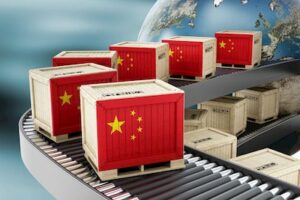
Two summers ago, we helped an importer who panicked over port congestion in Europe, then found the real issue was upstream.
Their product used a China-made chip, and a single sourcing decision from a sub-tier supplier created lead time variability of 10 to 14 weeks.
China supply chain risk is structural when your BOM, tooling, molds, or contract manufacturing capacity is effectively “locked” in one country.
A “normal” supply chain disruption is often a logistics management problem, like container shortages, transportation bottlenecks, or a missed customs clearance window.
Structural dependence is different because even perfect freight forwarding can’t ship what you can’t build.
To make the difference obvious, here’s a quick comparison you can use in internal meetings.
| Situation | What it looks like | Typical fix | Risk signature |
| Normal logistics disruption | Port congestion, blank sailings, customs queue | Reroute, change carrier, adjust Incoterms, add inventory buffer | Short-term cost spike, recoverable service level |
| China structural dependence | Single sourcing, tooling held by supplier, sub-tier in China | Dual sourcing, manufacturing relocation, redesign, qualify alternates | Multi-quarter disruption, margin compression, lost revenue |
| Compliance-driven interruption | Export controls, sanctions compliance holds, origin challenges | Vendor due diligence, documentation controls, product classification review | Shipments blocked, legal exposure, forced re-sourcing |
You’ll notice fast that the second and third rows don’t get solved by “calling the forwarder”.
They force a sourcing strategy decision, and that’s where managing supply chain risk becomes a board-level conversation.
DocShipper Alert
DocShipper audits your China footprint, quantifies risk, and builds concrete sourcing and logistics alternatives you can deploy fast.
Key external triggers: tariffs, geopolitics, and macro shocks
Here’s the tip: treat every headline as a potential cost and clearance event, not just politics.
China supply chain risk often spikes when tariffs, export controls, or new regulatory compliance requirements appear with short notice.
We’ve watched buyers absorb “temporary” surcharges, then get hit again when a new tariff line applied, and suddenly the product wasn’t profitable at all.
That’s why you keep hearing about trade war dynamics, and why queries like US China tariffs in charts global supply chains at risk keep trending.
Even if you don’t sell in the US, the shockwaves can change carrier capacity, pricing, and supplier priorities across global supply chains.
According to the WTO, trade measures and uncertainties can reshape flows quickly, and your lead times can swing before your contracts are updated.
To pressure test your exposure, use this short checklist before you renew any China-heavy PO plan.
- Tariff sensitivity: do you know the HS codes, duty rates, and worst-case import duties impact by SKU?
- Country-of-origin rules: can your supplier prove origin, and do you have documents ready for customs clearance?
- Export controls: do any components fall under sensitive categories that can trigger holds?
- Supplier concentration: what share of sales relies on one region, one cluster, or one sub-tier?
- Operational buffers: do you run just-in-time inventory, and if so, what’s your minimum inventory buffer to stay in stock?
- ESG risk: can you demonstrate traceability and vendor due diligence if your customer asks tomorrow?
If you’re missing two or more answers, you’re not “behind”. You’re normal, and you’re also exposed.
DocShipper Info
DocShipper maps your HS codes, duty exposure, and compliance gaps, then designs import strategies that stabilize landed costs and secure customs clearance in volatile China trade conditions.
How to map and quantify your real exposure to China disruptions
China supply chain risk gets manageable the moment you turn it into a map and a number.
You’re not trying to predict geopolitics, you’re trying to quantify procurement risk, lead time variability, and margin impact in scenarios you can actually act on.
We’ve seen teams swear they were “only 25% China-dependent”, then uncover China content inside “Vietnam-assembled” goods through sub-tier materials.
This is also where distribution and supply chain risks in china show up, not as theory, but as missed deliveries, surprise duty, and strained customer SLAs.
Tracing China content across products, revenue, and sub-tier suppliers

What if your “non-China” supplier is still buying the critical inputs from China?
That’s a core pattern in China supply chain risk, and it’s why decoupling from China often takes longer than expected.
From experience, the fastest wins come when you trace exposure along three lines, not one.
Use this workflow to build an exposure map that procurement, finance, and ops can all agree on.
Workflow to trace China exposure (SKU to sub-tier):
- Step 1: rank SKUs by revenue and gross margin contribution, then pick the top 20% that drive 80% of profit.
- Step 2: for each SKU, log manufacturing country, Incoterms, and known component origins.
- Step 3: request sub-tier disclosure for critical parts (chips, batteries, castings, textiles, packaging) and record where those parts are made.
- Step 4: identify single sourcing points, tooling lock-in, and MOQ constraints that block dual sourcing.
- Step 5: match each SKU to customs data needs, including origin proofs and product classification owners.
- Step 6: tag each lane for logistics fragility (port congestion history, container availability, transit-time variance).
This is vendor due diligence with a purpose, not paperwork for its own sake.
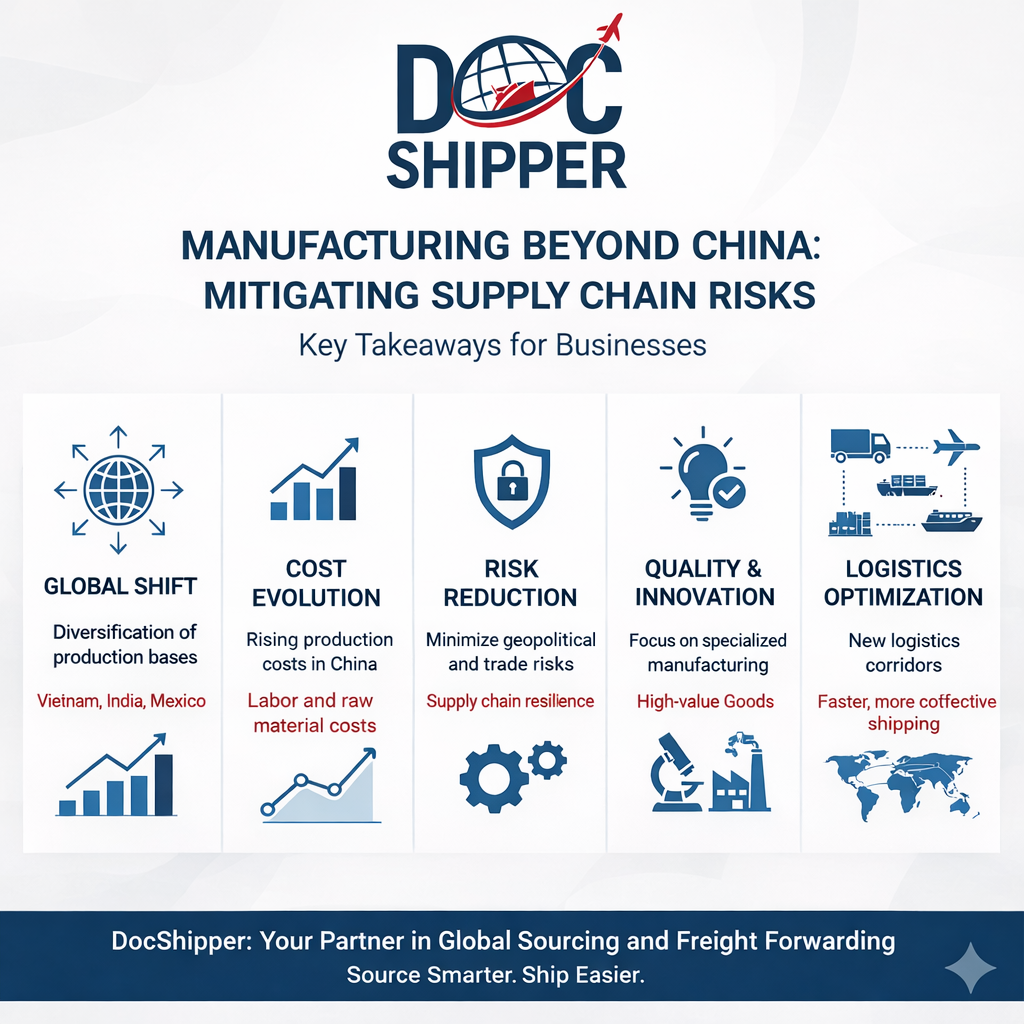
Once you see the map, your diversification strategy gets concrete, nearshoring where it’s realistic, reshoring where it’s strategic, and keeping China where it’s still the best tradeoff.

Looking for a Reliable Shipping & Sourcing Partner?
Scenario stress tests that link China shocks to landed cost and margin
Bold truth: if you can’t translate a China shock into margin impact, you won’t get budget to fix it.
China supply chain risk becomes actionable when you stress test a few scenarios and quantify total landed cost changes, week by week.
We’ve run exercises where a buyer assumed “tariffs add 5%”, then discovered the real hit was duties plus freight spikes plus air freight emergency moves to recover service levels.
To keep it practical, run three scenarios that reflect how disruptions actually stack.
- Tariff shock: duty rate jumps, stricter origin checks, slower customs clearance, added broker costs.
- Logistics crunch: port congestion, blank sailings, premium surcharges, longer lead time variability requiring a bigger inventory buffer.
- Geopolitical escalation: export controls, sanctions compliance screening delays, forced supplier switch, requalification costs.
Then link each scenario to the numbers your CFO cares about: margin %, cash tied in inventory, and revenue at risk from stockouts.
If you want a simple structure, here’s a lightweight table you can copy into a spreadsheet and fill in with your own data.
| Scenario | Cost drivers to model | Operational impact | Output you need |
| Tariff increase | Duty %, customs fees, classification review time, origin documentation cost | Clearance delays, compliance workload | Total landed cost delta per SKU, margin delta |
| Freight disruption | Spot rate uplift, detention, demurrage, mode switch (sea to air) | Service level risk, backorders | Extra logistics spend, required inventory buffer |
| Forced relocation | New supplier onboarding, tooling remake, audits, testing, travel, rejects | Production gap, quality drift | Time-to-recover, one-time costs, ongoing unit cost change |
This is the heart of managing supply chain risk, you stop debating feelings and start comparing options like dual sourcing, nearshoring, or selective manufacturing relocation based on numbers.
DocShipper Info
DocShipper builds realistic China shock scenarios, simulates total landed cost and margin impact, and helps you choose the smartest mix of dual sourcing, safety stock, and alternative routes.
Practical levers to cut China dependence without exploding total cost
Last year, one of our clients told us how a single factory shutdown froze three SKUs overnight, that moment is where china supply chain risk stops being theory and starts hurting cash flow. From experience, you’ll notice fast that cutting exposure is less about leaving China entirely and more about rebalancing intelligently.
Here’s the thing, when you diversify with intention, you protect margins while keeping products moving, and that’s exactly what the World Economic Forum keeps highlighting in its resilience work. We’ve watched teams succeed when they treat China as one pillar among several, not the whole structure.
This comparison helps you choose the right lever before you act.
| Lever | What you change | Impact on cost | Risk reduction |
| Dual sourcing | Secondary factory in Asia or nearshore | Low to medium increase | High |
| China+1 relocation | Shift volume gradually out of China | Medium increase | Very high |
| Component rebundling | Source sub-parts outside China | Low increase | Medium |
What usually surprises you is how often smarter freight planning offsets higher unit costs, something we routinely model at DocShipper using landed-cost simulations.
DocShipper Advice
DocShipper compares suppliers, routes, and inventory scenarios so you can add China+1 capacity, cut single-sourcing, and keep overall landed cost under control.
Legal, contractual, and operational safeguards with Chinese manufacturers
Direct tip from the field, if your contracts still look like purchase orders from five years ago, china supply chain risk is already baked in. We once stepped into a dispute where tooling ownership was “understood verbally”, that misunderstanding cost six months and a painful settlement.
You’ll benefit most when safeguards are layered across legal wording, Incoterms, and daily operations, a point consistently reinforced by the ICC Incoterms Committee. Protection works when every document and process points in the same direction.
Before signing or renewing, run this quick safeguard checklist.
- Clear Incoterms aligned with your risk tolerance and insurance coverage.
- Tooling and IP clauses that confirm ownership and audit rights.
- Lead-time penalties tied to delivery windows, not promises.
- Right-to-inspect clauses including sub-tier suppliers.
We’ve seen teams regain leverage simply by enforcing these basics, and when needed, we step in quietly to align contracts with inspection, consolidation, and shipping execution.
DocShipper Alert
DocShipper aligns your sourcing contracts, inspection plans, and freight setup so tooling, IP, and delivery risk are clearly protected before the next dispute.
Conclusion
So, where does that leave you with china supply chain risk after all this? We remember a client who realized too late that dependency only shows itself when pressure hits, and by then, options feel limited.
Here are the key takeaways you should keep front of mind.
- China risk is structural, not just a logistics hiccup you can wait out.
- Measured diversification protects margins better than rushed exits.
- Contracts and Incoterms matter as much as factories and freight.
- Visibility beyond tier-one is where real resilience starts.
Handled early and deliberately, this risk becomes manageable, and you stay in control when others scramble.
FAQ | China supply chain risk: how to protect margins and keep products flowing
Use a simple 3-step loop you can repeat every quarter:
1) Diagnose:
- Map top 20% SKUs by margin and list their suppliers, countries, ports.
- Flag single-sourced items and any >50% dependency on one country/region.
2) Decide:
- For each risky SKU, pick 1–2 levers: dual sourcing, more safety stock, contract changes, or design changes.
- Set clear thresholds: “If lead time >X weeks or landed cost +Y%, we switch to backup plan Z.”
3) Deploy:
- Run small pilot orders with backup suppliers instead of full shifts.
- Add specific clauses in POs (lead-time commitments, penalties, inspection rights).
- Review performance and update your risk map quarterly.
This way you’re constantly reducing risk in small, controlled steps, not in one big disruptive project.
The same errors come up repeatedly:
- Moving too fast:
- Shifting all volume to a new country before validating quality, capacity, and hidden costs.
- Treating “country” as the only variable:
- Assuming any non-China supplier is safer, without checking their own China-based sub-tiers.
- Ignoring internal alignment:
- Procurement diversifies suppliers, but logistics, finance, and quality aren’t involved, so execution breaks.
- Underestimating transition costs:
- Forgetting about tooling, certifications, lab tests, and re-onboarding retailers.
Avoid this by:
- Running dual-sourcing pilots first.
- Demanding sub-tier transparency from “alternative” suppliers.
- Setting a joint roadmap with procurement, logistics, finance, and QA before you move volume.
If budget or headcount is tight, focus on low-cost levers:
- Inside your current supplier base:
- Negotiate clearer service levels and penalties around lead time and quality.
- Secure capacity reservation for your peak season in exchange for more predictable orders.
- On the logistics side:
- Diversify ports, routes, or carriers even if the factory doesn’t change.
- Use slightly longer but more stable services (e.g., regular vs ultra-low-cost carriers).
- In inventory:
- Hold extra stock only on your top-margin or critical SKUs, not across the board.
- In documentation:
- Clean up HS codes, origin proofs, and contracts to reduce the chance of clearance surprises.
You reduce risk meaningfully just by stabilizing existing relationships and flows, before you add new suppliers.
Watch for small operational and financial signals before a real breakdown:
- Operational red flags:
- Lead times creeping up, more “last-minute” delays, frequent rework.
- Increased defect rates, more disputes about quality standards.
- Communication red flags:
- Slower responses, staff turnover, sudden change of your main contact.
- Vague answers on capacity, raw material sourcing, or sub-tier issues.
- Financial red flags:
- Aggressive requests for higher deposits or faster payments.
- Complaints about “cash flow problems” or “bank issues”.
Once you see 2–3 of these at once, start:
- Reducing exposure (smaller POs, shorter horizons).
- Qualifying at least one backup factory.
- Tightening payment terms and documentation.
Build it into existing routines so it doesn’t feel like extra work:
- In S&OP / planning meetings:
- Add one slide: “Top 10 SKUs by risk this month” (by dependency, lead-time volatility, or China content).
- In supplier reviews:
- Score suppliers on risk, not just price and OTIF: financial health, sub-tier visibility, concentration level.
- In purchasing:
- Require a “risk note” for any new single-source decision: why it’s acceptable and what the backup could be.
- In finance:
- Include disruption scenarios in budgeting: e.g., “What if freight or duties from China +20%?”
- In product development:
- Ask early: “Can we design this so at least two regions can make it?”
Continuous small decisions like these build resilience far more effectively than a one-time “risk project”.
You can still act strategically with a light toolkit:
- Focus on a short list:
- Pick your top 10–20 SKUs by profit and manage those like a big company would.
- Use partners instead of building everything in-house:
- Lean on forwarders, sourcing agents, and 3PLs for visibility, audits, and alternative options.
- Standardize simple rules:
- “No single factory should supply more than X% of any top-SKU volume.”
- “Always have at least one pre-vetted backup supplier per critical product type.”
- Keep documentation tight:
- Centralize POs, contracts, specs, and quality reports in one shared place.
- Review quarterly:
- 1-hour review every quarter: what went wrong, which SKUs became riskier, which supplier is your weakest link.
Even without a big team, a handful of clear rules and disciplined reviews will dramatically reduce the chance that one China shock shuts you down.
Need Help with
Logistics or Sourcing ?
First, we secure the right products from the right suppliers at the right price by managing the sourcing process from start to finish. Then, we simplify your shipping experience - from pickup to final delivery - ensuring any product, anywhere, is delivered at highly competitive prices.
Fill the Form
Prefer email? Send us your inquiry, and we’ll get back to you as soon as possible.
Contact us