In short ⚡
FCL LCL refers to two ocean freight options: Full Container Load (FCL), where you book an entire 20’/40’/40HC container and control stuffing, sealing, and reduce handling; and Less than Container Load (LCL), where your cargo shares a consolidated container, pays per cubic meter/ton, and goes through consolidation and deconsolidation at container freight stations.
We hope you’ll find this article genuinely useful, but remember, if you ever feel lost at any step, whether it’s finding a supplier, validating quality, managing international shipping or customs, DocShipper can handle it all for you!
What FCL and LCL mean and how they work in ocean freight
If you’re stuck on fcl lcl, you’re really deciding how your cargo gets boxed into the ocean freight system, either as your own container or inside a consolidated shipment.
And yes, this choice affects your freight quote, your transit time, and the amount of cargo handling your goods will endure.
We’ve seen importers assume “LCL is always cheaper” or “FCL is always faster”, then get surprised by destination fees, deconsolidation delays, or a messy freight invoice.
Let’s make the terms clear, then walk through the real-life process you’ll book and pay for.
Basic definitions: FCL meaning, LCL meaning, and key terminology
Last month, we handled a lcl shipment of cosmetic jars that arrived fine, but the buyer panicked when they saw two different bills of lading and thought something was wrong.
Here’s the thing, with groupage, that’s normal.
To remove the confusion, here are the core definitions you’ll use when comparing lcl vs fcl.
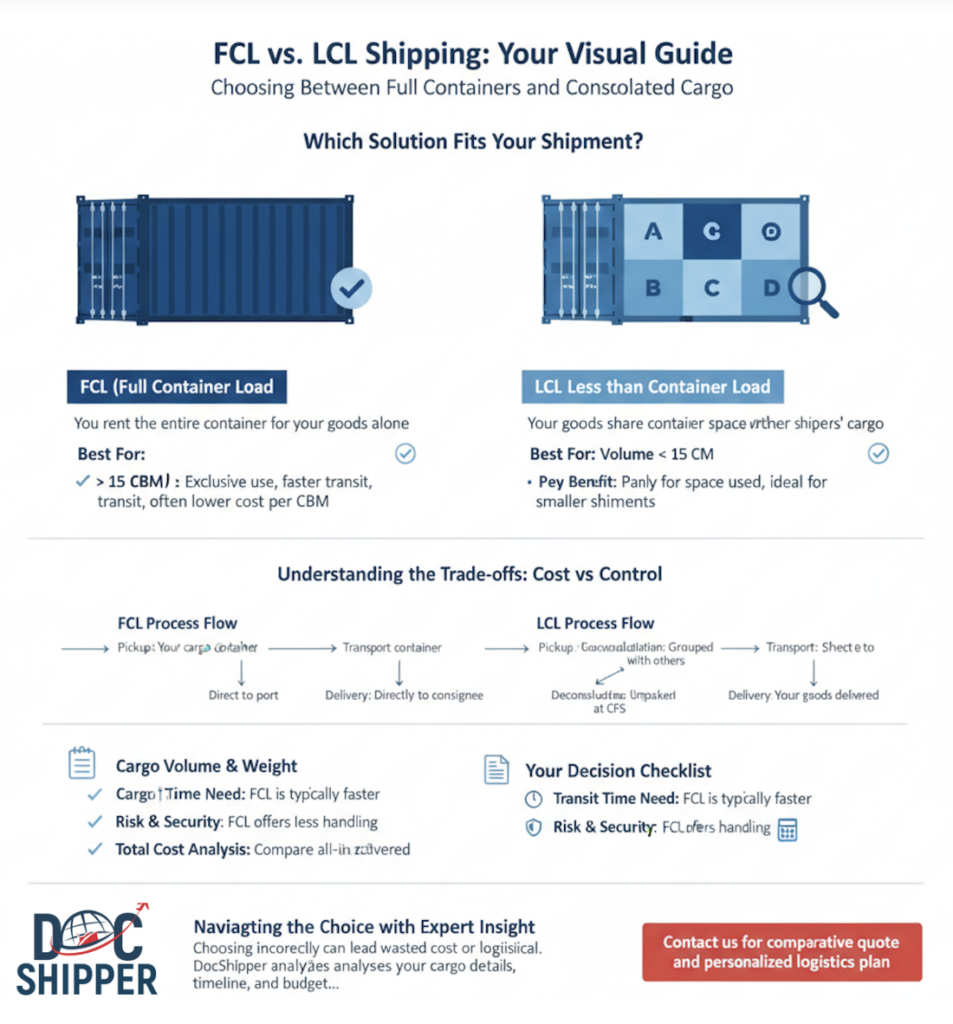
- FCL (Full Container Load), the fcl meaning in shipping is simple, you book a full container (20’/40’/40HC). You control container stuffing, sealing, and usually reduce touches.
- LCL (Less than Container Load), the lcl term means your cargo shares a container with other shippers. It’s also called groupage or cargo consolidation.
- Consolidation, a warehouse process where a NVOCC or co-loader combines multiple shipments into one container.
- Deconsolidation, also known as container stripping, where that combined container is opened and each consignee’s cargo is separated at destination.
- Port of loading and port of discharge, the start and end ports for the ocean leg of your sea freight.
- Bill of lading, the transport contract. In LCL you’ll often see a house bill of lading (issued by the forwarder) plus a master bill of lading (issued by the carrier).
- Freight forwarding and freight brokerage, the services that organize booking, documentation, and routing across carriers and partners.
To keep your costing realistic, match those words to the charges you’ll see, freight rate, origin fees, destination fees, and the final freight invoice.
And don’t forget the trade layer, Incoterms like EXW, FOB, CIF, DDU, DDP, plus customs clearance, import duties, and the HS code.
Step-by-step: how an FCL shipment differs from an LCL shipment in practice
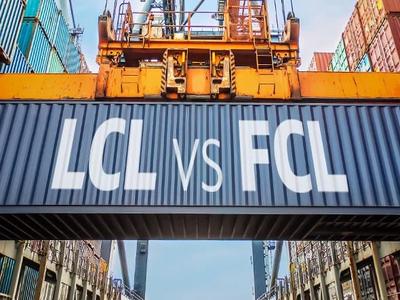
Tip: when you compare fcl lcl options, don’t just compare “port-to-port”. Ask what happens at the warehouse and who touches your cargo.
This is the moment most importers get stuck, because the processes look similar on paper but behave differently in real operations.
Here’s a simple workflow you can visualize before you confirm a shipment booking.
FCL workflow (Full Container Load):
- Shipment booking for a full container, carrier allocates equipment.
- Trucking to your supplier or origin warehouse (especially common under EXW or FOB).
- Container stuffing at origin, you load cartons or do proper palletization, then seal.
- Export documentation prepared, then customs clearance at origin.
- Gate-in at port of loading, ocean leg, then discharge at port of discharge.
- Import customs, duties, then delivery, often with fewer warehouse moves.
LCL workflow (Less than Container Load):
- Your forwarder confirms the lcl shipment as a booking with a consolidator.
- Cargo goes to a CFS, then gets measured, weighed, labeled, and staged for cargo consolidation.
- The consolidator builds a consolidated shipment, stuffs the container, issues house bill of lading.
- The carrier issues the master bill of lading for the full box, then ocean freight moves.
- At destination CFS, deconsolidation (container stripping) happens, then your cargo is released for import clearance and pickup.
Use this quick checklist before you approve an LCL plan, it prevents the classic “why is my cargo stuck at CFS” situation.
- Packaging strength suits extra handling, corners protected, cartons strapped.
- Labels match documents exactly, shipper, consignee, cartons count.
- Cargo insurance is confirmed in writing, especially for fragile or high-value goods.
- Incoterms are crystal clear, so you know who pays CFS fees and destination charges.
One last operational note, supply chain management improves when you plan lead time with the right process, not with wishful thinking.

FCL vs LCL: main differences in cost, transit time, and cargo risk
When you compare fcl lcl, you’re really comparing fee structures and how often your cargo gets handled between consolidation and deconsolidation.
You’ll notice fast that the cheapest freight rate doesn’t always create the lowest landed cost once customs, local charges, and delays hit.
We like to frame it the way UNCTAD does when discussing logistics performance, the “chain” is what matters, not a single line item.
Let’s break down cost first, then speed and risk.
Looking for a Reliable Shipping & Sourcing Partner?
Price comparison: when LCL is cheaper and when FCL becomes more economical

Is lcl vs fcl mainly a price decision for you right now?
It often starts that way, until you see how LCL costs stack up at both ends.
From experience, LCL looks attractive for small volumes, then suddenly tips as soon as CFS fees, minimum charges, and peak season surcharges pile in.
Here’s a clean side-by-side table you can use when reading a freight quote.
| Cost item | LCL (Less than Container Load) | FCL (Full Container Load) |
| Ocean freight pricing | Charged per W/M (weight or cubic meter), plus minimums | Flat per container, sometimes better at higher volume |
| CFS handling | Pay consolidation and deconsolidation fees | Usually none, you avoid CFS for the main flow |
| Documentation | House B/L fees are common, plus admin charges | Carrier B/L fees, often simpler |
| Risk of “surprise” destination charges | Higher if you didn’t model CFS, handling, and delivery order fees | Lower, but you can still get port storage and demurrage if late |
| Best use case | Smaller shipments, mixed SKUs, testing a supplier | Heavier volumes, stable demand, tighter cost control |
A real scenario we see a lot, you buy under CIF, think everything is “included”, then your LCL cargo lands and you discover destination CFS and handling are still yours to pay.
That’s why we always pressure-test the Incoterms against the full freight invoice, not just the ocean line.
DocShipper Alert
Let DocShipper audit your LCL and FCL quotes before you book, so you avoid “surprise” destination charges and choose the structure that protects your cash flow.
Speed, handling, and damage risk: how consolidation impacts your shipment
Bold truth: with fcl lcl, the more parties touch your cargo, the more variability you introduce in lead time and condition on arrival.
That doesn’t mean LCL is unsafe, it means you need to plan for the reality of cargo handling at CFS.
Here’s what usually changes when consolidation is involved.
- Transit time vs lead time, LCL can have similar vessel time, but longer total lead time due to consolidation cut-offs and deconsolidation queues.
- Handling frequency, LCL adds moves at origin CFS and destination CFS, each move adds risk.
- Damage and contamination risk, shared containers increase exposure if someone else ships liquids, dusty goods, or poorly packed pallets.
- Customs inspection impact, if the consolidated container gets flagged, your release can be delayed even when your documents are perfect.
We remember a fragile ceramics lcl shipment where the cartons were decent, but the palletization was weak, the CFS re-stacked it during consolidation, and the consignee opened the doors to a bad surprise.
Since then, we treat packaging and insurance as part of the routing decision, not an afterthought.
When you want fewer touches, clearer accountability, and often faster release at destination, FCL tends to win, especially if your customs clearance is time-sensitive under DDP commitments.
If you want help choosing between FCL and LCL based on your SKU mix, packing method, and route constraints, we can model the options with you at DocShipper using real lane data and realistic fee assumptions.
DocShipper Info
DocShipper maps your full flow, from factory to final delivery, so you see the real operational impact behind each option, not just the ocean rate.
How to decide between FCL and LCL based on volume, weight, and routes
Here’s a quick story to ground this, last month we helped a buyer shipping fcl lcl cargo from Ningbo to Rotterdam , 9 cbm of furniture that looked cheap in LCL until port congestion hit and delays stacked up. You’ll notice fast that volume, weight, and route stability matter more than the headline freight rate, and even UNCTAD trade data shows how route density shifts cost logic.
From experience, you usually feel the tipping point, once you’re close to filling half a container, FCL shipping often wins on predictability and control. Let us break it down in a practical way so you can choose without guessing.
Use this quick comparison table as your first filter before asking any forwarder for quotes.
| Criteria | LCL | FCL |
| Volume threshold | 1 to ~12 cbm | ~13 cbm and above |
| Weight sensitivity | Charged per cbm or ton | Fixed container price |
| Main routes | Major trade lanes only | All routes, more flexibility |
| Risk tolerance | Higher, shared container | Lower, sealed container |
One last nuance we see all the time, if your goods are heavy and dense, LCL charges escalate quietly, and that’s when FCL surprises you as the cheaper option.
Practical tips to optimize your FCL or LCL shipment and avoid extra charges
Direct tip from the field, fcl lcl headaches rarely come from ocean freight itself but from poor prep before pickup. We once saw a buyer save on LCL freight but lose it all on repacking fees after a failed warehouse inspection.
This is where process discipline pays off, and aligning with WCO customs guidelines helps you avoid delays that trigger storage and demurrage fees.
Before confirming any booking, run through this short checklist to protect your margins.
- Confirm cargo dimensions after final packing, not proforma stage.
- Ask for all-in pricing including origin and destination charges.
- Check cut-off times for LCL consolidations or FCL gate-in.
- Validate Incoterms so you know who pays what and where.
Here’s what we usually guide you through step by step to optimize either mode.
Workflow: validate packing list → simulate LCL vs FCL cost → assess route congestion → lock booking → pre-clear documents to avoid port delays.
Small detail that matters, misdeclared volume is one of the top reasons LCL shipments explode in cost after sailing.
DocShipper Info
DocShipper validates your data, simulates scenarios, and negotiates with partners so your FCL or LCL plan runs exactly as costed.
Conclusion
So what’s the real answer to fcl lcl, it’s not about which is cheaper on paper but which protects your shipment, cash flow, and sanity. We’ve seen seasoned importers rethink everything after one bad LCL delay during peak season.
If you want a clean recap, here are the key points you should walk away with.
- LCL works best for low volumes and flexible timelines.
- FCL becomes smarter as soon as volume, weight, or risk increases.
- Route and seasonality can flip the cost equation overnight.
- Preparation is what separates smooth shipments from costly surprises.
When you need a second opinion, we step in as your operational partner at DocShipper, stress-testing your choice before mistakes hit the port.
FAQ | FCL vs LCL: how to choose the right ocean freight option for your cargo
FCL stands for “Full Container Load.” You’re using FCL when:
- A 20’/40’/40HC container is booked under your name (one shipper, one consignee).
- Your cargo is loaded into that container, sealed, and moved as a single unit from origin to destination.
- You pay a flat rate per container, regardless of whether it’s half‑full or completely full.
- You (or your supplier) control how goods are packed inside, which helps reduce handling and damage.
The pricing logic behind FCL vs LCL is a bit more subtle than it looks:
- With LCL, you pay:
- Ocean freight per cbm/ton (whichever is higher).
- Minimum charges (even if your cargo is tiny).
- CFS handling at origin + destination, plus documentation fees.
- With FCL, you pay:
- One all‑in container rate for the sea leg.
- Port/terminal handling and trucking per container, but not CFS consolidation fees.
- Rule of thumb in practice:
- Very small, light shipments: LCL usually wins.
- Mid‑range volumes (10–15 cbm): you must compare both; FCL can suddenly become cheaper.
- Heavy, dense cargo: FCL often wins earlier because LCL charges climb quickly on weight.
The customs rules are the same, but the impact on you can differ a lot:
- In LCL:
- Your forwarder issues you a House Bill of Lading; the carrier holds a Master B/L for the whole box.
- If any shipment in the shared container triggers an inspection, everyone in that box can be delayed.
- Examination, storage, and handling fees are often split between all consignees.
- In FCL:
- You have a single Bill of Lading for your container.
- If your box is inspected, you bear the full exam and storage cost, but you don’t depend on other shippers’ paperwork.
- Actionable tip: always ask your forwarder who pays what if the container is held for customs, especially for LCL.
When you’re in the “grey zone,” use a simple 4‑step check:
1) Run a side‑by‑side quote:
- Ask for “all‑in” LCL (incl. CFS, docs, destination charges) and “all‑in” FCL (incl. THC, trucking).
2) Look at weight and density:
- If your cbm is low but weight is high, FCL becomes more interesting.
3) Check time sensitivity:
- Tight deadlines or fixed launch dates? FCL usually offers more predictable lead time.
4) Consider risk tolerance:
- Fragile, high‑value, or branded goods: FCL generally safer (fewer touches, no unknown co‑loaders).
A few recurring errors cost importers a lot of money:
- Choosing only by ocean rate, ignoring origin/destination charges.
- Assuming “CIF LCL” includes everything and being surprised by CFS fees at destination.
- Under‑declaring volume for LCL, then paying adjustments and penalties after re‑measurement.
- Using LCL for fragile goods without reinforcing packaging and pallets.
- Waiting too late to switch from LCL to FCL when orders grow, and overpaying for months.
A good moment to switch is when these three signals appear together:
- Financial: repeated quotes show your total LCL cost is equal to, or above, a full container on the same lane.
- Operational: you ship the same SKUs regularly, and your forecast fills a large part of a container each month.
- Risk/brand: delayed or damaged deliveries start to impact customer experience or retail commitments.
When at least two of these are true, run a 3–6 month projection with FCL and compare the savings and reliability gains against your current LCL model.
Read more
Looking for more? Check out these articles.
Need Help with
Logistics or Sourcing ?
First, we secure the right products from the right suppliers at the right price by managing the sourcing process from start to finish. Then, we simplify your shipping experience - from pickup to final delivery - ensuring any product, anywhere, is delivered at highly competitive prices.
Fill the Form
Prefer email? Send us your inquiry, and we’ll get back to you as soon as possible.
Contact us