Freight Shipping between China and Bahrain | Rates, Transit Times, Duties and Taxes

Here’s the hard truth about shipping from China to Bahrain, most delays and cost overruns don’t come from bad luck, they come from small decisions made too early. Choosing the wrong incoterm, misjudging transit time to Khalifa Bin Salman Port, or underestimating customs prep in Bahrain can quietly derail your plan.

If you’re looking at this route, you should know it’s not complicated once you understand the logic. In this guide, we walk you through what actually matters when shipping from China to Bahrain, how to compare rates without getting misled, what really impacts transit times, and where duties and taxes tend to surprise first‑timers. And if you want a second set of eyes, we’re here to sanity‑check your setup with real operational insight, not theory.

Which are the different modes of transportation between China and Bahrain?

Deciding on the ideal shipping method between China and Bahrain is a bit like planning a cross-country road trip: Widely separated and with multiple borders in their way, the journey could be tricky. Considerations like distance and travel time shape your options. Air freight is king when speed is the priority: China to Bahrain in just a few hours. On the other hand, sea freight sails the path of economic efficiency, ideal for large, heavy shipments that aren’t time-sensitive. It’s all about matching your business’s unique shipping needs with the right transportation choice.

Note DocShipper :

How can DocShipper help?

Struggling with the complexities of shipping goods from China to Bahrain? DocShipper is your lifeline! We ensure a hassle-free journey for your goods with our all-round services, from transportation organization to customs clearance. Why wait? Call our consultants for free, or contact us for a free estimate in less than 24 hours. Your shipping mission made simple with DocShipper!
sea-freight-dg

Sea freight from China to Bahrain

If you’re looking at sea freight from China to Bahrain, the first thing to know is this. It makes sense when volume matters more than speed, and when your cost logic can absorb a longer shipping lead time by sea. For full container loads, consolidated cargo, or heavy shipments, ocean shipping China Bahrain is usually the right call. If you’re shipping urgent, low-volume, or high-value goods, sea freight is often the wrong tool.

Here’s where many importers get caught off guard. They underestimate destination charges in Bahrain, assume transit times are fixed, or choose an Incoterm that leaves them exposed at origin. From experience, most issues on this lane don’t come from the vessel itself, but from origin handling, paperwork, or poor port choice. Our goal here is to help you decide early if maritime transport China to Bahrain fits your case, and what to watch before you commit.

DocShipper Tip:

Sea freight might be the best solution for you if:

Which Incoterms should you use?

On this route, FOB shipping terms are usually the safest balance between control and simplicity. You control the ocean leg, we handle the booking process, and surprises are easier to manage. EXW origin handling looks cheaper on paper, but in practice it often creates confusion, hidden origin charges, and delays before the cargo even reaches the loading port.

CIF shipping terms can work if your supplier is experienced and transparent, but many first-time importers don’t realize they lose control once the cargo is on the water. You still pay destination charges, port handling charges, and time-related fees in Bahrain. The key question isn’t the definition of the Incoterm, it’s who controls the risk when something goes wrong. That’s what we help you decide upfront.

Main ports to know in China and Bahrain

You don’t need to memorize every terminal. You need to know which ports actually make sense for container shipping China Bahrain and how they affect inland transport.

  • Shanghai and Ningbo, ideal for eastern China suppliers, reliable sailings, but longer inland trucking if your factory is inland.
  • Shenzhen and Guangzhou, strong for southern China, faster factory-to-port moves, often better for LCL consolidation.
  • Khalifa Bin Salman Port, the main discharge port, efficient but destination charges add up fast if documents aren’t clean.
  • Mina Salman, used for specific cargo types, but inland delivery planning matters more here.

Port choice doesn’t stop at vessel arrival. It directly impacts door-to-port ocean freight costs, trucking availability, and how quickly you can clear customs in Bahrain.

Should I choose FCL or LCL when shipping between China and Bahrain?

Choosing between Full Container Load (FCL) or Less than Container Load (LCL), also known as consolidation, for your sea freight from China to Bahrain can feel like navigating a maze. But, it’s a pivotal decision tied to costs, delivery timelines, and smooth sailing of your shipping process. Picture this – your goods packaged safely, reaching their destination on time, without denting your budget. The key? Understanding the nitty-gritty of FCL and LCL. So, let’s dive right in and debunk these sea shipping options, helping you make the best decision for your specific business needs.

LCL: Less than Container Load

Definition: LCL, short for Less than Container Load, is an option in sea freight where smaller shipments from multiple shippers are consolidated into a single container. This shared-space approach makes LCL a cost-effective and flexible solution for businesses shipping smaller volumes of merchandise.

When to Use: You should consider LCL shipping when your cargo volume falls between 1 CBM (Cubic Meter) and 15 CBM. LCL enables you to only pay for the volume of the container your shipment uses—perfect for those with lower volume needs.

Example: Suppose you’re a toy manufacturer in China shipping 10 CBM of goods to a retailer in Bahrain. Instead of shipping an entire container that’s mostly empty, you can share the container space with other shippers, optimizing logistics costs while still ensuring timely delivery.

Cost Implications: LCL shipping can lower your expenditure, as you’re only paying for the space your cargo occupies in the shared container. However, it’s essential to remember that LCL shipments entail more handling, leading to an increase in the cost-per-unit than a Full Container Load (FCL). So, while you save on unused space, the per-unit freight cost might be higher. Consequentially, LCL proves itself to be a suitable choice for businesses looking to manage their finances with fluid cargo volumes.

FCL: Full Container Load

Definition: FCL (Full Container Load) shipping is the transport of goods where the entire container, typically a 20’ft or 40’ft, is occupied by one consigner.

When to Use: FCL shipping is ideal for higher volume shipments. If your cargo is more than 13/14/15 CBM, FCL shipping becomes a cost-effective solution. Moreover, it provides added safety as the FCL container is sealed at the origin and stays sealed until the destination, mitigating risk of mishandling.

Example: Let’s dive into a real-life scenario. A home appliances manufacturer in Guangzhou, China, wants to send a 20’ft container filled with rice cookers to a retailer in Manama, Bahrain. As the shipment volume is sizable and the safety of the goods is paramount, the manufacturer opts for FCL shipping, ensuring the entire container load is devoted to their products only.

Cost Implications: FCL shipping becomes cheaper per unit with higher volume, due to a fixed container cost. The FCL shipping quote includes these costs, and understanding this can influence optimal utilization of container space. However, keep in mind the cost of unused space, should your cargo not fully occupy a container.

Unlock hassle-free shipping

Choosing between consolidation or a full container for shipping from China to Bahrain? Make it stress-free with DocShipper. Our experienced ocean freight team extensively evaluates your unique needs, dimensions, and weight of your cargo, along with pricing. We’re committed to turning complexities into straightforward solutions. Get expert guidance on the best cost-efficient and effective shipping option for your business. Don’t guess – Get a free estimation now. Trust us, we simplify shipping.

Transit times: How long does it take to ship from China to Bahrain?

For port-to-port sea freight, you’re usually looking at a sea transit time of around 20 to 30 days. That’s vessel time plus the reality of transshipment in the Middle East. LCL shipments often sit on the longer end of the range due to consolidation and deconsolidation.

Congestion at origin, indirect services, and seasonal volume spikes can all stretch the ocean freight transit duration. From experience, the biggest delays happen before departure, not at sea. Planning buffers and clean documentation matter more than chasing the shortest advertised sailing.

Origin portDestination portEstimated transit time
ShanghaiKhalifa Bin Salman23–26 days
NingboKhalifa Bin Salman25–28 days
ShenzhenKhalifa Bin Salman20–23 days
GuangzhouKhalifa Bin Salman24–27 days

Transit times are planning estimates, not guarantees. Always build margin into your schedule.

Shipping rates: how much does a sea freight shipment cost from China to Bahrain?

Shipment typeIndicative pricing
LCL (1–5 CBM)USD 40–100 per CBM
20ft container (FCL)Variable, market-driven
40ft container (FCL)Variable, market-driven

The numbers above help you plan, not lock a budget. On this lane, costs are driven by consolidation fees, origin charges and destination charges, and carrier space availability. The ocean freight rate is only one line of the bill. That’s why two quotes with the same rate can land very differently once the cargo arrives in Bahrain.

Step-by-step: how a sea freight shipment usually works on this route

This is what the process looks like when we handle your shipment. It’s straightforward, but it requires patience, especially at origin and during customs clearance. Most surprises happen when documents are late or cargo misses a cutoff.

  1. We confirm your cargo details, Incoterm, and ports, then book the container or LCL space.
  2. Your supplier prepares the goods, we manage cargo stuffing and export clearance.
  3. The vessel departs China, often via transshipment.
  4. Before arrival, we prepare documentation, including the bill of lading and shipping instructions.
  5. Cargo arrives in Bahrain, clears customs, and moves to delivery or pickup.

Delays usually come from missing documents or late payments of local charges, not the vessel itself.

Special sea freight solutions

If your cargo doesn’t fit standard boxes, we also handle breakbulk sea freight, oversized cargo by sea, project cargo shipping, Ro-Ro, and reefers. The logic stays the same, but planning and approvals start earlier.

Air freight from China to Bahrain

If you’re looking at air freight from China to Bahrain, you should know one thing upfront. Air works when speed, value, or risk exposure matters more than pure cost. We usually see it used for time‑critical air shipment, high‑value goods, perishables, or when production delays leave you no buffer. It’s fast, but it’s also demanding. Cut‑off times are strict, security screening cargo can block a flight, and the chargeable weight concept catches many importers off guard.

The first thing we always tell people is this. Air does not automatically mean 3 days door‑to‑door, and it’s not always outrageously expensive either. Most cost blowups come from predictable mistakes. Wrong volumetric weight calculation, packaging that fails airline rules, incomplete air freight documentation, or suppliers missing the ready date by a few hours. We’ve handled enough air cargo China Bahrain shipments to know where it usually breaks, and how to avoid it.

DocShipper Tip:

Air freight might be the best solution for you if:

Air Cargo vs Express Air Freight: How should I ship?

Cracking the code between air cargo and express air freight for your China‑Bahrain trade route? Let’s clear the air. Think of air cargo as booking a seat for your goods on a commercial flight, while express air freight is like having a dedicated private jet for your shipment. Get ready to weave through these two options and determine which elevates your business to greater heights. Stay tuned!

Should you choose air cargo from China to Bahrain?

Standard air freight becomes relevant on this route once you cross roughly 1 CBM or 100 to 150 kg. That’s where airport‑to‑airport air freight starts making sense compared to express. It’s typically used for B2B flows, regular replenishment, or shipments where you want control over airline choice, flight availability for cargo, and cost structure.

For it to work smoothly, you need a few things ready. Exact dimensions and weight, Incoterm clarity, chosen origin and destination airports, confirmed ready date, and commodity details for security screening. Where people get stuck is assuming airport‑to‑airport means door‑to‑door. It doesn’t. Handling, consolidation in air freight, export clearance, and destination charges are separate lines. Miss a cut‑off or underestimate handling charges, and the savings disappear fast.

Should you choose express air freight from China to Bahrain?

The express air freight option is logical when shipments are small, urgent, or when you don’t have an internal logistics team. Couriers handle pickup, customs, and delivery, which feels simple. That simplicity comes with trade‑offs. You give up billing transparency, control over airport handling charges, and sometimes clarity on Incoterms.

From experience, the most common errors are underestimating volumetric weight, assuming everything is included, or shipping with packaging that doesn’t meet airline rules. Express is good if speed and simplicity matter more than cost control. It becomes risky if your shipment is dense, irregular, or close to airline size limits.

Main airports to know in China and Bahrain

  • Shanghai Pudong (PVG). Major international hub with strong Middle East connectivity. Good for stable flight availability, but inland trucking can add cost if your supplier is far.
  • Guangzhou Baiyun (CAN). Common choice for South China manufacturing. Often competitive on rates, but congestion during peak seasons matters.
  • Shenzhen Bao’an (SZX). Works well for electronics and high‑tech goods. Capacity can fluctuate, so booking timing is key.

The airport you choose impacts trucking distance, total air shipping lead time, and exposure to backlog. A cheaper airport rate can quickly vanish if pre‑carriage isn’t planned correctly.

Main airports to know in Bahrain

  • Bahrain International Airport (BAH). The main entry point for all air cargo. Efficient for Middle East distribution, with facilities for perishables and high‑value goods by air.

Choosing BAH keeps the routing simple. What changes your outcome is not the airport, but how fast customs and last‑mile delivery are organized.

Transit times: how long does air freight take from China to Bahrain?

Service typeEstimated transit time
Airport‑to‑airport air cargo2 to 6 days
Express air freight3 to 7 days

These are realistic planning ranges, not promises. What really drives delays on this route are pre‑flight handling and cut‑off timing, security screening cargo for electronics or DG, and capacity constraints during peak periods. If you want a reliable estimate, you must check the exact airports, service level, ready date, and cargo type.

Shipping rates: how much does air freight cost from China to Bahrain?

Service typeIndicative rate range
Standard air freightUSD 3.8 to 7.8 per kg
Express air freightUSD 5 to 8 per kg

Rates move based on chargeable weight, dimensions, fuel surcharge air freight, seasonality, and airport selection. Dense cargo pays less per kg than bulky cargo. Urgency and limited capacity push prices up quickly. Always look at the total landed cost, not just the per‑kg headline.

What is the difference between volumetric and gross weight?

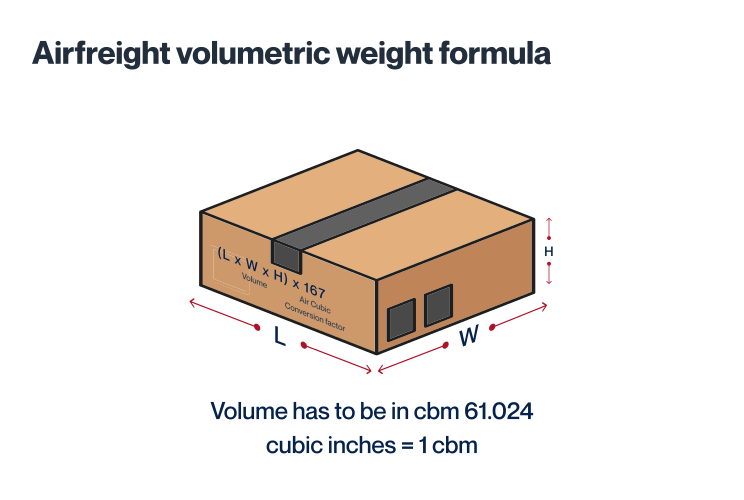
In international air shipping, airlines charge based on space or weight, whichever is higher. Gross weight is what your shipment actually weighs. Volumetric weight reflects how much space it occupies in the aircraft. This is where most surprises come from.

How to calculate
Length x Width x Height (cm) ÷ 6000 for air cargo. Example. 100 x 80 x 60 cm = 80 kg volumetric.

ServiceStandard divisor
Air cargo1 m³ = 167 kg
Express1 m³ = 200 kg

Common mistakes are guessing dimensions, ignoring pallets, or assuming weight matters more than volume. On this route, that misunderstanding alone can double your invoice.

Door to door between China and Bahrain

International Door to Door shipping is your one-stop solution, taking care of everything from pick-up in China to delivery in Bahrain. It’s time-saving, hassle-free, and provides a single point of contact for the entire journey. Sound good to you? Well, it gets better! Let’s dive in and unpack all you need to know about Door to Door shipping between China and Bahrain.

Overview – Door to Door

Choosing Door-to-Door shipping from China to Bahrain presents a stress-free logistics solution, especially for newcomers grappling with the complexities of international shipping. Packed with advantages, it covers all your transport needs from origin to destination – a favourite among DocShipper’s clients.

Yet, bear in mind minor setbacks, like potentially higher costs or unexpected delays due to customs. Nevertheless, the convenience offered gives you more time to focus on Core Business tasks, making it an attractive choice despite any challenges. Always remember, an informed decision is the best decision. Dive into the details below!

Why should I use a Door to Door service between China and Bahrain?

Guess what? Cutting the red tape in international freight just got easier! Door to Door services have emerged as game-changers in freight forwarding, especially for trades between China and Bahrain.

1. Stress-free logistics: Let’s face it, wrangling logistics can be a headache. A Door to Door service picks up your goods straight from the source and delivers them right to the destination. No need for you to sweat about coordination.

2. Timely delivery: Pressed for time? With direct responsibility for your shipment from beginning to end, Door to Door services increase the chances of your cargo reaching its destination faster and right on schedule.

3. Specialized care: Got cargo that needs some TLC? Door to Door services offer specialized handling. Whether it’s fragile electronics or bulky machinery, rest assured your cargo gets the attention it deserves.

4. Convenience: You don’t need a roadmap to navigate the loads of paperwork and multiple freight stages. The service streamlines the process, handling everything from custom duties to paperwork, so you can sit back and relax.

5. Final mile delivery: The nightmare of transferring goods from a port to the final destination? History! It manages trucking until it reaches your doorstep, meaning you don’t have to lift a finger.

Think about it, Door to Door service could be the wonder pill for your freight forwarding headaches, giving you more time to focus on scaling your business.

DocShipper – Door to Door specialist between China and Bahrain

Shipping from China to Bahrain completely stress-free? Absolutely! With DocShipper, you’ll find it as easy as booking a vacation. Our expert team, fully versed in all modalities and nuances of International freight forwarding, will manage every step: packaging, transport, customs, and more. Plus, a dedicated Account Executive ensures you never lose track of your shipment. Don’t worry, you don’t have to lift a finger. Get in touch and receive a free estimate within 24 hours, or give our expert consultants a call for advice at no cost. Let DocShipper make your shipping experience smooth sailing!

DocShipper Tip:

Door to Door might be the best solution for you if:

Customs clearance in Bahrain for goods imported from China

Customs clearance in Bahrain is where your total landed cost is locked in, your release timeline is decided, and legal responsibility is assigned to the Importer of Record. This is also the point where duties, VAT, and any additional fees are formally assessed. On this China to Bahrain route, we usually coordinate the clearance flow with licensed partners so you are not left managing filings, payments, and customs communication on your own.


Most problems don’t come from the Bahraini border itself. They come from document gaps and assumptions made upstream. We regularly see delays caused by the wrong Incoterm logic, weak HS code classification, undervaluation that ignores freight and insurance, or incomplete documents at filing time. Below, we’ll walk you through how clearance usually unfolds on this route, then show you a reliable way to estimate duties and taxes before you ship.

How to calculate duties & taxes when importing from China to Bahrain?

If you want a realistic estimate for duties and taxes calculation, you need a few solid inputs. Customs will look at the country of origin declaration, the HS code classification, the customs value assessment, and the applicable import tariff application in Bahrain. Miss one of these, and the number you budgeted won’t match what customs assesses.

This is also why cheap quotes can be misleading. They often ignore parts of the tax base, like freight and insurance value, or assume a duty rate without checking the tariff notes. Use the method below to build an estimate that holds up when the customs entry filing actually happens.

Step-by-step: how customs clearance usually works on this route

If you’re importing from China into Bahrain, here’s what usually happens in real life. Not theory, but the operational sequence we see every week.

  1. Pre-clearance preparation starts before departure. We collect the customs documentation set, commercial invoice, packing list, and certificate of origin, and check them for consistency.
  2. The carrier sends a pre-alert. This is where document mismatches first show up, and where many holds start.
  3. Customs entry filing is submitted in Bahrain. HS code classification and invoice value for customs are reviewed at this stage.
  4. Customs questions or inspection requests may follow, especially if the product description is vague or the value looks incomplete.
  5. Duties and import taxes and fees are assessed and must be paid or advanced before release.
  6. Once cleared, release of goods is granted and delivery or warehouse appointment is booked. Miss this timing, and storage costs can kick in fast.

The exact flow can vary by port of entry, Incoterm, and whether the shipment is express, consolidated, or direct. But the pressure points are always the same: documents, classification, value, and payment timing.

Step 1 - Identify the Country of Origin

Country of origin declaration is not a label, it’s a pricing and compliance lever. On China to Bahrain shipments, origin affects the duty outcome, whether any preferential rate can even be considered, and what proof customs may ask for.

A common mistake is confusing origin with shipping country or seller location. Customs will cross-check the origin story against the invoice, manufacturer details, and product labeling. If those don’t line up, expect questions.

Preferential tariffs or trade defense measures like anti-dumping depend on both HS code and origin. We’ll cover how to verify that combination in Step 4.

Step 2 - Find the HS Code of your product

HS code classification drives everything. Duty rate, inspections, additional measures, and how long your shipment sits in customs. A wrong code doesn’t just change the math, it can freeze the shipment.

Start with your supplier’s HS code, but don’t stop there. Validate it using an official tariff classification lookup and build a small support file. Product function, materials, photos, and datasheets help defend the code if customs questions it.

You can cross-check using the Bahrain tariff lookup, then compare the logic with your product specs.

When HS codes are wrong, we see reclassification, back-payments, penalties, and storage fees while it’s sorted out.

Here’s an infographic showing you how to read an HS code.

Step 3 - Calculate the Customs Value

Customs value assessment is usually based on the transaction value, adjusted according to Bahrain’s valuation method. In practice, this often means the invoice value for customs plus elements customs considers dutiable.

Freight and insurance value are the most common adjustments, and whether they are included depends on your Incoterm. If you bought EXW or FOB, expect additions. If you bought CIF, they’re often already baked in.

Example with round numbers: goods at 20,000, freight and insurance at 3,000. Customs value becomes 23,000. This is the base customs will use for duty and tax calculations.

Step 4 - Figure out the applicable Import Tariff in Bahrain

An import tariff is the duty rate applied to your HS code. In Bahrain, duty rates are organized by HS code under the GCC framework.

How we check it in practice:

  1. Open the official Bahrain tariff tool.
  2. Enter your HS code and select China as the origin.
  3. Read the duty rate and any notes tied to that code.

What to watch for is whether the rate shown is standard, whether proof of origin is required, and whether any additional measures appear for that HS code.

Mini example: customs value 23,000, duty rate X%. Import duty equals 23,000 × X%.

Rates change, and the same product can be treated differently if the HS code or origin proof is weak. We usually recommend saving a screenshot of the tariff result for budgeting and sharing it with your broker. We can also double-check the HS code and tariff logic before you ship if you share your product details, value, and Incoterm.

Step 5 - Consider other Import Duties and Taxes in Bahrain

Import taxes and fees go beyond basic duty. VAT is usually the biggest line, and it’s rarely calculated on the invoice alone. The tax base often includes customs value plus duty and other assessable charges.

Example logic with symbols: VAT = (customs value + duty) × X%.

Other measures can apply depending on the product. For example, excise duty on alcohol or tobacco adds an extra assessment line and often triggers closer inspection. If it’s not anticipated, clearance slows and cash-out increases.

Before shipping, verify for your HS code: applicable VAT base, any excise or trade defense measures, and what documents support your value and classification.

Step 6 – Calculate the Customs Duties

Once all elements are known, the math is straightforward. Duty equals customs value multiplied by the duty rate. VAT equals the applicable tax base multiplied by the VAT rate.

What happens next is operational. Depending on your setup, duties and taxes are paid directly by you or advanced by the broker. Release only happens after payment confirmation. If clearance stalls, storage, handling, and rebooking costs can appear quickly.

This is why we focus on getting the numbers and documents right before the shipment lands, not after it’s already waiting.

Prohibited and restricted items are a separate compliance layer. If your product falls into one of these categories, clearance timing and documentation change immediately. Always confirm before shipping.

Contact Details for Customs Authorities

customs china logo

China Customs

Official name: General Administration of Customs of the People’s Republic of China

Official website: www.english.customs.gov.cn
Bahrain Customs logo

Bahrain Customs

Official Name: Customs Affairs, Kingdom of Bahrain

Official Website: www.bahraincustoms.gov.bh

Bill of Lading or Air Waybill

This is the transport document issued by the carrier that proves the shipment exists and who controls it.

Customs and your broker use it to match the cargo to the importer and release it at arrival.

Example: The consignee name on the Bill of Lading must exactly match the importer registered in Bahrain, no shortcuts or trade names.

Common mistake: Original Bill of Lading delayed or consignee details not matching the invoice.

Packing List

This document breaks down what’s inside the shipment, carton by carton.

Bahrain Customs relies on it to assess inspections, weights, and physical checks.

Example: 120 cartons, net weight 3,240 kg, gross weight 3,480 kg, clearly split by product type.

Common mistake: Quantities or weights that don’t match the physical cargo.

Commercial Invoice

This is the document that tells customs what you sold, to whom, and for how much.

It’s used to calculate duties and confirm the transaction is legitimate.

Example: CIF Bahrain, unit price, total value, HS code at 6 digits, currency clearly stated.

Common mistake: Invoice value or Incoterm not matching the shipping arrangement.

Certificate of Origin

This document confirms where the goods were manufactured.

Customs uses it to apply the correct duty rate and verify trade eligibility.

Example: Issued by an authorized Chinese chamber, stating China as the country of origin.

Common mistake: Origin stated differently than manufacturing reality.

Import Declaration and Customs Entry

This is the formal declaration submitted to Bahrain Customs, usually by your licensed broker.

It connects all documents into one official clearance file.

Example: HS code, customs value, importer ID, and shipment reference all aligned.

Common mistake: Wrong HS code selected, triggering reassessment or inspection.

Product Compliance or Special Certificates

Some products require additional proof before they can enter Bahrain.

Customs needs this to confirm safety, health, or regulatory compliance.

Example: Conformity documents for electronics or licensing proof for medical products.

Common mistake: Shipping first and checking compliance after arrival.

Certificate of Origin

Navigating customs clearance between China and Bahrain? Then you’ll appreciate the importance of the Certificate of Origin. This document verifies where your goods were made, with ‘made’ often being synonymous with ‘grown’ or ‘produced’. Why is it beneficial? When filled accurately, you may receive preferential customs duty rates, boosting your bottom-line.

Here’s an illustration: Imagine being a toy manufacturer based in China exporting dolls to Bahrain. When filled appropriately, the Certificate of Origin could facilitate smoother customs clearance and result in lower tariffs. Just remember to accurately mention the country of manufacture, China in this case, to reap the benefits. It’s a tiny piece of paperwork that could make a considerable difference to your shipment process!

Get Started with DocShipper

Navigating customs can be tricky and time-consuming. Let DocShipper handle every detail of your customs clearance between China and Bahrain, putting our extensive experience and knowledge at your service. No more stress or complexities – just smooth, efficient shipping. Ready to explore a hassle-free shipping experience? Contact us for a free quote today, and we’ll respond in less than 24 hours!

Prohibited and restricted items when importing into Bahrain

Here’s the distinction that matters operationally. Restricted items can enter Bahrain, but only if you meet specific conditions like permits, approvals, or inspections. Prohibited items should not be shipped at all, expect seizure, return, or penalties if they arrive.

Restricted products

  • Pharmaceuticals, require prior licensing and GCC approvals
  • Medical devices, subject to health authority registration
  • Telecommunications equipment, often needs radio or frequency approval
  • Chemicals and industrial substances, controlled for safety and use
  • Food products, require labeling and health compliance
  • Cosmetics and personal care items, formulation and registration checks

Prohibited products

  • Narcotics, drugs, and substances with drug effects
  • Used or reconditioned tires
  • Items containing asbestos
  • Live swine and pork-related products
  • Ivory, rhinoceros horn, and similar protected materials
  • Printed or media content violating public morals or religious standards

If you’re unsure whether your product falls into one of these categories, stop before booking freight. Ask your broker to confirm in writing or check directly with Bahrain Customs. From experience, this single step saves weeks of delay and a lot of frustration.

Trade agreements and preferential duties for imports from China to Bahrain

This is an area where many importers get misled, so let’s be very clear. As of 2025, there is no active Free Trade Agreement in force between China and Bahrain. China and the Gulf Cooperation Council have been negotiating an FTA for years, but it has not been finalized or implemented yet.

In practice, most goods from China entering Bahrain fall under the GCC Common External Tariff, typically around 5 percent, unless your product is subject to higher specific duties or exemptions.

If your supplier tells you an FTA applies automatically, pause and verify. You should always check your HS code in Bahrain’s official tariff system or confirm in writing with your customs broker before pricing your shipment.

Your Next Step with DocShipper

Confused by complexities in the China-Bahrain freight process? Concerned about customs, duties, or choosing the best shipping methods? Let DocShipper step in and transform your shipping experience. With our end-to-end solutions, we’ve got your cargo covered. Ready for stress-free shipping? Contact us today, and let’s ship together.

Additional logistics services

Explore further with DocShipper! Not just shipping and customs, we're your A to Z supply chain solution. Want warehousing, quality control, or insurance? Look no further. Let's dive in!

1 Warehousing and storage
1

Warehousing and storage

Finding the right warehousing in China for storage or transit to Bahrain can be tedious. Reliable solutions must ensure goods, especially temperature-sensitive items, aren't compromised. This is where our specialized services step in. Our offerings meet varying storage conditions, ensuring your products are well-kept until shipping. Keen to explore? More info on our dedicated page: Warehousing.
img
2 Packaging and repackaging
2

Packaging and repackaging

Shipping from China to Bahrain? Don't let improper packaging damage your goods. Our expert teams know how to secure everything from lightweight fabrics to manufacturing equipment, ensuring your cargo withstands the journey. Trust us for reliable packaging and repackaging, preserving product integrity every step of the way. An example? We once safely shipped fragile porcelain products, all thanks to proper cushioning and handling! More info on our dedicated page: Freight packaging.
img
3 Cargo insurance
3

Cargo insurance

While fire insurance safeguards your property, cargo insurance is a beacon for your shipment, acting like a safety net during transit. Let's say your goods are damaged by a storm at sea; cargo insurance sweeps in to recover those losses. Or perhaps your consignments face theft or mishandling - again, insurance delivers peace of mind. Hence, it plays a pivotal role in preventing unexpected setbacks. Unearth more insights at our dedicated page: Cargo Insurance.
img
4 Supplier Management (Sourcing)
4

Supplier Management (Sourcing)

Looking for a daily ally for your trading operations between China and Bahrain? DocShipper is your ace in the hole. We make sourcing and manufacturing in Asia and East Europe as smooth as a silk road caravan. From locating suppliers to managing procurement, let us conquer the language barriers and red tape for you. Real-world example? A coffee roaster benefitted from our expertise when we found a reliable bean supplier in Yunnan, China. More info on our dedicated page: Sourcing services.
img
5 Personal effects shipping
5

Personal effects shipping

Moving your delicate or bulky items from China to Bahrain? It's a breeze with our Personal Effects Shipping service! We handle your prized possessions with the utmost care and flexibility, ensuring they reach their destination safely. Imagine smoothly shipping your grandmother's porcelain collection or that oversized sculpture worried you. More info on our dedicated page: Shipping Personal Belongings.
img
6 Quality Control
6

Quality Control

Shipping between China and Bahrain requires impeccable quality control. These key inspections during manufacture or customization ensure your product meets all set standards before they set sail. Imagine clearing Bahrain customs smoothly and seeing no returns due to defects - that's the peace of mind this service offers you. More info on our dedicated page: Quality Inspection.

img
7 Product compliance services
7

Product compliance services

Shipping your goods internationally? Ensuring product compliance with destination regulations is paramount. Our services include conducting laboratory tests to certify your product aligns with these rules. An illustrative example - imagine shipping toys that need to meet specific safety norms. We help you hurdle these challenges seamlessly. More info on our dedicated page: Product Compliance Services.
img

FAQ | Freight Shipping between China and Bahrain | Rates - Transit times - Duties and Taxes

On this route, delays almost never come from the Bill of Lading or Air Waybill, we handle those. The real risk sits in the commercial invoice and packing list. Bahrain Customs checks values, HS codes, and product descriptions very closely. If your invoice looks copied from a template, mismatches the packing list, or uses vague product names, clearance can stall for days. Certain goods also require prior approvals, such as electronics with wireless functions, cosmetics, chemicals, or food products. If those permits are missing, your cargo will wait at the port while the clock and storage fees keep running. We review documents before departure to catch these issues early, not once the container is already in Bahrain.