


In short ⚡
China Compulsory Certification (CCC): Products Covered and Process involves checking whether a product appears in China’s catalogue of 109 items across 17 categories, selecting the applicable conformity route, completing testing and factory evaluation, and obtaining permission to use the CCC mark before legal sale or import.
Key products covered and process stages include:
| Element | Key information |
|---|---|
| Products covered | Electrical wiring, electrical devices, household appliances, electronics, lighting, motor vehicles and components, toys and children’s products, fire products, and certain building materials. |
| Scope check | Match the product’s exact model, intended use, technical characteristics and applicable GB standard to the current CCC catalogue. |
| Full certification | Usually includes application review, type testing, factory inspection, technical evaluation, certificate issuance and CCC mark permission. |
| Self-declaration | Eligible lower-risk products may use SDoC Method A with a CNAS/ILAC-recognised laboratory or Method B with a designated CCC laboratory. |
| Timeline | Full certification generally takes several months, depending on the product, number of models, factory readiness, testing results and corrective actions. |
| Ongoing compliance | Follow-up certification typically includes an annual factory audit and reassessment of product or factory changes. |
| Consequences of non-compliance | Covered goods may be held or refused at Chinese customs and cannot legally be sold or distributed in China without the required conformity. |
In this guide, you will find the CCC mark’s role at Chinese customs, the 17 product categories and 109 items, the differences between full certification and SDoC, the step-by-step process and timeline, and the consequences of skipping compliance.
If you are placing a product on the Chinese market, the first question is not how much CCC certification costs. It is whether your product is inside the compulsory catalogue at all.
The decision is binary: a product listed in the CCC catalogue needs the applicable conformity route before legal sale and import into China; a product outside the catalogue does not need the CCC mark. This guide explains how to check the scope, choose between full certification and self-declaration, and plan the process before your shipment reaches Chinese customs.
What the CCC mark is and why it blocks non-compliant goods at Chinese customs
China Compulsory Certification (CCC) is a mandatory safety conformity system for products covered by China’s official catalogue. A covered product cannot legally be sold or distributed in China, whether it is manufactured domestically or imported, without completing the applicable route and obtaining the right to use the CCC mark.
CCC in one paragraph
The CCC mark is a market-access requirement, not a premium quality badge. It confirms that a product has met the applicable minimum safety, health or environmental requirements under China’s certification framework.
The system was implemented on 1 May 2002 and became fully effective on 1 August 2003. As of 23 September 2025, the catalogue covers 109 product items across 17 categories, including examples such as wiring, electrical devices, household appliances, electronics, lighting, motor vehicles, toys and children’s products, fire products and certain building materials.
China generally applies the same compulsory requirement to an imported product and to an equivalent product made in China for domestic sale. The fact that your factory is located in China does not remove the obligation, and exporting from outside China does not create an exemption.
Who runs it: CNCA and CQC
CNCA means the Certification and Accreditation Administration of China. It administers the broader certification and accreditation framework, including the compulsory certification system.
CQC, the China Quality Certification Center, is a major certification organisation that processes applications and supports certification activities for covered products. Depending on the product sector and route, the application may also involve another designated certification body or laboratory.
The applicable technical requirements are usually linked to Chinese GB standards. GB means “Guobiao”, the national standards system. A GB standard may define the safety tests, technical parameters, marking rules and documentation expected for a particular product.
| Question | Practical answer |
| What is CCC? | A compulsory Chinese conformity system for products listed in the official catalogue. |
| Who administers the system? | CNCA administers the framework; CQC and other designated bodies process relevant applications and evaluations. |
| Who is covered? | Both imported products and products manufactured in China for domestic sale. |
| When did CCC begin? | Implemented in 2002 and fully effective in 2003. |
| What does the mark mean? | The product has completed the applicable compulsory conformity route. It is a minimum safety requirement, not a premium quality award. |
For the regulatory background and current scope information, see the EU SME Centre’s CCC overview and the Intertek explanation of the CCC mark.
Which products need CCC certification: the 17 categories and 109 items
CCC currently covers 109 product items grouped into 17 categories. Electrical products, household appliances, electronic equipment, lighting, vehicles, toys and fire-safety products are among the areas that may fall within scope, but the product name alone is not enough to make a final determination.
Your product needs CCC when its technical characteristics match an item in the current catalogue and the applicable certification rules require the CCC route. If the product is not listed, it does not need CCC, although other Chinese requirements may still apply, such as product standards, labelling, environmental rules or customs documentation.
The covered categories
The following table presents representative catalogue areas rather than a replacement for the official 109-item list. A product can fall within scope because of its function, voltage, intended user, installation method, risk profile or technical configuration.
| Catalogue area | Representative products or use | Scope indication |
| Electrical wiring and cables | Wiring products and related electrical conductors | Check the exact product type, rating and applicable GB standard. |
| Electrical devices | Electrical equipment and devices connected to an installation | Often requires a detailed technical match. |
| Household appliances | Appliances intended for domestic use | Consumer-use products are a priority for scope checking. |
| Electronics and information technology | Electronic or IT equipment | Check power supply, function and product classification. |
| Lighting products | Lighting equipment and related products | Confirm the exact catalogue entry and test requirements. |
| Motor vehicles and components | Vehicles, tyres or related regulated products | Vehicle-related scope is product-specific and should be checked before shipment. |
| Toys and children’s products | Products intended for children | Intended age and product function can affect the classification. |
| Fire products | Fire-safety and fire-protection products | Safety performance and intended application are central to the check. |
| Building materials and other listed areas | Selected regulated construction or safety-related products | Only the listed items within the category are covered. |
These representative areas sit within the broader 17-category, 109-item catalogue reported by the EU SME Centre on 23 September 2025. The catalogue is not a simple list of broad commercial sectors: two products that look similar in a sales catalogue may follow different rules because their specifications or intended uses differ.
How to check if your product is in scope
Use the following scope-check sequence before asking a laboratory for a quotation:
- Write down the product’s exact commercial name, model, intended use and target user.
- Record its electrical ratings, power source, materials, dimensions and main technical functions.
- Identify whether it is consumer-facing, intended for domestic use or used only in an industrial environment.
- Match those characteristics to the current CCC catalogue and the relevant product rules.
- Identify the applicable GB standard and check whether the product configuration corresponds to the testing requirements.
- Confirm whether the model is a new type, a variation of an already-certified type or part of an existing certificate family.
The consumer or domestic-use question is useful as an initial filter, not as a legal exemption. A purely industrial machine may fall outside CCC, while a small consumer electronic product may be covered because it creates a safety or environmental risk during normal use.
Do not rely only on the HS code, the supplier’s statement or the presence of a CE mark. HS classification supports customs work, but it does not by itself decide CCC scope, and European conformity marks do not replace a Chinese compulsory certification requirement.
DocShipper Advice
Confirm route eligibility with the designated body before testing or declaring conformity.
Full CCC certification vs self-declaration: which route applies?
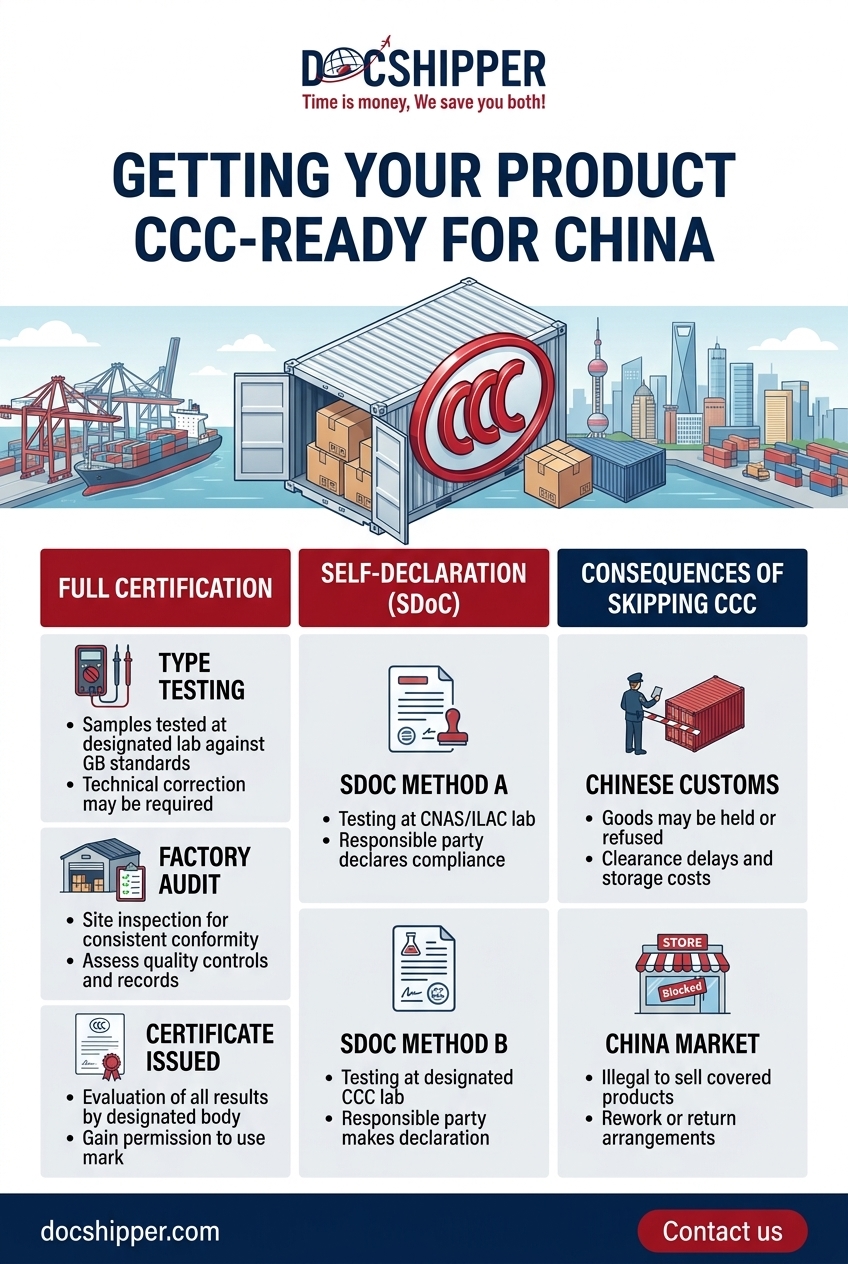
Once a product is confirmed as in scope, it normally follows one of two routes: full third-party certification or self-declaration, also called SDoC. Higher-risk products generally require type testing, factory inspection and evaluation by a designated certification body, while eligible lower-risk and stable-quality products may use an SDoC route.
Third-party certification
Full CCC certification involves an independent designated body. The process normally includes application review, sample testing against the relevant GB standard, an initial factory inspection, technical evaluation and issue of the certificate and permission to use the mark.
This route is more demanding because the authority assesses both the product and the manufacturing controls behind it. The factory must be able to show that the certified model can be produced consistently, not merely that one sample passed a laboratory test.
The applicant may be the manufacturer or, depending on the applicable rules and commercial structure, an importer or another responsible party. In practice, the applicant must coordinate product documents, samples, factory contacts, technical files and access for the designated body.
Self-declaration, or SDoC, Method A vs B
Self-declaration of conformity means that the responsible party declares that the product meets the applicable Chinese requirements instead of obtaining the standard full third-party certificate. It is not a general shortcut for every CCC product: eligibility depends on the product category, risk level and applicable implementation rules.
Under Method A, testing is performed by a laboratory recognised by CNAS or operating under the relevant ILAC-recognised arrangements. Under Method B, testing is performed by a designated CCC laboratory. The distinction concerns the recognised testing route, not the removal of technical obligations.
The company using SDoC still needs accurate product information, test evidence, a declaration and records that support the conformity claim. If the product changes, the responsible party must determine whether the existing evidence remains valid or whether further testing or a new declaration is required.
| Decision point | Full third-party certification | Self-declaration, SDoC |
| Typical use | Products for which the applicable rules require designated-body certification or which present a higher conformity risk. | Eligible lower-risk products with stable quality and an applicable SDoC provision. |
| Testing route | Type testing by an approved or designated laboratory. | Method A: CNAS/ILAC-recognised laboratory; Method B: designated CCC laboratory. |
| Factory assessment | Initial factory inspection is part of the normal route, followed by ongoing supervision. | Requirements depend on the applicable SDoC rules and supporting conformity controls. |
| Responsible party | Manufacturer, importer or other eligible applicant under the applicable rules. | Manufacturer, importer or other responsible party able to support the declaration. |
| Main risk | Applying under the wrong product category or submitting a model that does not match the tested sample. | Making a declaration without confirming eligibility or maintaining adequate evidence. |
A product with close consumer contact or a significant safety risk should not be placed into the SDoC route merely because it appears technically simple. Confirm the route with CQC or the relevant designated body before testing, because choosing the wrong route can force you to repeat the compliance work.
DocShipper Info
Plan certification before shipment to protect your launch timeline.
The CCC certification process step by step, and how long it takes
The full process normally runs from application and type testing to factory inspection, evaluation, certificate issuance and follow-up. Full certification takes several months in the route described by the EU SME Centre, but the actual duration varies by product, model count, factory readiness, test results and the designated body’s requirements.
Application and type testing
Start by preparing a product file that clearly identifies the applicant, manufacturer, factory, model numbers, technical specifications, user instructions, schematics and relevant materials. The tested sample must correspond to the product that will actually be imported and sold.
After the application is accepted, the designated laboratory tests the sample against the applicable GB standard. A failure may require a technical correction, a new sample or additional testing, so sending a production-representative sample at the outset reduces avoidable delays.
Factory inspection and evaluation
The factory inspection checks whether the production site can maintain consistent conformity. Auditors may review quality procedures, incoming-material controls, production records, inspection equipment, non-conforming product handling, traceability and the controls used to prevent unauthorised changes to the certified model.
The factory should also prepare a clear answer to a practical question: how will it prove that every production unit continues to match the tested design? Inconsistent components, undocumented engineering changes or weak batch records can create problems even when the original sample passed.
Certificate and annual follow-up
Once the designated body has completed the technical evaluation and accepted the factory results, it can issue the certificate and the permission to use the CCC mark where applicable. The certificate is not the end of the compliance obligation.
Follow-up certification generally includes a factory audit, typically on an annual basis. This ongoing review means CCC is not a one-time purchase: the factory must maintain conformity and keep the certificate and mark permission valid over time.
- Confirm scope: match the product, model and intended use to the current CCC catalogue.
- Identify the route: determine whether the product requires full certification or is eligible for SDoC Method A or Method B.
- Submit the application: provide applicant, factory, product and technical information to the relevant designated body.
- Complete type testing: send production-representative samples for testing against the applicable GB standard.
- Prepare the factory: organise quality records, production controls, traceability and inspection procedures for the factory audit.
- Complete evaluation: resolve test or audit findings and wait for the designated body’s conformity decision.
- Obtain the certificate and mark permission: confirm the approved models and marking conditions before shipment.
- Maintain conformity: plan the follow-up factory audit, typically annually, and reassess any product or factory change.
| Process step | What happens | Planning point |
| Application | The applicant and product are registered with the relevant designated body. | Use exact model and factory information from the start. |
| Type testing | Samples are tested against the applicable GB standard. | Allow for corrective work if the sample does not pass. |
| Factory inspection | Production and quality controls are reviewed. | Records and processes must match the certified product. |
| Evaluation | The designated body reviews the testing and factory results. | Unresolved findings can delay issuance. |
| Certificate and mark permission | The approved certificate and applicable marking authorisation are issued. | Check the permitted models and marking instructions before shipping. |
| Follow-up | Ongoing supervision, typically including an annual factory audit, maintains validity. | Plan recurring compliance rather than treating CCC as a one-off task. |
There is no fixed universal CCC price or timeline that can be responsibly quoted for every product. The cost and duration depend on the product category, number of models, testing scope, factory location and readiness, route, corrective actions and follow-up requirements, so confirm them per product with the designated body.
DocShipper Alert
Check compliance before dispatch to avoid costly customs and market consequences.
What it costs you to skip CCC: customs and market consequences
Shipping a covered product without the required CCC conformity can result in the goods being held or refused at Chinese customs. Even if the shipment is physically released, the product cannot legally be sold or distributed in China without completing the applicable requirement.
At Chinese customs
CCC is part of the compliance information checked for covered products entering China. If customs or another authority identifies a product that should carry CCC but does not, the shipment may be stopped while the importer provides evidence or resolves the non-compliance.
The operational consequences can include delayed clearance, storage exposure, re-labelling or rework, return arrangements and the need to organise compliance after the goods have already left the origin country. A shipment that cannot be regularised may be returned rather than placed on the Chinese market.
On the market
A product without the required CCC conformity cannot legally be sold or distributed in China. Market surveillance, customer complaints or a later inspection can expose the same issue after import, when stock is already located in warehouses, retail channels or customer sites.
Consider the practical scenario: a shipment of covered electronic devices reaches China without the required CCC route completed. The immediate problem is not a missing administrative line item; it is stranded stock, a disrupted launch, possible rework and a shipment that cannot be lawfully commercialised.
The most economical point to identify a CCC problem is before production and shipment. Confirming the catalogue entry, route and model scope early is usually more useful than trying to repair a compliance file at the border.
| If CCC is skipped | Likely consequence |
| At customs | Goods may be held or refused while conformity is checked. |
| For the shipment | Clearance delays, storage exposure, rework or return arrangements may follow. |
| On the Chinese market | The covered product cannot legally be sold or distributed without the required conformity. |
| For the launch plan | Stock may be unavailable for sale even though it has already been manufactured and transported. |
DocShipper Advice
Ask DocShipper for a pre-shipment CCC review before goods enter China.
Key takeaways and how to get your product CCC-ready for China
CCC is scope-driven and binary: check the catalogue first, select the correct route second, and plan the certification work before shipping to China.
- CCC is a mandatory safety mark administered within the CNCA framework, with CQC and other designated bodies processing relevant certification activities.
- The catalogue covers 109 product items across 17 categories as of 23 September 2025. If your product is not listed, it does not need CCC, although other Chinese requirements may still apply.
- Imported and domestically manufactured products are both covered when they fall within the catalogue.
- In-scope products follow either full third-party certification or an eligible SDoC route. Do not assume that a low-risk product automatically qualifies for self-declaration.
- Full certification usually takes several months and can include type testing, factory inspection, evaluation, certificate issuance and mark permission.
- Compliance continues after certification. Follow-up certification typically includes an annual factory audit.
- Without CCC, covered goods may be blocked or returned at Chinese customs and cannot legally be sold or distributed in China.
Not sure whether your product needs the CCC mark? Send DocShipper your product details and destination, and our China team can confirm the scope, coordinate the testing and certification route, and support customs clearance before your goods enter China.
FAQ | China Compulsory Certification (CCC): Does Your Product Need It?
Not automatically. Certain samples, prototypes, research items or exhibition products may qualify for a specific import exemption, but the exemption usually depends on their quantity, intended use and whether they will be sold or put into commercial service. Do not assume that labelling a shipment “sample” is sufficient: the importer should confirm the applicable customs procedure and prepare supporting documentation before dispatch.
It depends on whether the component is independently listed in the CCC catalogue and how it will be used. A component incorporated into a certified finished product is not automatically exempt, particularly if it has its own regulated safety function. Check the component’s exact classification, rather than relying only on the certification status of the final assembly.
Usually not without a formal review. A change to the factory, production site, key components, design, ratings or model identification may require a certificate variation, additional testing or a new application. Shipping the modified product under an unchanged certificate can create a mismatch between the approved product and the goods presented to customs.
The certificate is linked to specific applicant, manufacturer, factory and approved models, so private-label arrangements need to be checked carefully. If the brand, applicant or commercial structure changes, the responsible party may need to update the certification records or obtain approval for the arrangement. Confirm this before production, especially when several importers will sell the same factory-made product.
The importer should verify that the certificate or self-declaration matches the exact product models, factory and shipment configuration. It is also important to confirm that the marking is applied according to the applicable rules and that the commercial and customs documents use consistent product descriptions. A valid certificate can still cause problems if the shipped model or declared information does not correspond to the approved scope.
Yes. Being outside the CCC catalogue only means that the compulsory CCC route does not apply. The product may still be subject to other requirements, such as telecommunications approval, energy-efficiency rules, environmental controls, medical-device registration or sector-specific market-access obligations. Scope checking should therefore continue after the CCC question has been answered.
Need Help with
Logistics or Sourcing ?
First, we secure the right products from the right suppliers at the right price by managing the sourcing process from start to finish. Then, we simplify your shipping experience - from pickup to final delivery - ensuring any product, anywhere, is delivered at highly competitive prices.


Fill the Form
Prefer email? Send us your inquiry, and we’ll get back to you as soon as possible.
Contact us


:%20Does%20Your%20Product%20Need%20It?)