Freight Shipping between China and Portugal | Rates – Transit times – Duties and Taxes
The first thing we always tell people is this, shipping from China to Portugal looks straightforward on paper, but small choices early on can cost you weeks or blow up your budget.
You’ll notice fast that rates, transit times, and customs rules don’t behave the same way as on other Europe bound routes.
If you’re looking at this route, you should know exactly which transport option fits your cargo, where delays usually happen, and how duties and taxes really apply in Portugal.
That’s what we focus on here, practical guidance from experience, so you can plan shipping from China to Portugal with fewer surprises and better decisions.
Which are the different modes of transportation between China and Portugal?
Are you considering shipping goods from the bustling factories of China to the classic, cobblestone streets of Portugal? Selecting the ideal means of transport can be trickier than a jigsaw puzzle! When you factor in the long distance, air and sea emerge as realistic options. Air freight provides speed, while sea freight offers an efficient solution for heavy loads. It’s like choosing between a cheetah and a pack mule – quickness or strength? Understanding your shipment’s unique needs is a pivotal step in making a cost-effective, efficient decision.
Docshipper Note:
Need assistance with your shipment? Dont hesitate to contact us even for a simple question. Choose the option that suits you
Live chat with an expert Chat us on WhatsApp Fill the formNote DocShipper :
How can DocShipper help?
Seeking to ship goods between China and Portugal? Let DocShipper streamline the process for you. Our team of experts tackle everything, from transport organization to customs clearance. Uncertain? Feel free to call our consultants. Need a quotation? We guarantee a free estimate within 24 hours. Your efficient shipping solution is just a chat away!
Sea freight from China to Portugal
If you’re looking at sea freight from China to Portugal, here’s the first thing we always tell people. Sea freight makes sense when volume matters more than speed, when your cargo is not urgent, and when you want predictable cost logic over time. It’s the right choice for FCL or LCL shipments, steady replenishment flows, and industrial or commercial goods. It’s not the right option if your delivery window is tight or if one late document can shut down your operation.
You’ll notice fast that this route has its own friction points. Long sailing distances mean lead time matters. European destination charges can quickly outweigh the ocean freight if you’re not prepared. And Incoterm mistakes are still the number one reason importers lose control of costs. From experience, most problems don’t happen at sea, they happen before loading or after arrival. Our role is to help you see those risks early, not after the container lands.
DocShipper Tip:
Sea freight might be the best solution for you if:
- You are shipping large volumes or bulky items, as sea freight offers the most space at a cost-effective rate.
- Your cargo doesn't have an urgent deadline, as sea freight typically has longer transit times compared to air or rail.
- Your shipping routes are between major ports, allowing you to leverage the extensive global network of sea shipping lanes.
Which Incoterms should you use?
On this route, Incoterms are not just contractual words, they define who controls the shipment when things go wrong. If you ship under EXW, you take responsibility in China earlier than most first-time importers realize. You handle export clearance, trucking, and booking, often without local leverage. That’s where delays usually start.
FOB is often the safest balance. Your supplier handles export formalities, and you take control once the cargo is on board. You control the carrier choice, transit routing, and destination costs. CIF looks easy on paper, but you give up control of the ocean freight and usually discover destination charges too late. We usually recommend FOB unless you clearly understand what CIF includes and what it doesn’t.
Port of Guangzhou
Location and Volume: Nestled in the Pearl River Delta, the Port of Guangzhou has a robust annual volume, with over 25.5 million TEU handled in 2023.
Key Trading Partners and Strategic Importance: With established trade routes to Africa, the Middle East, and America, this port is integral to the Belt and Road Initiative.
Context for Businesses: The Port of Guangzhou is an ideal choice if your business revolves around manufacturing industries, given its proximity to one of China’s industrial centers.
Port of Qingdao
Location and Volume: Located in Shandong Province, the Port of Qingdao saw a volume exceeding 18.49 million TEU in 2023.
Key Trading Partners and Strategic Importance: This port is a key point of connection for trade with Japan and South Korea, with extensive reach to the Americas and Europe.
Context for Businesses: If your goal revolves around reaching customers in North Asian markets or in the thriving eastern Chinese provinces, the Port of Qingdao can effectively meet those requirements.
Port of Tianjin
Location and Volume: Located in Northern China, the Port of Tianjin caters to Beijing and surrounding provinces, with an impressive volume of over 21 million TEU.
Key Trading Partners and Strategic Importance: Its trading partners include the US, Asia, and Europe making it an essential part of Northern China’s import-export activities.
Context for Businesses: Given its location as the maritime gateway to China’s capital, Tianjin serves as a valuable link in shipping strategies that aim to directly target or originate from Northern China and beyond.
Main ports to know in China and Portugal
You don’t need to memorize every port, you need to understand why some matter more than others. In China, Shanghai, Ningbo, Shenzhen, and Qingdao dominate this lane because of vessel frequency and reliable Europe services. Your port of loading affects sailing schedules and inland trucking costs more than most people expect.
On the Portuguese side, Sines is the main deep-sea gateway with strong Asia connections. Lisbon and Leixões are often used when inland delivery matters more than pure transit time. Port choice impacts not just arrival but how easily your container moves inland by truck or rail, which is where delays and extra costs often appear.
Should I choose FCL or LCL when shipping between China and Portugal?
In the intricate maze of international shipping, making the right choice between Full Container Load (FCL) and Less than Container Load (LCL), also known as consolidation, is akin to plotting a winning strategy. This choice could be the game-changer, tipping the scales of cost, delivery time, and overall success in your favor.
Read on to discover how these sea freight options can fit into the bigger picture of your shipping journey from China to Portugal, and inform your decision for a smooth sailing.
LCL: Less than Container Load
Definition: LCL (Less than Container Load) shipping is a method of sea freight transport where multiple consignments from different shippers are consolidated in a container for the journey, paying only for the volume occupied.
When to Use: Ideally, opt for LCL freight when your cargo sizes between 1-15 CBM (Cubic Meter), where full container usage is not cost-effective. The flexibility of LCL allows it to be more economical for businesses shipping smaller volumes.
Example: Imagine you are a supplier of decorative porcelain from China, needing to send 10 CBM of merchandise to a customer in Portugal. Renting a full 20-foot container (which holds 25-28 CBM) would be financially impractical. Instead, by choosing LCL shipment, you pay only for the 10 CBM you occupy, sharing the remainder space with other shippers.
Cost Implications: Although LCL freight may seem costlier per unit, costs are significantly reduced for low volume shipments because you’re not investing in unused space. However, do bear in mind there may be additional costs for deconsolidation at the destination port.
FCL: Full Container Load
Definition: FCL, or Full Container Load, is a type of shipping mode where a whole container is used for one shipment. In other words, your goods exclusively occupy an entire ’20ft’ or ’40ft’ FCL container.
When to Use: If you’re moving goods over 13-15 CBM, FCL shipping is often the best choice. It not only ensures the safety of your cargo, as the container is sealed from origin to point of delivery, but is also economical for high-volume shipments.
Example: Consider Company A in China wants to ship 20 CBM of porcelain figurines to Portugal. They would likely opt for an FCL shipment, to minimize the risk of damage and reduce costs.
Cost Implications: Despite a higher upfront FCL shipping quote, the per-unit cost often ends up being lower for FCL than LCL, especially when shipping larger volumes. However, additional charges might apply if you’re unable to unload and return the container within the agreed-upon time. Shipping costs fluctuate based on demand and container availability, so the optimal choice may vary.
Unlock hassle-free shipping
Fast, cost-effective, or eco-friendly? Making the choice between consolidation and full container shipping between China and Portugal has never been easier with DocShipper. Our logistics whizzes are here to make cargo shipping seamless, analyzing factors such as volume and weight of your goods, your budget, and time constraints. We are here to guide you to the most suitable shipping option. Don’t let shipping complexities weigh you down, reach out to DocShipper for a free estimation today. Let’s make shipping simplified!
Transit times: how long does it take to ship from China to Portugal?
For ocean shipping China Portugal, you should plan for an estimated 33 to 41 days port to port. That’s sailing time plus standard port operations, not door delivery. LCL shipments often sit slightly longer due to consolidation and deconsolidation steps.
Here’s how typical sea transit times look between key ports:
| Port of loading in China | Port of discharge in Portugal | Estimated sea transit time |
|---|---|---|
| Shanghai | Lisbon | 34 days |
| Ningbo | Leixões | 33 days |
| Shenzhen | Setúbal | 41 days |
| Qingdao | Sines | 40 days |
These are planning ranges, not guarantees. Congestion at origin, transshipment in Northern Europe, and seasonal peaks can easily add days. If timing is critical, we usually check routing and vessel frequency before booking, not after.
Shipping rates: how much does a sea freight shipment cost from China to Portugal?
| Shipment type | Indicative price range |
|---|---|
| LCL (1–5 CBM) | USD 50–200 per CBM |
| FCL 20ft | Varies by market and season |
| FCL 40ft | Varies by market and season |
On this route, ocean freight pricing is only one part of the equation. Rates fluctuate with carrier capacity, fuel adjustments, and equipment availability. What usually surprises importers is not the freight rate itself but the destination charges in Portugal. That’s why the cheapest quote on paper is rarely the cheapest landed cost.
Special sea freight solutions
If your cargo doesn’t fit standard containers, you still have options. We regularly handle OOG containers, breakbulk shipping, Ro-Ro, dry bulk, and reefer cargo on this lane. Oversized machinery, project cargo, temperature-sensitive goods, or rolling equipment all require different planning logic, permits, and port handling. This is where experience really matters, because one wrong assumption can block loading or inflate costs fast. If your shipment falls outside standard FCL or LCL, we’ll map the solution before you commit.
Air freight from China to Portugal
If you’re considering air freight from China to Portugal, here’s the reality. Air works when time matters more than unit cost, for example electronics, spare parts, high value cargo by air, or urgent cargo by air. It stops making sense the moment volumes get bulky, packaging is inefficient, or your supplier misses the ready date. Fast, yes. Forgiving, no.
From experience, most problems on this lane don’t come from the flight itself. They come from chargeable weight surprises, late cargo missing airline cut-off, or incomplete export docs that block screening. Air is not “always 3 days”, and it’s not “always too expensive to consider”. What really drives cost is density, timing, and how clean your paperwork is when cargo hits the origin airport.
DocShipper Tip:
Air freight might be the best solution for you if:
- You are in a hurry or have a strict deadline requirement, as air freight offers the fastest transit times.
- Your cargo is less than 2 CBM (Cubic Meter), making it more suitable for smaller shipments.
- Your shipment needs to reach a destination that is not easily accessible by sea or rail, allowing you to tap into the extensive network of global airports.
Air cargo vs express: how should you ship on this route?
You’ll quickly face the classic decision: air cargo shipping China Portugal or express air freight option. Air cargo moves on commercial airline capacity, usually airport to airport shipping. Express relies on integrated courier networks, designed for speed and simplicity. Both are international air transport, but the logic, cost structure, and control level are very different. Choosing wrong is where budgets slip.
Should you choose air cargo from China to Portugal?
Air cargo becomes logical on this route once you pass roughly 1 CBM or 100–150 kg. It’s the standard air freight service for B2B flows, repeat shipments, temperature controlled air cargo, or fragile goods air transport that need planning rather than panic.
To make it work smoothly, you need your dimensions, gross weight vs volumetric weight, Incoterm, origin and destination airports, and cargo ready date locked in early. Where importers get caught is assuming airport to airport equals door to door air freight. It doesn’t. Miss the airline cut-off, underestimate screening time, or forget handling charges, and transit time and cost both jump.
Should you choose express air freight from China to Portugal?
Express makes sense when shipments are small, urgent, and operationally simple. Think samples, urgent spare parts, or when you don’t have an internal logistics team. Express air freight option trades control for speed.
The risk is hidden cost. You’ll often see reweighs, volumetric weight calculation shocks, and destination charges you assumed were included. Express is great if speed is non-negotiable. It’s risky if margins are tight or packaging isn’t optimized.
Main airports to know in China and Portugal
- Shanghai Pudong (PVG), main long-haul cargo hub with frequent Europe connections, ideal for consolidation vs direct flight decisions.
- Guangzhou (CAN), strong for South China manufacturing, good capacity but sensitive to peak congestion.
- Shenzhen (SZX), preferred for electronics and high value cargo by air, fast export handling at origin airport.
- Hong Kong (HKG), premium option with reliable screening and flexible capacity planning.
On the Portugal side, flows concentrate on Lisbon (LIS) for connectivity and Porto (OPO) for northern distribution. Airport choice impacts inland trucking, handling speed, and real lead time more than most expect.
Main airports to know in China and Portugal
Lisbon handles most intercontinental air cargo and customs clearance volume. Porto is efficient for regional delivery but may route via EU hubs. Choosing wrong can add a full day post-flight during import handling at destination airport.
Transit times: how long does air freight take from China to Portugal?
| Service | Typical air shipping lead time |
|---|---|
| Standard air cargo | 3–7 days |
| Express courier | 1–4 days |
These are ranges, not guarantees. What stretches timelines are missed cut-offs, screening holds, and capacity bottlenecks during peak season. If you need accuracy, you must confirm airport pair, service level, and ready date upfront.
Shipping rates: how much does air freight cost from China to Portugal?
| Service | Indicative rate range |
|---|---|
| Standard air cargo | USD 4.5–8.0 per kg |
| Express air freight | USD 7.0–12.0 per kg |
Rates move with chargeable weight concept, dimensions, fuel surcharge air cargo, security surcharge, and seasonality. The biggest cost driver is almost always density, not distance.
What is the difference between volumetric and gross weight?
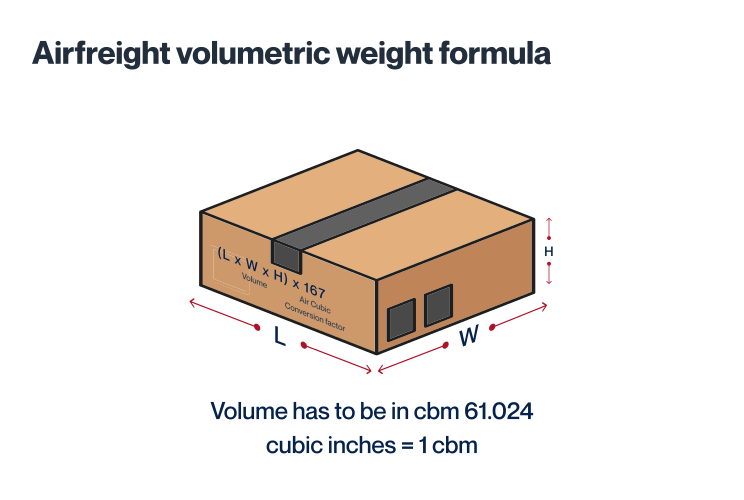
Airlines bill on whichever is higher between actual weight and space used. That’s why understanding gross weight vs volumetric weight is critical for air freight cost estimation.
- Gross weight, what the cargo weighs on a scale.
- Volumetric weight, what the cargo occupies on the aircraft.
Formula: (L × W × H in cm) ÷ 6000 for air cargo, ÷ 5000 for express. Example: a 300 × 250 × 150 cm crate equals 1,875 kg chargeable on air cargo.
Common mistakes include over-packaging, guessing dimensions, or assuming weight alone drives pricing. On this route, that’s how air freight rates China Portugal spiral unexpectedly.


Rail freight between China and Portugal
Can you believe it was red tape, not dragons, that almost thwarted the legendary journey behind the iron Silk Road? This historic rail link from China to Portugal blazed its trail in the early 2000s, forging a path through numerous countries across Eurasia. High volumes of electronics, clothing, and automotive parts make this trek annually.
However, points of friction exist with cumbersome customs procedures and occasional bottlenecks in countries like Kazakhstan and Belarus. Yet, the rail’s existence has unquestionably spurred economic cooperation and growth between China and Portugal. While slower than air transport and faster yet more expensive than sea freight, this route offers balance.
Like Goldilocks in the tale of the three bears, could rail freight be ‘just right’ for your international shipping needs? It is worth exploring further, taking into consideration the trade-offs between cost, transit times, and the complexity of customs procedures.
DocShipper Tip:
Rail freight might be the best solution for you if:
- You are looking for a cost-effective transportation method for large volumes.
- Your shipping route is well-connected by rail, providing a reliable and environmentally friendly option.
- Your cargo's destination and origin are near rail terminals, minimizing the need for additional road transportation.
What are the main train stations between China and Portugal?
Shanghai Railway Station, China
Located in China’s financial hub, Shanghai Railway Station handles one of the highest cargo volumes in the country. It participates in major trading with European countries, including Portugal. For your business, its strategic location and access to major commercial ports proves advantageous, enabling easy transshipment and significantly reducing lead times.
Beijing Railway Station, China
This station utilizes numerous international railway lines. It’s a crucial link in the China-Europe railway network, and Portugal is among its key trading partners. Beijing Station’s high cargo volume capacity and direct links to China’s main industrial areas make it an excellent choice if your business handles large cargo volumes frequently.
Chengdu Railway Station, China
Situated in Southwest China, Chengdu is a significant rail hub. It has immense strategic importance given its proximity to major manufacturers and robust connections to Europe via the China-Europe rail network. This may especially benefit your business if you’re looking for seamless connectivity to China’s manufacturing heartlands.
Shenzhen West Railway Station, China
A critical southern access point, Shenzhen West is dynamically connected to the international rail network. It boasts a high cargo volume and strong trade links with Southeast Asian countries and Europe. Its connections to China’s Pearl River Delta manufacturing area might be attractive if you’re shipping goods locally before international distribution.
Lisboa Santa Apolónia, Portugal
Santa Apolónia is Portugal’s oldest railway terminus and a primary hub for international rail freight. Strategically situated in Lisbon, the capital city, it links your shipments directly to the European rail network. Its affinity to the port of Lisbon justifies its strategic importance, enabling easy transition from sea to rail freight for your business.
Alfândega Terminal Intermodal, Portugal
This state-of-the-art terminal is located in Leixões and is a key rail gateway for international freight. Highlighting excellent accessibility to the broader rail network in Europe and advanced cargo handling facilities, it assures efficient handling and can act as a critical component of your international logistics plan.
Terminal XXI, Sines, Portugal
As Portugal’s most modern rail terminal, it features excellent connections to the rest of Europe via the international rail network. Being part of the Sines logistics platform and adjacent to the largest deep-water port in Portugal, Terminal XXI could be a strategic choice if your business prefers integrated sea-rail freight solutions.
Leixões Port Container Terminal, Portugal
Being uniquely connected to major industrial and business centers, this terminal handles significant cargo volume and has strong connections to the broader European rail network. Leixões’s location makes it an optimal choice if your business requires efficient dispersion of goods across Portugal and other European nations.
Weigh these options carefully as you devise your shipping strategy. Remember that choice of rail freight station should align with your business needs, including cargo volume, preferred shipping routes, and local distribution needs.
How long does rail freight take between China and Portugal?
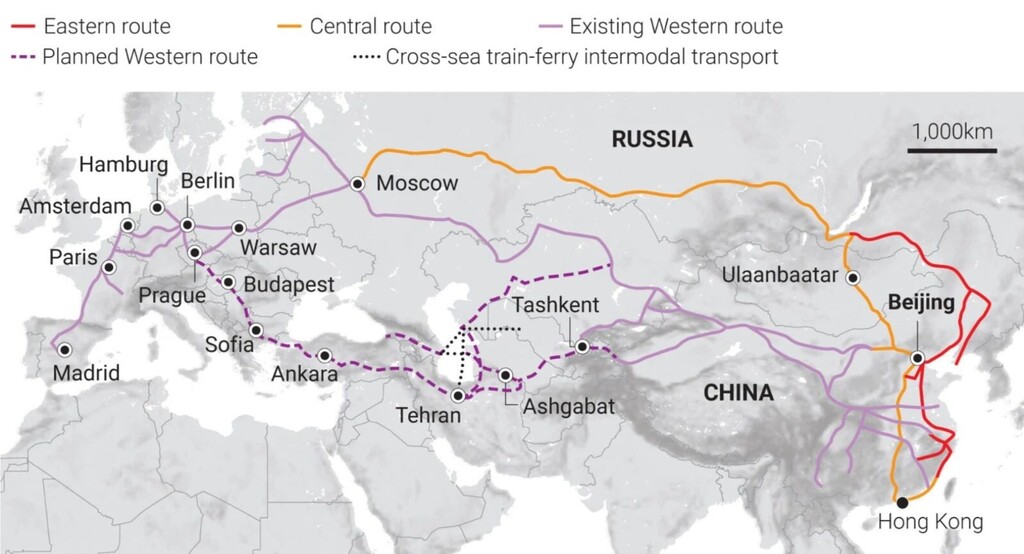
Transit times for rail freight between China and Portugal are influenced by various factors, such as the cargo’s starting location, destination, and custom clearances. On average, it takes around 16-22 days. Below is a depiction of rail networks connecting China and Europe with their transit times and departure frequency. However, these estimates as rail transit depends on unpredictable variables, making accurate forecasting a challenge.
- Zhengzhou to Hamburg (Germany): ~ 15-17 days, Departs Daily
- Zhengzhou to Munich (Germany): ~ 17-18 days, Departs Monday and Friday
- Zhengzhou to Liege (Belgium)/Milan (Italy): ~ 20 days, Departs Monday, Thursday and Friday
- Chongqing to Duisburg (Germany): ~ 16-17 days, Departs Monday/Friday
- Yiwu to Hamburg (Germany): ~ 16-18 days, Departs Monday/Thursday/Friday
- Yiwu to Duisburg (Germany): ~ 16-18 days, Departs Monday/Thursday/Friday
- Yiwu to Madrid (Spain): ~ 20 days, Departs Monday/Thursday/Friday
- Wuhan to Hamburg (Germany): ~ 17-19 days, Departs Saturday/Wednesday/Thursday
- Wuhan to Duisburg (Germany): ~ 17-19 days, Departs Saturday/Wednesday/Thursday
- Chengdu to Tilburg (Netherlands): ~ 18 days, Departs Wednesday/Sundayy
- Suzhou to Hamburg (Germany): ~ 18-20 days, Departs Sunday
- Suzhou to Duisburg (Germany): ~ 18-20 days, Departs Sunday
- Xi’an to Duisburg (Germany): ~ 18-20 days, Departs Wednesday/Thursday/Friday/Saturday
What are the advantages of rail transport between China and Portugal
Navigating the shipment landscape between China and Portugal may seem daunting, but rail freight eases the journey. As a middle ground between sea and air freight, rail transport offers a blend of speed and affordability. For instance, if you’re shipping electronic goods and need expedited delivery without the hefty air freight price tag, the Trans-Eurasian Railway, linking China to Europe, can cut your transit time to around 18-20 days, much faster than the 30-40 days of ocean freight.
On the other hand, it’s significantly cheaper than air freight which is a big advantage if cost-effectiveness is a pain point for your business. Plus, the predictable routes and scheduled departures of rail transport mean fewer unpleasant surprises along the shipping route. Thus, rail freight may be your ideal compromise between speed and cost.
How much does shipping goods by train between China and Portugal cost?
Giving an exact cost for train freight from China to Portugal, like air and sea freight, isn’t a one-size-fits-all quote. This is because numerous factors influence the cost — from the type and size of goods, their weight, to specific rail fees. However, fret not! Our experts work with each client individually, ensuring you receive the best rates according to your unique requirements. We believe in transparency and custom solutions because your business isn’t just a number. Ready to engage our team? Contact us and receive a bespoke quote in less than 24 hours — your first step to optimal shipping costs!
Door to door between China and Portugal
In international logistics, Door to Door shipping neatly wraps up your shipping process from China to Portugal in one tidy package. It reduces cognitive load and streamlines operations, perfect for business with enough on their plate already. So, ready for a stress-free, comprehensive shipping solution? Let’s dive in!
Overview – Door to Door
Doing business between China and Portugal? Consider Door to Door shipping. This popular DocShipper service is all about ease, taking care of complicated logistics and customs specifics for you. No more paperwork headaches or transit anxieties. Still, it may not suit every shipping timeframe or budget. Despite challenges, many find the stress removed from the shipping process a priceless advantage. Clearly, this service could transform your international trading experience.
Why should I use a Door to Door service between China and Portugal?
Ever wondered why a GPS comes preloaded in your car? Just like you, your shipment also dislikes getting lost, especially when it needs to navigate its way from China to Portugal! Here’s the deal – with Door to Door service, your shipment enjoys a hassle-free and punctual transit. Now, let’s dive into the top 5 reasons why this service could be your magic ticket to simple and effective shipping:
1. Say Goodbye to Stress: Imagine shipping without the headaches of logistics nightmares. Goods pickup, customs clearance, compliance – all taken care of!
2. Timely Delivery: Got an urgent shipment? Door to Door service is designed to follow strict timelines, ensuring your cargo promptly reaches its destination.
3. Special Care: Have a complex cargo? Rest assured your shipment, no matter how complicated, receives complete care till it is safely delivered, because every package deserves VIP treatment.
4. Ultimate Convenience: With Door to Door, it’s just that. From the first mile in China to the last in Portugal, your shipment’s trucking is handled meticulously, because convenience is king.
5. First to Last Mile – We Care: While your shipment enjoys an exciting trip, you can sit back, relax and watch it move through every step, because let’s face it, tracking is fun and comforting.
So, if you’re into cutting stress, sticking to schedules, handling precious cargo, basking in convenience, and thoroughly enjoying your shipping journey – Door to Door service is definitely your thing. Above all, it’s not just about the shipment, it’s about the peaceful smile on your face when your goods reach their destination spot-on! Isn’t that a great reason to consider this service? Now, who said logistics couldn’t be fun? Let’s make your shipping story a pleasant one together!
DocShipper – Door to Door specialist between China and Portugal
Trust in DocShipper’s comprehensive door-to-door shipping from China to Portugal. Say goodbye to logistics hassles and let us handle everything from packing to customs clearance across all transportation modes. We provide you with a dedicated Account Executive ensuring smooth and efficient shipping. Get your goods moving today – reach out to us for a free and quick estimate or speak to our expert consultants at no added cost. We’re skilled, efficient, and ready to serve your shipping needs!
DocShipper Tip:
- You value convenience and want a seamless shipping process, as door-to-door takes care of every step from pickup to delivery.
- You prefer a single point of contact, as door-to-door services typically provide a dedicated agent to handle all aspects of the shipment.
- You want to minimize the handling of your goods, reducing the risk of damage or loss, as door-to-door minimizes transitions between different modes of transport.
Customs clearance in Portugal for goods imported from China
Customs clearance in Portugal is where your final landed cost is confirmed, your release timing is decided, and legal responsibility is locked in. When you’re importing goods from China, everything hinges on who is the Importer of Record, how your shipment is declared, and whether duties and taxes are calculated correctly. We coordinate these clearance steps with our local partners so you’re not left managing the process alone.
What usually causes trouble on the customs process China to Portugal is not the border itself, but assumptions made upstream. We regularly see delays and extra costs from the wrong Incoterm logic, weak HS code classification, or undervaluation where freight and insurance were never added to the customs value. In the next sections, we’ll walk you through the real clearance workflow and a reliable method to estimate duties and taxes before you ship.
How to calculate duties & taxes when importing from China to Portugal?
If you want a realistic estimate of duties and taxes calculation, you need a few solid inputs, not guesswork. Customs looks at your country of origin, HS code classification, customs value assessment, and the applicable import tariff application. Miss one, and the numbers change.
Final amounts often differ from early estimates because of reclassification, value questions, or taxes being calculated on a wider base than expected. This is also why cheap quotes can be misleading, they sometimes ignore freight, insurance, or import taxes considerations that appear at assessment.
Step 1 - Identify the Country of Origin
On this route, the country of origin is already China, but country of origin determination still matters more than most importers expect. It affects which tariff rates apply, what proof customs may request, and how credible your declaration looks when reviewed.
Customs will cross-check origin against your commercial invoice details, packing list accuracy, manufacturer data, and even product labeling. If the story doesn’t match, questions start fast.
Preferential rates or trade defense measures like anti-dumping can apply depending on the HS code and origin combination. We’ll cover how to verify this when we get to the import tariff application step. A common mistake we see is confusing origin with the shipping country or relying on a vague “Made in” claim that can’t be supported.
Step 2 - Find the HS Code of your product
Your HS code classification drives almost everything, duty rate, controls, inspections, and clearance delays causes. On the China to Portugal lane, a weak or generic code is one of the fastest ways to trigger questions.
Start with the HS code provided by your supplier, but treat it as a reference, not a guarantee. We always recommend validating it against an official tariff code lookup and building a small support file, product function, materials, photos, datasheet, or model number.
You can cross-check using the EU TARIC database here: TARIC tariff code lookup. Make sure the description you select truly matches your product.
If the HS code is wrong, customs may reclassify the goods, back-charge duties, apply penalties, or hold the shipment during a customs inspection handling phase. Storage and handling costs add up quickly while this gets sorted.
Here’s an infographic showing you how to read an HS code.
Step-by-step: how customs clearance usually works on this route
Here’s what the clearance workflow step by step looks like in real operations when importing goods from China into Portugal. This sequence is where timing and documentation either work smoothly or fall apart.
- Before departure, we run pre clearance checks on your documents, commercial invoice details, packing list accuracy, HS code, and Importer of Record setup.
- A pre-alert is sent before arrival. This is often where delays start if documents don’t match or arrive late.
- The import declaration filing is prepared and submitted to Portuguese customs.
- Customs reviews the file and may ask questions on value, origin, or classification.
- If selected, a document check or physical inspection takes place, adding time if support is weak.
- Duties and taxes are assessed, then paid or advanced depending on your setup.
- Once cleared, the shipment release process is authorized.
- Final delivery is booked, delays here usually come from missed warehouse appointments or unpaid charges.
The exact flow changes depending on port of entry, Incoterm, and whether the shipment is express, consolidated, or direct. The moment of truth is almost always document consistency.
Step 3 - Calculate the Customs Value
Portuguese customs generally relies on the transaction value method, meaning what you actually paid for the goods, adjusted when needed. This is where many importers get caught out.
The customs value usually includes the invoice price plus freight and insurance value, depending on your Incoterm. For example, goods worth $500, freight at $200, and insurance at $50 gives a customs value assessment of $750. Duties are calculated on this base, not just the invoice.
If you leave out freight or insurance when they should be included, expect reassessment and delays.
Step 4 - Figure out the applicable Import Tariff
An import tariff is the duty rate applied to your goods based on the HS code. In Portugal, rates are organized under the EU Common Customs Tariff.
To find the correct rate, open the official TARIC tool, enter your HS code, and select China as the origin. Review the duty rate and any notes shown.
What to look for: standard versus preferential rates, whether proof of origin is required, and any additional measures tied to this HS code.
The formula is simple, import duty = customs value × duty rate. Save a screenshot of the result for budgeting and for your broker. We can double-check the HS code and tariff logic before you ship if you share your product details and Incoterm.
Step 5 - Consider other Import Duties and Taxes
Import taxes considerations go beyond basic duty. In Portugal, VAT is usually calculated on the customs value plus duty and often freight and insurance.
For example, if your customs value plus duty totals $10,500 and VAT is applied at X%, VAT = $10,500 × X%. This is where landed cost jumps.
Other measures can apply. A common pattern is anti-dumping duties on certain product categories tied to HS code and origin, which adds an extra line of duty and often delays clearance if not anticipated.
- Confirm VAT base for your HS code.
- Check for additional measures in TARIC.
- Prepare classification and value support to avoid reassessment.
Step 6 - Calculate the Customs Duties
The calculation logic is straightforward. Customs duties calculation equals customs value × duty rate. VAT equals the applicable tax base × VAT rate.
Once assessed, duties and taxes are paid or advanced depending on your broker setup. Clearance is released after payment confirmation.
If clearance stalls, storage, handling, and delivery rebooking costs can appear quickly. This is why accurate paperwork preparation and early checks matter.
Does DocShipper charge customs fees?
When we act as your customs broker support, duties and taxes are always paid to the authorities, not to us. Our fees cover the import customs procedure and documentation handling. You receive official customs documents so you can reconcile exactly what was assessed and why.
Contact Details for Customs Authorities
China Customs
Official name: General Administration of Customs of the People’s Republic of China
Official website: http://www.customs.gov.cn/

South Korea Customs
Official name: Autoridade Tributária e Aduaneira (Portuguese Customs and Tax Authority)
Official website: https://www.portaldasfinancas.gov.pt/pt/home.action
Required documents for customs clearance in Portugal
Here’s the thing you’ll notice fast when importing into Portugal from China. Customs rarely stop cargo because of the goods themselves. They stop it because documents don’t match. Names, values, quantities, HS descriptions. Everything must tell the same story. Most delays we see come from small inconsistencies or missing proof, not from the border being slow. Use the checklist below and you’ll avoid 90 percent of first-time importer headaches.
Bill of Lading or Air Waybill
This is the transport document issued by the carrier that proves the goods were shipped and to whom they’re consigned.
Portuguese customs and your broker use it to identify the shipment, confirm the consignee, and release cargo once cleared.
Example: Shipper and consignee names must exactly match the commercial invoice, including legal entity names and addresses.
Common mistake: Using a different consignee name than the EORI holder, which blocks customs release.
Packing List
This document breaks down what’s physically inside the shipment, carton by carton.
Customs relies on it to check quantities, weights, and packaging consistency during inspections.
Example: 120 cartons, net weight 1,840 kg, gross weight 2,020 kg, with clear item descriptions per carton.
Common mistake: Vague descriptions like “parts” or rounded quantities that don’t match the invoice.
Commercial Invoice
This is the value declaration of your transaction between seller and buyer.
Portuguese customs uses it to calculate import duties, VAT, and to assess valuation risks.
Example: Unit price, total value, currency, Incoterms, and HS-based product description all aligned with other documents.
Common mistake: Declaring values that don’t reflect the real transaction, triggering reassessment or audit.
Certificate of Origin
This document confirms where the goods were manufactured.
Customs may request it to apply the correct duty rate, anti-dumping rules, or origin-based controls.
Example: Goods manufactured in China, clearly stated and consistent with production records.
Common mistake: Assuming it gives duty reduction automatically. For China to EU, it usually doesn’t.
CE conformity documentation
This proves your products comply with EU safety, health, and environmental rules.
Customs can block release if CE-marked products lack proper conformity files.
Example: Electronics shipped with CE marking plus a valid Declaration of Conformity.
Common mistake: Applying a CE logo without having the technical file to back it up.
EORI number
This is your EU customs identification number.
Without it, you cannot lodge an import declaration in Portugal.
Example: Portuguese importer uses a PT-issued EORI on all customs entries.
Common mistake: Trying to clear goods before the EORI is issued.
Get Started with DocShipper
Navigating the customs maze between China and Portugal can be tough. Save your energy for what matters – running your business. Trust DocShipper to expertly handle every step of your customs clearance process, reducing bottlenecks and ensuring smooth delivery. Need help now? Contact us within 24 hours for a free quote. Let us turn your customs confusion into a seamless shipping solution.
Prohibited goods cannot be imported under any circumstances. If your product category is unclear, confirm with customs before booking transport.
Prohibited and restricted items when importing into Portugal
Quick clarification before you ship. Restricted goods are allowed, but only if you meet specific conditions like permits, certifications, or inspections. Prohibited goods should not enter the EU at all and usually end in seizure, return, or fines. If you’re unsure, this is the point where asking before shipping saves real money.
Restricted products
- Electronics and radio equipment, CE compliance and safety testing required
- Cosmetics and personal care products, ingredient and labeling controls
- Food and supplements, health certificates and border inspections
- Chemicals and batteries, REACH and hazardous goods declarations
- Toys and children’s products, strict safety and material standards
- Textiles and footwear, labeling and product safety checks
Prohibited products
- Counterfeit goods and trademark-infringing products
- Illegal drugs and controlled substances
- Products from endangered species
- Weapons, explosives, and unlicensed firearms
- Obscene or illegal media and materials
If your product sits in a grey area, get written confirmation from your customs broker before it leaves China. Once it arrives, options are limited.
Trade agreements and preferential duties for imports from China to Portugal
This is where expectations often don’t match reality. There is no free trade agreement between China and the European Union, including Portugal. Most goods from China enter Portugal under standard WTO MFN duty rates, plus import VAT.
That means your Certificate of Origin usually won’t reduce duties, but it still matters for compliance and trade defense rules like anti-dumping.
Duty rates depend entirely on your HS code. Before you ship, you should always check the EU’s official tariff database to confirm applicable duties and any additional measures for your product.
If you’re importing sensitive goods like steel, electronics, or chemicals, extra duties or controls can apply. This is where we usually step in to review the HS code and flag risks before cargo is on the water.
Your Next Step with DocShipper
Ride the waves of international shipping without worry. Opt for DocShipper’s expert handling, from customs clearances in vibrant Lisbon docks to the bustling Beijing ports. We simplify the intricate, turning obstacles in the China-Portugal route into seamless transitions. Ready for smoother shipping solutions? Contact us now, and let’s set sail.
Additional logistics services
Dive into DocShipper's comprehensive, end-to-end services! Beyond shipping and customs, we offer a diverse suite of solutions, making each step of your supply chain smoother. Seize the power of hassle-free international trade!
Warehousing and storage
Finding a reliable place to store your goods in China or Portugal can feel like a Rubik's Cube, especially if they need specific conditions - imagine champagne stored in heat! That's why temperature controlled warehousing is critical for certain goods. Want to crack the cube? Explore Warehousing and unlock your ideal storage solution.
Packaging and repackaging
Shipping goods from China to Portugal? Your products need rigorous packaging to ensure they survive the journey. Whether it's delicate glassware or hefty machinery, our trustworthy agents cater to your specific needs, providing packaging and repackaging services. Remember, taking care of goods on the move saves you replacement costs! More info on our dedicated page: Freight Packaging.
Cargo insurance
Transport insurance is your safety net during the unpredictable journey of goods. Unlike fire insurance, transport insurance covers mishaps from departure to arrival, be it damage, theft, or loss. Think of it as preventing a heavy financial blow if a container gets lost at sea or a package is damaged during road transport. In the shipping world, prevention is always better, and this service ensures just that. More info on our dedicated page: Cargo Insurance.
Supplier Management (Sourcing)
Struggling to find reliable suppliers in Asia or Eastern Europe? With DocShipper's Supplier Management (Sourcing) service, we find trustworthy manufacturers for you and manage the entire procurement process. Overcome language obstacles and avoid common headaches with our expert guidance. For example, we can help you find a high-quality, cost-effective manufacturer for your next product line in China, smoothly bridging cultural differences. Discover more about how we can streamline your supply chain on our dedicated page: Sourcing services.
Personal effects shipping
Relocating between China and Portugal? Our Personal Effects Shipping service handles your prized possessions with utmost care, be it a grand piano or fragile porcelain. We mitigate the headache by expertly coordinating your bulky or delicate items, from the quaint neighborhoods in Shanghai to the cobblestone streets of Lisbon. Want to learn how? More info on our dedicated page: Shipping Personal Belongings.
Quality Control
When shipping from China to Portugal, it's crucial to guarantee your goods meet standards from the get-go. Quality Control curbs any hiccups by inspecting your items during manufacturing or customization. Think of it as a watchful eye, ensuring your designer furniture pieces aren't flawed, saving you costs and potential headaches down the line. More info on our dedicated page: Quality Inspection.

Product compliance services
Shipping goods globally? It's crucial to ensure your items meet all required regulations. That's where our Product Compliance Services come in. Our specialized team conducts rigorous tests in certified laboratories; this ensures your goods comply with every tickbox for the destination's regulations. Avoid those unwanted customs hold-ups and take advantage of our comprehensive support. Find out more on our Product Compliance Services.