In short ⚡
Amazon FBA is a fulfillment model where you sell as a third-party seller on Amazon while Amazon handles storage, pick and pack, shipping, returns, and customer service under Prime-eligible conditions. You control product sourcing, listings, and inventory decisions, but must follow strict inbound rules on labeling, FNSKU barcoding, packaging, and restock limits to avoid warehouse blocks and extra storage fees.
We hope you’ll find this article genuinely useful, but remember, if you ever feel lost at any step, whether it’s finding a supplier, validating quality, managing international shipping or customs, DocShipper can handle it all for you!
What is Amazon FBA and is it right for you?
Amazon FBA is the setup where you sell as a third-party seller, but Amazon handles the hard operational part, storage, pick and pack, shipping, returns, and customer service.
Here’s the thing, this model can feel “plug-and-play” until you hit real-world constraints like restock limits, storage fees, and prep compliance.
Before you spend on your first product sourcing run, you want a clear view of how Fulfillment by Amazon actually works, and when FBM or Seller-Fulfilled Prime beats it.
DocShipper Info
DocShipper audits your products, volumes, and markets, then designs the most profitable fulfillment setup.
We align storage, shipping, and compliance so your offer structure actually scales.
Amazon FBA meaning, how it works, and key benefits
One Tuesday, we saw a new seller ship “perfectly fine” cartons from a supplier, then get blocked at the warehouse because the labels were wrong, no valid FNSKU, mixed ASIN in a carton, and zero appointment readiness.
That’s the practical amazon fba meaning, you run the offer and inventory decisions, Amazon runs fulfillment, but only if you play by their inbound rules.
At a high level, Amazon fulfillment services work like this, you create a listing (with an ASIN), define your internal SKU, generate a shipping plan, prep and label units with barcoding and FNSKU, then send an inbound shipment to an FBA warehouse.
To make the flow concrete, here’s the typical Fulfillment by Amazon workflow that you’ll repeat for every reorder.
- Product sourcing: choose a private label, wholesale, or arbitrage model, then confirm compliance and specs with your supplier.
- Packaging and prep: polybag, bubble wrap, suffocation warnings (if needed), carton labels, and unit-level FNSKU application.
- Shipment plan: select case-pack vs. individual, enter carton dimensions, weights, and box count.
- Carrier handoff: book your carrier or freight forwarding, then match labels and delivery method (small parcel or LTL/FTL).
- Warehousing: Amazon receives, checks in, and stores inventory, then charges monthly storage fees and possibly long-term storage fees.
- Orders: Amazon does pick and pack, ships fast, and manages returns, which helps protect conversion and the buy box.
The big benefits show up fast, Prime eligibility, operational leverage, and a more scalable inventory management routine once your inbound process is clean.
From experience, what makes or breaks it is not the listing, it’s your upstream control, labeling accuracy, and how seriously you treat inbound compliance.
For a reality check, you can align your process to global trade practices referenced by the WCO when you start importing, because customs errors often start with simple paperwork gaps.
FBA vs. other Amazon fulfillment options (FBM, Seller-Fulfilled Prime)
Tip: decide your fulfillment model before you lock packaging, carton counts, or even your Incoterms, because those choices ripple through your fees and delivery promises.
With Amazon FBA, Amazon stores and ships your inventory, with FBM you ship yourself or via a 3PL, and with Seller-Fulfilled Prime you ship from your own network while meeting strict Prime delivery metrics.
To compare the options without guesswork, use this table as a quick decision frame.
| Option | Who stores inventory? | Who ships? | Main upside | Main risk |
| FBA | Amazon warehouse | Amazon | Higher conversion, Prime reach, simpler ops | Storage fees, restock limits, inbound compliance |
| FBM | You or 3PL | You, 3PL, or carrier pick-up | More control, often better for bulky or slow movers | Late shipments, customer service workload, less Prime advantage |
| Seller-Fulfilled Prime | You or 3PL | You / 3PL under Prime rules | Prime badge with your own warehousing | Strict performance metrics, operational pressure |
You’ll notice fast that FBA wins when you need speed and trust, while FBM wins when margins are tight or your product profile triggers high fulfillment surcharges.
If you’re building a private label brand, FBA also helps you focus on PPC advertising, listing optimization, and even A/B testing, instead of spending your evenings printing labels.

DocShipper Advice
DocShipper compares FBA, FBM, and SFP costs on your exact SKUs and dimensions, then recommends the optimal route.
Avoid packaging choices that lock you into high, recurring fees.
How to start with Amazon FBA step by step (for beginners)
Amazon FBA for beginners feels overwhelming because you’re learning selling, operations, and international logistics at the same time.
We’ve seen the same pattern repeatedly, you can have a great product, but one missed checkbox, wrong label type, or messy inbound plan can freeze your launch for weeks.
So let’s make it simple and operational, account first, then product, then inbound plan, then scaling.
Looking for a Reliable Shipping & Sourcing Partner?
Account setup, FBA enrollment, and using the FBA calculator
What stops most beginners is not Amazon itself, it’s the first time you see referral fees, fulfillment fees, storage costs, and you realize your “good margin” disappears.
Your first move is setting up Seller Central, choosing your marketplace, and enrolling in Fulfillment by Amazon so you can create a shipment plan and generate FNSKU labels.
Next, you pressure-test your economics with the fba calculator, because guessing fees is how you end up selling at break-even.
Before you order inventory, run this tight checklist so your account is ready for an inbound shipment.
- Business details and verification completed, no pending compliance tasks.
- Brand strategy chosen, private label vs. wholesale vs. arbitrage, and category approvals checked.
- SKU structure defined for internal tracking, especially if you’ll expand variations.
- Tax and payouts set up, so you don’t get blocked at the first disbursement.
- FBA settings reviewed, labeling preference, prep requirements, and inbound placement settings where applicable.
Here’s a practical mini-workflow we use to validate a product with the calculator before you spend a dollar on freight.
- Enter selling price, category, and size tier to estimate referral fees and fulfillment fees.
- Add realistic inbound logistics cost per unit, including cartons, palletization if needed, and domestic delivery to the FBA node.
- Reserve a buffer for storage fees and potential long-term storage fees if sell-through slips.
- Decide your max landed cost per unit, then use that number to negotiate supplier pricing.
If you want an end-to-end partner later, we can support you with freight forwarding, customs clearance, and inbound coordination, but you’ll still win only if the calculator says the margin is real.
DocShipper Advice
DocShipper can review your FBA calculator assumptions, logistics quotes, and fee structure so you launch with a real margin.
We stress test landed costs, not just factory prices.
Product selection for new sellers and the best items to try first
Bold truth: your first Amazon FBA product shouldn’t be the “coolest” idea, it should be the one you can source consistently, ship compliantly, and restock without drama.
New sellers often rush into fragile, regulated, or oversized products, then get hit with high damage rates, category restrictions, or brutal fulfillment fees.
Instead, choose items that fit the operational sweet spot and play nicely with FBA’s warehousing and inbound rules.
To keep it actionable, here are criteria we recommend when you’re hunting for the best items to sell on amazon fba for beginners.
- Small and durable, fewer returns and lower pick-and-pack handling issues.
- Non-regulated, avoid hazmat, ingestibles, cosmetics, and anything needing tricky documentation at first.
- Stable demand with enough differentiation for a private label angle, not pure commodity.
- Simple prep, minimal polybagging, no complex kitting, straightforward barcoding.
- Supplier clarity, consistent specs and packaging, so every unit matches your listing.
We’ve watched beginners win with boring products like simple home organizers, basic pet accessories, and lightweight kitchen tools, then scale once their IPI score and restock cadence stabilize.
Your product choice also impacts your future fba supply chain, because a tricky item multiplies problems across inspection, prep center handling, inbound shipment accuracy, and storage velocity.
DocShipper Alert
Complex, fragile, or regulated SKUs can kill your FBA account with returns, suspensions, and cash flow gaps.
DocShipper helps you shortlist safe, scalable products for a clean start.
Build a reliable FBA supply chain from supplier to Amazon warehouse
You’ve probably heard an amazon fba horror story where a seller rushed production and got blocked at the warehouse, we still remember a client who saved two weeks on sourcing in China, then lost two months fixing compliance issues. Here’s the thing, FBA is unforgiving, and your supply chain either works smoothly or exposes every weakness fast. From experience, when you control sourcing, quality checks, and international shipping as one flow, your FBA launch feels boring in the best way.
This is where product compliance, Incoterms, and shipment visibility change everything, especially when you ship from Asia to the US or Europe and deal with customs authorities aligned with WCO standards. At DocShipper, we see daily how sellers underestimate this step, then call us when cartons sit at port because labels or HS codes were wrong.
Before jumping in, let us walk you through what a stable FBA supply chain really looks like in practice.
| Stage | What you handle | Common mistake |
| Sourcing | Supplier vetting, MOQ negotiation | Choosing price over reliability |
| Production | Specifications, samples, timelines | No written quality criteria |
| Pre-shipment | Inspection, carton labeling | Skipping final inspection |
| International shipping | Incoterms, customs, FBA appointment | Wrong Incoterm or missing documents |
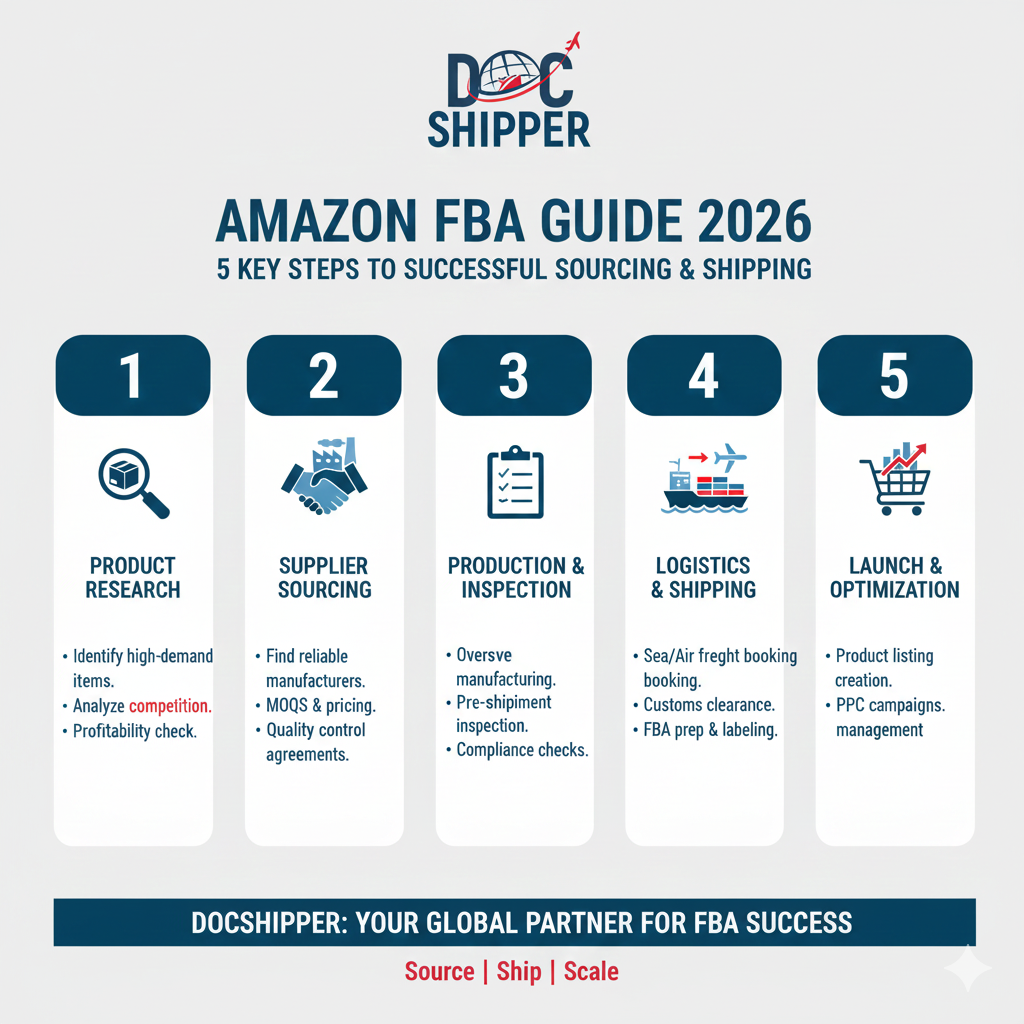
To make this concrete, here’s the workflow we usually recommend when you ship to Amazon FBA from China.
Step 1. Validate your supplier with samples and factory checks.
Step 2. Lock specs, packaging, and FBA labeling rules in writing.
Step 3. Run a pre-shipment inspection before final payment.
Step 4. Choose the right Incoterm and book freight to the correct FBA warehouse.

DocShipper Info
DocShipper manages sourcing support, inspections, freight, and FBA bookings as one flow.
We turn scattered steps into a single, visible supply chain from factory to warehouse.
Understand Amazon FBA costs, fees, and your profit margins
Direct tip, before you scale anything on amazon fba, you must obsess over costs because margins disappear quietly. We once saw a seller celebrating strong sales, then realize storage fees wiped out profits after Q4 congestion. You’ll notice fast that Amazon fees are predictable, logistics costs are not.
This is where landed cost clarity makes the difference, a concept heavily emphasized by OECD trade cost studies. If you ignore freight volatility, customs duties, or FBA long-term storage, your calculator lies to you.
Here’s a quick checklist we always use to pressure-test FBA profitability before shipping.
- Product cost, including tooling and packaging
- Inbound shipping, ocean or air plus local charges
- Customs duties and VAT, based on HS code accuracy
- Amazon fees, referral, fulfillment, storage
- Buffer margin, for delays and peak season surcharges
From experience at DocShipper, sellers who track these line by line can adjust Incoterms, consolidate shipments, or switch transport modes early rather than after profits vanish.
DocShipper Alert
If freight, duties, or storage spike, your “winning” product turns into a loss.
DocShipper models total landed cost and optimizes routes so your margin survives reality.
Conclusion
So, is amazon fba worth it for you, knowing what really happens between the factory floor and the Amazon warehouse? If you remember one thing, FBA rewards operators who treat logistics and compliance as strategy, not admin.
Here are the key takeaways to keep in front of you as you move forward.
- Your supply chain is your moat, weak sourcing and inspections always show up at FBA.
- Landed cost beats product cost, shipping and duties decide your real margin.
- Compliance is not optional, Amazon and customs will stop you without hesitation.
- End-to-end coordination matters, fragmented partners create expensive gaps.
- Support changes outcomes, the right logistics partner saves months, not days.
FAQ | Amazon FBA explained: how to launch, ship, and scale profitably
“Becoming an FBA seller” is mostly about activating the right settings and learning the inbound workflow:
- In Seller Central
- During account setup, select that you plan to use Fulfillment by Amazon.
- In Settings → Fulfillment by Amazon, enable FBA and review prep/label preferences.
- Decide if Amazon will label for you (paid per unit) or if you/your supplier will apply FNSKU labels.
- For each product
- Create or join a listing, then in the “Fulfillment Channel” choose: “I want Amazon to ship and provide customer service.”
- Convert any existing FBM SKU to FBA by changing the fulfillment method.
- First shipment
- Create a shipping plan: case‑packed vs individual, carton sizes/weights, ship‑from address.
- Download and apply FNSKU labels to each sellable unit and carton labels to each box.
- Book transport to the assigned FBA warehouse(s) and respect Amazon’s delivery requirements.
Once you’ve successfully checked in your first shipment and it’s “Available,” you are, in practice, an FBA seller.
The “true” startup cost is your first full inventory cycle, not just the Amazon fees. For a first product, budget across:
- Fixed/one‑off setup
- Amazon Professional plan (if chosen): monthly subscription.
- Brand assets: logo, basic packaging design, product photos.
- Samples and lab tests (if needed for your category).
- Variable per-product
- Product manufacturing: MOQ × unit cost (don’t forget packaging).
- International freight: air/sea/express + local port/airport charges.
- Customs duties, VAT, brokerage: based on HS code and destination.
- FBA fees: referral %, fulfillment per unit, storage.
- Safety buffer
- 10–20% extra for delays, higher freight quotes, or a second small restock before profits come back.
For many beginners, a realistic minimum to launch a simple, small, non‑regulated product is often four figures (USD/EUR), not a few hundred, once you include inventory + freight + fees.
It’s worth it when your product, pricing, and logistics are aligned; it’s brutal when they’re not. FBA tends to work best when:
- Your product profile fits FBA economics:
- Small/light, high value relative to weight/volume.
- Low return rate expected (not fragile, not “taste‑based” like fashion).
- You can defend your pricing:
- Some differentiation (bundle, design, brand) so you’re not in a pure price war.
- Enough margin to absorb fee increases and ad spend.
- You manage inventory and logistics like a system:
- Forecasting and restocking based on data, not guesswork.
- Clear landed cost per unit and tight control of freight/customs.
On the other hand, it’s often not worth it for:
- Bulky/low‑margin items that get hit by high fulfillment and storage fees.
- Sellers unwilling to invest in proper sourcing, compliance, and cashflow for inventory.
The model still works, but it rewards operators, not improvisation.
After check‑in, a few key mechanisms determine your daily reality:
- Storage & distribution
- Amazon may split or redistribute your inventory across multiple fulfillment centers.
- You pay storage based on cubic feet/meters and time stored.
- Order handling
- When a customer orders, Amazon automatically picks, packs, and ships from the closest facility with stock.
- Tracking and delivery notifications are managed by Amazon.
- Returns & customer service
- Amazon handles customer inquiries and most returns directly.
- Returned items are inspected: resellable go back to stock; damaged/unsellable can be removed or destroyed (fees apply).
- Performance metrics
- Your delivery performance, cancellation rate, and customer feedback impact your Buy Box and account health, even though Amazon fulfills.
You’re still responsible for keeping FBA stocked and profitable; Amazon is “just” your logistics machine.
Most painful issues show up again and again. You can sidestep them by watching for:
- Wrong product choice
- Entering hyper‑competitive categories with no differentiation.
- Choosing fragile or regulated items for a first launch.
- Miscalculating economics
- Ignoring freight, customs, and storage when calculating margin.
- Pricing based only on competitors’ prices, not your actual landed cost.
- Weak quality control
- Skipping pre‑shipment inspections and only discovering defects at FBA or via reviews.
- Letting suppliers change materials/packaging without written approval.
- Inbound compliance errors
- Incorrect or missing FNSKU/carton labels, mixed SKUs in cartons, wrong carton weights.
- Sending goods without coordinating FBA delivery requirements or time slots.
- Inventory mismanagement
- Over‑ordering and paying heavy storage fees.
- Under‑ordering and going out of stock, killing your ranking.
Mitigation is simple but disciplined: small first order, strict inspections, precise cost tracking, and a logistics partner who knows FBA rules if you’re not ready to manage them alone.
You can start lean, but you must adjust your strategy to reduce risk:
- Product strategy
- Choose ultra‑simple, light products with predictable demand and easy prep.
- Avoid custom molds or complex packaging that lock in high upfront costs.
- Order strategy
- Negotiate the smallest practical MOQ, even at a slightly higher unit cost.
- Test demand with a micro‑batch rather than betting everything on one big shipment.
- Cost control
- Use the FBA calculator conservatively: underestimate price, overestimate costs.
- Start in one marketplace instead of multiple regions to cut complexity.
- Logistics
- For very small initial quantities, consider express or air to simplify, then optimize later.
- Use partners or prep centers only when they clearly save you from costly mistakes.
Starting small doesn’t mean starting sloppy; it means you trade some margin for proof of concept and learning, then tighten everything once the product is validated.
Need Help with
Logistics or Sourcing ?
First, we secure the right products from the right suppliers at the right price by managing the sourcing process from start to finish. Then, we simplify your shipping experience - from pickup to final delivery - ensuring any product, anywhere, is delivered at highly competitive prices.
Fill the Form
Prefer email? Send us your inquiry, and we’ll get back to you as soon as possible.
Contact us